ARMs And FPGAs Make For Interesting Dev Boards

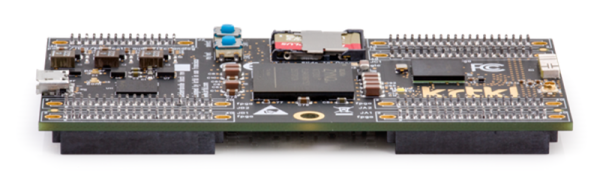
Tiny Linux computers are everywhere, and between BeagleBones, Raspberry and Banana Pis, and a hundred other boards out there, there are enough choices to go around. There is an extremely interesting ARM chip from Xilinx that hasn’t seen much uptake in the field of tiny credit-card sized computers: the Zynq. It’s an ARM Cortex-A9 coupled with an FPGA. It’s great for building peripherals that wouldn’t normally be included on a microcontroller. With Zynq, you just instantiate the custom bits in the FPGA, then interface them with a custom Linux driver. Thanks to CrowdSupply, there’s now a board out there that brings this intriguing chip to a proper development platform. It’s called the Snickerdoodle, and if you’ve ever wanted to see the capabilities of an FPGA tightly coupled to a fast processor, this is the board to watch.

The core of the Snickerdoodle is a Xilinx Zynq that features either a 667 MHz ARM Cortex A9 and a 430k gate FPGA (in the low-end configuration) or an 866 A9 and 1.3M gate FPGA. This gives the Snickerdoodle up to 179 I/O ports – far more than any other tiny Linux board out there.

Fully loaded, the Snickerdoodle comes with 2.4 and 5GHz WiFi, Bluetooth, 1GB of RAM, and an ARM Cortex A9 that should far surpass the BeagleBone and Raspberry Pi 2 in capabilities. This comes at a price, though: the top-shelf Snickerdoodle has a base price of about $150.

Still, the power of a fast ARM and a big FPGA is a big draw and we’re expecting a few more of these Zynq boards in the future. There are even a few projects using the Zynq on hackaday.io, including one that puts the Zynq in a Raspberry Pi-compatible footprint. That’s exceedingly cool, and we can’t wait to see what people will build with a small, fast ARM board coupled to an FPGA.
Robot Clock Writes Time Over And Over And Over

We’ve seen quite a few clocks that write the time out with a pen or marker. If you think about it, this really isn’t a great solution; every whiteboard marker will dry out in a day or two, and even if you’re using a pen, that’s still eventually going to run out of ink.

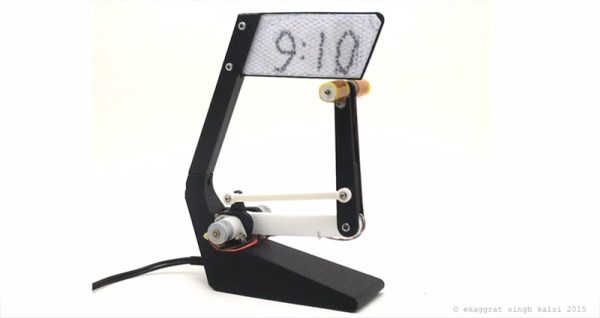
[ekaggrat] wanted a drawing clock that didn’t have these problems, and after taking a look at a magnetic drawing board, was struck with inspiration. The result is a clock that will perpetually write the time. It’s a revision of one of his earlier builds and looks to be much more reliable and mechanically precise.

A clock that writes time needs some sort of surface that won’t degrade, but can be written to over and over again. Whiteboards and glass won’t work, and neither will anything with ink. The solution to this problem was found in a ‘magnetic writing board’ or a Magna Doodle. These magnetic writing boards have a series of cells encapsulating iron filings. Pass a magnet over one side of the board, and a dot of filings appear. Pass a magnet over the opposite side of the board, and the filings disappear.

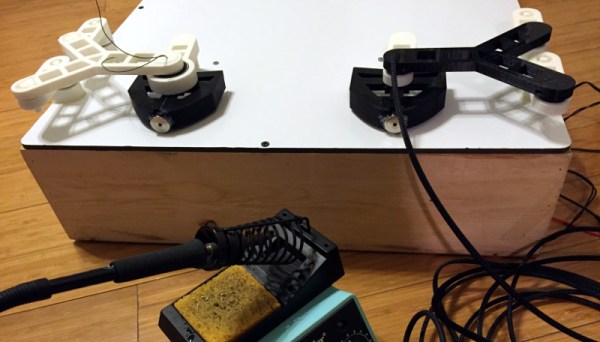
[ekaggrat]’s time-writing robot consists of a small Magna Doodle display, a robotic arm controlled by two stepper motors, and two solenoids on the end of the arm. The kinematics come from a helpful chap on the RepRap forums, and with the ATmega644 and two stepper drivers, this clock can write the time by altering the current flowing through two solenoids.

A video is the best way to experience this project, and you can check that out below.

Continue reading “Robot Clock Writes Time Over And Over And Over”

Juggling Robot Deftly Handles Balls

A well-designed robot can do any action a human can do. Whether this is an acrobatic performance, or just writing with a pen, there’s a robot out there for any single action a human can perform. This includes juggling, but never before has the human action of juggling been replicated at this scale. [Nathan] built a robot that can juggle seven balls simultaneously. That’s more balls in the air than any other juggling robot.

jugglebotWhile the original plan was to build a low-cost version that could juggle balls by throwing them up in the air, this proved to be very difficult. Instead of giving up, [Nathan] simplified the problem by rolling the balls up a ramp. The entire build is documented in an imgur gallery, and there’s some interesting tech going on here. The 3D printed arms are controlled by beefy stepper motors running at 60V. To stop the balls from bouncing around in the arms, [Nathan] included and electromagnet to hold the balls in place for a fraction of a second during each cycle.

Juggling seven balls is amazing, but how about eight? This is the question every builder of a juggling robot will get, and it’s not quite as simple as adding another ball. The motion of juggling an even number of balls is completely different from juggling an odd number. That being said, [Nathan]’s robot does have four balls under its belt. It should probably get that looked at.

This isn’t [Nathan]’s first amazing 3D printed robot, and it probably won’t be the last, either: he recently built a Skittles sorting machine for the next time Van Halen comes to town. There’s an amazing amount of skill in all his projects, and he’s certainly an asset to the entire hackaday.io community.

Continue reading “Juggling Robot Deftly Handles Balls”

Doubling Down On A Big LED Display

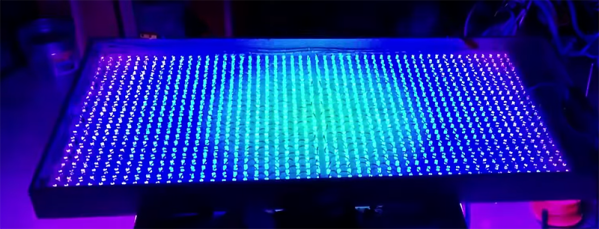
Last year at the 2014 NC Maker Faire, Manical Labs brought a large LED display. Blinking LEDs and pixel animations are always welcome, but at 24 inches square this build was impressive, but it wasn’t impressive enough. This year, [Adam] at Manacal Labs wanted to go bigger. Much bigger. This build is called Colossus, and at two square meters and with 1250 individual LEDs, this LED display is a colossal build.

When building a big LED display, an enormous amount of planning pays off in dividends. The backbone of this project is a sheet of 3/8″ plywood, ripped down to 1 meter by 2 meters. 1250 half-inch holes are drilled in this sheet over four or five very long and very tedious evenings. The LEDs are installed in the thousand or so holes, and a grid of foam core board encases each individual LED.

One of the biggest problems with large arrays of LEDs is the sheer scale of it all. If one LED pixel draws 60mA, 1250 pixels means a draw of 75 Amps. This current will melt most wires, so the power is delivered over custom made copper bus bars. Driving this display with a reasonable refresh rate is another important consideration; WS2812 lights, with an 800kHz signal over one wire, is far too slow for a huge display. Instead of the 2812s, [Adam] went with LPD8806 LEDs that can be clocked at 30MHz. This is controlled with two AllPixels, effectively making this two displays acting as one. It all comes together in a very big LED display. You can check out a video of it below.

Continue reading “Doubling Down On A Big LED Display”

Tech Journos Link Samsung To Volkswagen, Somehow

On Thursday The Guardian published information linking Samsung to the current Volkswagen emissions fiasco. Samsung is accused of installing a ‘defeat device’ on some televisions that uses less energy during official testing conditions than would be found during real-world use.

“The apparent discrepancy between real-world and test performance of the TVs is reminiscent of the VW scandal that originated in the US last week,” wrote [Arthur Nelson] of The Guardian. This report was based on an unpublished lab test by the research group ComplianTV which found discrepancies between real-world and test performance when measuring power consumption. According to ComplianTV, this is due to the ‘motion lighting’ setting included in some Samsung TVs. Samsung vehemently denies this ‘motion lighting’ saying that it is not a method of cheating the consumption tests.

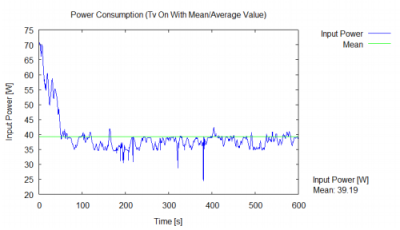
Typical results recognized during testing. Source

Not one to let a good controversy go to waste, the BBC reports a Samsung TV will reduce its power draw shortly after the start of the test. A graph of the power draw of a TV – not explicitly a Samsung television – demonstrating this functionality was found in a PDF of a ComplianTV workshop from last year labeled as, “Typical results recognized during testing” with a decrease in power consumption being a recognized behavior when the appropriate test video was found.

This is not the first time ComplianTV tested a Samsung TV equipped with a ‘motion lighting’ setting. Earlier this year, ComplianTV measured the power consumption of the Samsung UE55H8090 television, and found this TV was compliant with energy regulations. Incredibly, all Samsung TVs listed on the ComplianTV database were found to be compliant with the relevant energy directives.

Samsung’s rebuttal to the Guardian article states the ‘motion lighting’ technology is an ‘out of the box’ feature, active in both the lab and at home. Unlike Volkswagen’s ‘defeat device’ for their diesel engines which is only active during emissions testing, the ‘motion lighting’ technology is active whenever it is enabled in the TV’s settings menu.

Anyone in the US who has shopped for a television in the last four years will have noticed cost-per-year estimates for operating the appliance. This is only an issue if the televisions don’t actually meet that advertised benchmark. Until we see a published study we’re raising our eyebrows at The Guardian, easily one of the most trusted journalistic institutions on the planet, and reserving judgement for Samsung.

A White Hat Virus For The Internet Of Things

The Internet of Things is going gangbusters, despite no one knowing exactly what it will be used for. There’s more marketing money being thrown at IoT paraphernalia than a new soda from Pepsi. It’s a new technology, and with that comes a few problems: these devices are incredibly insecure, and you only need to look at a few CCTV camera streams available online for proof of that.

The obvious solution to vulnerable Internet of Things things would be to get people to change the login credentials on their devices, but that has proven to be too difficult for most of the population. A better solution, if questionable in its intentions, would be a virus that would close all those open ports on routers, killing Telnet, and reminding users to change their passwords. Symantec has found such a virus. It’s called Wifatch, and it bends the concept of malware into a force for good.

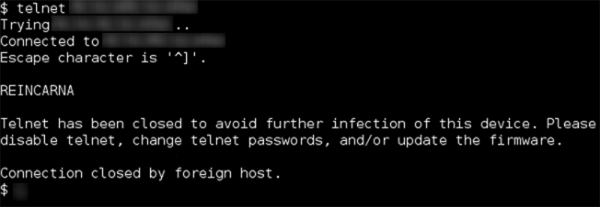
Wifatch is a bit of code that slips through the back door of routers and other IoT devices, closes off Telnet to prevent further infection, and leaves a message telling the owner to change the password and update the device firmware. Wifatch isn’t keeping any secrets, either: most of the code is written in unobfuscated Perl, and there are debug messages that enable easy analysis of the code. This is code that’s meant to be taken apart, and code that includes a comment directed at NSA and FBI agents:

To any NSA and FBI agents reading this: please consider whether defending
the US Constitution against all enemies, foreign or domestic, requires you
to follow Snowden's example.

Although the designer of Wifatch left all the code out in the open, and is arguably doing good, there is a possible dark side to this white hat virus. Wifatch connects to a peer-to-peer network that is used to distribute threat updates. With backdoors in the code, the author of Wifatch could conceivably turn the entire network of Wifatch-infected devices into a personal botnet.

While Wifatch is easily removed from a router with a simple restart, and re-infection can be prevented by changing the default passwords, this is an interesting case of virtual vigilantism. It may not be the best way to tell people they need to change the password on their router, but it’s hard to argue with results.

[Image source: header, thumb]