THP Hacker Bio: IamTeknik

[IamTeknik]’s reason for entering his home automation assistant into The Hackaday Prize is simple; we have smart phones, TVs, and even smart cars. Why not a smart house?

Like its namesake from Iron Man, Project Jarvis is an intelligent assistant with a bit of home automation thrown into the mix. The hardware includes the usual relays and door locks, but that’s just the start of it. There’s also a personal digital assistant, living somewhere in the space between the hardware modules and [IamTeknik]’s smartphone. Here, voice recognition, speech synthesis, and a Siri-like functionality is the name of the game. Jarvis is capable of answering questions, compiling reports, reading social network messages, and automating everything connected to the main base station over the Internet.

[IamTeknic] has been busy studying computer systems engineering and of course working on his project for The Hackaday Prize lately, but he was able to sit down and answer a few questions for our THP hacker bio. You can check that out below, along with a few demos of what his personal Jarvis can do.

Continue reading “THP Hacker Bio: IamTeknik”

A Proof Of Concept Project For The ESP8266

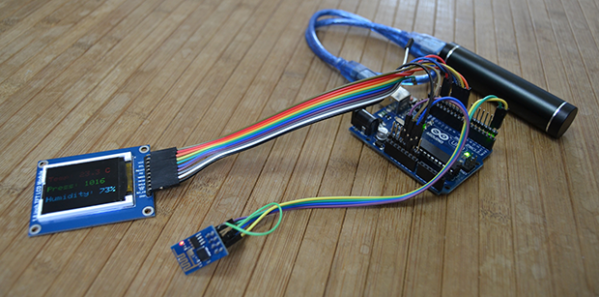
It’s hardly been a month since we first heard of the impossibly cheap WiFi adapter for micros, the ESP8266. Since then orders have slowly been flowing out of ports in China and onto the workbenches of tinkerers around the world. Finally, we have a working project using this module. It might only be a display to show the current weather conditions, but it’s a start, and only a hint of what this module can do.

Since the ESP8266 found its way into the storefronts of the usual distributors, a lot of effort has gone into translating the datasheets both on hackaday.io and the nurdspace wiki. The module does respond to simple AT commands, and with the right bit of code it’s possible to pull a few bits of data off of the Internet.

The code requests data from openweathermap.org and displays the current temperature, pressure, and humidity on a small TFT display. The entire thing is powered by just an Arduino, so for anyone wanting a cheap way to put an Arduino project on the Internet, there ‘ya go.

The Abovemarine

Over the course of a few weeks, [Adam] trained his betta fish, [Jose], to jump out of the water to snatch food off his finger. An impressive display for a fish, but being able to train his small aquatic friend got [Adam] thinking. What’s stopping [Jose] from interacting his environment even more? The abovemarine was born.

The abovemarine is a robotic platform specifically built for [Jose]’s aquarium. Below, three omni wheels drive the entire aquarium in any direction. A computer running OpenCV, a webcam, and a few motors directs the abovemarine in whatever direction [Jose] wants to go. Yes, it’s a vehicle for a fish, and that’s awesome.

[Adam] put a lot of work into the creation of the abovemarine, and was eventually able to teach [Jose] how to control his new home. In the videos below, you can see [Jose] roaming the studio and rolling towards the prospect of food.

Because [Jose] is a Siamese fighting fish and extremely territorial when he sees other males of his species, this brings up the idea of a version of Battlebots with several abovemarines. They’re in different tanks, so we don’t know what PETA would think of that, but we do expect it to show up in the Hackaday tip line eventually.

Continue reading “The Abovemarine”

We’re At Maker Faire This Weekend

It’s that time of year again where the east coast division of the Hackaday crew makes the trek out to Maker Faire New York. We’ll be there the entire weekend, checking out the sights, talking to the people who make the things you make things with, and standing in an hour-long line for a hamburger.

We’ve been going to the NYC Maker Faire for a few years now, and each time we’re surprised by the sheer variety of stuff at the faire. This year, SeeMeCNC is bringing a gargantuan delta printer, [Adam] and I are going to geek out when we meet the Flite Test crew, and we’ll be filing a few interviews with the folks from Intel, Atmel, BeagleBone, and TI. If you’re wondering what the, “I can’t believe Make is allowing this at the faire” project is for this year, here you go.

If you’re heading to the faire and find some of the Hackaday crew wandering around, don’t be afraid to introduce yourself. I’ll be wearing a flagpole with the Jolly Wrencher, and [Adam] will probably be wearing something emblazoned with the Hackaday logo. We have stickers to give out, and if you’re really cool, some sweet swag.

This year is a little different from the other times we’ve made the trek to Maker Faire – this time we have a press pass, and that means access to some very important people. If you have a question you’d like to ask Atmel’s VP of MCUs, Intel’s “maker czar”, [Massimo], someone at TI, or anyone else on the schedule, leave a note in the comments.

THP Quarterfinalist: 3GHz Spectrum Analyzer

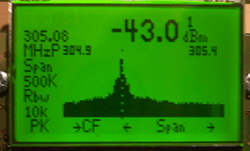
Radio seems to be an unofficial theme for The Hackaday Prize, with a few wireless frameworks for microcontrollers and software defined radios making their way into the quarterfinal selection. [roelh]’s project is a little different from most of the other radio builds. It’s a simple spectrum analyzer, but one that works up to 3GHz.

The hardware is a mishmash of chips including an ADL5519 power detector, an Si4012 for the local oscillator, and a MAX2680 mixer. An Atmel XMega takes care of all the on board processing, displaying the spectrum on a small LCD, writing data to an SD card, and sending data over a 3.5mm jack that doubles as either an analog input or a half duplex RS232 port.

Seen in the video below, [roelh]’s spectrum analyzer is more or less finished, complete with a nice looking enclosure. Now [roelh] is working on documentation, porting his source to English, and getting all the files ready to be judged by our real judges.


SpaceWrencherThe project featured in this post is a quarterfinalist in The Hackaday Prize.

Continue reading “THP Quarterfinalist: 3GHz Spectrum Analyzer”

Repent! The Church Of Robotron Accepts All!

Are you the mutant savior? Are you prepared for the robot uprising of 2084? Have you accepted robotron into your life? The Church of Robotron is now conducting training, testing, and confession at the new window altar in downtown Portland.

The Church of Robotron is the fake totally legit religion based on the classic arcade game prophecy Robotron 2084. In keeping with the church’s views on community outreach and missionary work, a Robotron altar has been installed at the Diode Gallery for electronic arts.

The altar consists of a system running Robotron 2084 with capacitive sensing controls built by DorkbotPDX’s own [Phillip Odom]. He’s using the same techniques featured in his capacitive sensing workshop, allowing the game to be played 24 hours a day. There are also monitors displaying the leaderboard and tenants of the Church of Robotron.

The Church of Robotron has also been showing up at Toorcamp for a few years now, with an even more spectacular altar that triggers physical events in response to game events. That’s a very cool use of MAME’s debugger, and a story worthy of its own Hackaday post.

Video of the altar below.

Continue reading “Repent! The Church Of Robotron Accepts All!”

The Hackaday Prize Semifinalist Update

There are only a few more days until The Hackaday Prize semifinalists need to get everything ready for the great culling of really awesome projects by our fabulous team of judges. Here are a few projects that were updated recently, but for all the updates you can check out all the entries hustling to get everything done in time.


Replacing really, really small parts
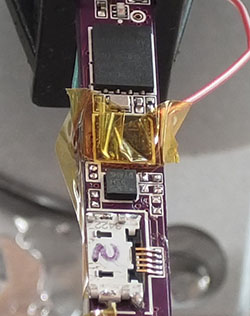
accThe NoteOn smartpen is a computer that fits inside a pen. Obviously, there are size limitations [Nick Ames] is dealing with, and when a component goes bad, that means board rework in some very cramped spaces. The latest problem was a defective accelerometer.

In a normal project, a little hot air and a pair of tweezers would be enough to remove the defective part and replace it. This is not the case with this smart pen. It’s a crowded layout, and 0402 resistors can easily disappear in a large solder glob.

[Nick] wrapped the closest parts to the defective accelerometer in Kapton tape. That seemed to be enough to shield it from his Aoyue 850 hot air gun. The new part was pre-tinned and placed back on the board with low air flow.

How to build a spectrometer

spec

The RamanPi Spectrometer is seeing a lot of development. The 3D printed optics mount (think about that for a second) took somewhere between 12 and 18 hours to print. Once that was done and the parts were cleaned up, the mirrors, diffraction grating, and linear CCD were mounted in the enclosure. Judging from the output of the linear CCD, [fl@C@] is getting some good data with just this simple setup.

Curing resin and building PCBs

uv[Mario], the guy behind OpenExposer, the combination SLA printer, PCB exposer, and laser harp is chugging right along. He finished his first test print with a tilted bed and he has a few ideas on how to expose PCBs on his machine.

You don’t need props to test a quadcopter

bladesGoliath, the gas-powered quadcopter, had a few problems earlier this month. During its first hover test a blade caught a belt and bad things happened. [Peter] is testing out a belt guard and tensioner only this time he’s using plywood cutouts instead of custom fiberglass blades. Those blades are a work of art all by themselves and take a long time to make; far too much effort went into them to break in a simple motor test.