Ask Hackaday: Can The Lix 3D Printing Pen Actually Work?

Introducing Lix, the world’s smallest 3D printing pen that allows you to draw plastic structures in 3D. It’s only been on Kickstarter for a few days now, and already it has garnered close to a million dollars in pledges. An astonishing achievement, especially considering we can prove – with math and physics – that it doesn’t work as advertised. However, we’re wondering if it could work at all, so we’re asking the Hackaday community.

The device is powered through a USB 3 port. In the video, the Lix team is using a MacBook Pro. This has a USB port capable of delivering 900 mA at 5 Volts, or 4.5 Watts. Another 3D printing pen, the 3Doodler, uses a 2A, 12V power adapter, equal to 24 Watts. Considering the 3Doodler works, and they both do the same basic thing, there’s something extremely odd going on here.

Just as a comparison, here’s a wirewound resistor commonly found in the heating element or ‘hot end’ of a 3D printer. It’s a 6.8  Ohm resistor powered at 12 Volts. That’s 21 Watts. Here’s a heater cartridge, also found in quite a few hot ends. It sucks down 40 Watts. Once again, the Lix Kickstarter clearly shows the pen extruding filament using only 4.5 Watts of power. Something is really, really fishy here.

Intuition doesn’t hold a candle to math, so let’s figure out exactly why it won’t work.

Continue reading “Ask Hackaday: Can The Lix 3D Printing Pen Actually Work?”
Game Boy Vs. Electronic Shelf Labels

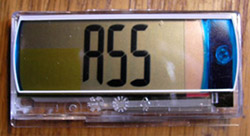
SANYO DIGITAL CAMERAWhile they’re probably rare as hen’s teeth in the US, there have been a few major stores around the world that have started rolling out electronic shelf labels for every item in the store. These labels ensure every item on a shelf has the same price as what’s in the store’s computer, and they’re all controlled by an infrared transceiver hanging on the store’s ceiling. After studying one of these base stations, [furrtek] realized they’re wide open if you have the right equipment. The right equipment, it turns out, is a Game Boy Color.
The shelf labels in question are controlled by a base station with a decidedly non-standard carrier frequency and a proprietary protocol. IR driver chips found in phones are too slow to communicate with these labels, and old PDAs like Palm Pilots, Zauruses, and Pocket PCs only have an IrDA chip. There is one device that has an active development scene and an IR LED connected directly to a CPU pin, though, so [furrtek] started tinkering around with the hardware.

The Game Boy needed to be overclocked to get the right carrier frequency of 1.25 MHz. With a proof of concept already developed on a FPGA board, [furrtek] started coding for the Game Boy, developing an interface that allows him to change the ‘pages’ of these electronic labels, or display customized data on a particular label.

There’s also a much, much more facepalming implication of this build: these electronic labels’ firmware is able to be updated through IR. All [furrtek] needs is the development tools for the uC inside one of these labels.

There’s a great video [furrtek] put together going over this one. Check that out below.

Continue reading “Game Boy Vs. Electronic Shelf Labels”

Magsafe On An Android, Cats And Dogs Living Together

Mag

We’re thinking most Hackaday readers have at one time or another been tasked with replacing the power connector in a laptop. Anyone who has done so can easily see the genius behind the Apple Magsafe connector. Since the second gen iPhone, there have been rumors Apple will release a cellphone with the Magsafe connector, a great idea, seeing as how cell phones are thrown around even more than laptops. [Tony] got tired of waiting, and had an Android device anyway, so he decided to retrofit a Magsafe power adapter to his Note II.

In the interest of excess, [Tony] is using the absurdly large ZeroLemon 9300mAh battery and case for his device, giving him a lot of room for this hardware mod. A tiny 3D printed adapter fits around a slightly modified Magsafe connector, and with a little bit of super glue and solder, the connector is wired up to the charging port.

Of course the charger isn’t a stock Apple power supply; it’s just another Magsafe plug wired into a 5V wall wart. We’re not going to take a guess at what would happen if [Tony] plugged a stock Apple charger into his modded phone, but the mod works perfectly without the danger of ripping a USB port out of his phone.

Using The Raspberry Pi To See Like A Bee

Bee

The Raspberry Pi board camera has a twin brother known as the NoIR camera, a camera without an infrared blocking filter that allows anyone to take some shots of scenes illuminated with ‘invisible’ IR light, investigate the health of plants, and some other cool stuff. The sensor in this camera isn’t just sensitive to IR light – it goes the other way as well, allowing some investigations into the UV spectrum, and showing us what bees and other insects see.

The only problem with examining the UV spectrum with a small camera is that relatively, the camera is much more sensitive to visible and IR than it is to UV. To peer into this strange world, [Oliver] needed a UV pass filter, a filter that only allows UV light through.

By placing the filter between the still life and the camera, [Oliver] was able to shine a deep UV light source and capture the image of a flower in UV. The image above and to the right isn’t what the camera picked up, though – bees cannot see red, so the green channel was shifted to the red, the blue channel to the green, and the UV image was placed where the blue channel once was.

Continue reading “Using The Raspberry Pi To See Like A Bee”

Eye Tracking With The Oculus Rift

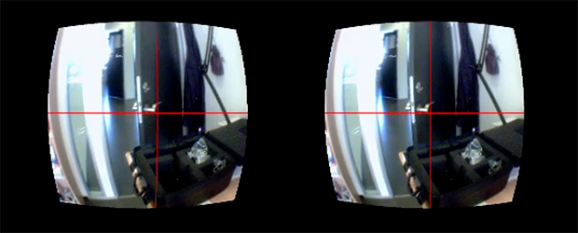
ocu

There’s a lot you can do with eye and gaze tracking, when it comes to interface design, so when [Diako] got his hands on an Oculus Rift, there was really only one thing to do.

Like a few other solutions for eye tracking we’ve seen, [Diako] is using a small camera with the IR filter removed to read the shape and location of an eye’s pupil to determine where the user is looking. This did require cutting a small hole near one of the Oculus’ eye cups, but the internal camera works great.

To get a window to the world, if it were, [Diako] slapped another camera onto the front of the Oculus. These two cameras are fed into the same computer, the gaze tracking is overlaid with the image from the front of the headset, and right away the user has a visual indication of where they’re looking.

Yes, using a computer to know where you’re looking may seem like a rather useless build, but stuff like this is used in research and extraordinarily high tech heads up displays. Although he’s not using the motion tracking on the Oculus, if [Diako] were to do so, he’d have the makings of one of the most powerful heads up displays possible.

Continue reading “Eye Tracking With The Oculus Rift”

Airchat, The Wireless Mesh Network From Lulzlabs

With the lessons learned from the Egyptian, Libyan, and Syrian revolutions, a few hardware and software hackers over at Lulzlabs have taken it upon themselves to create a free-as-in-beer and free-as-in-speech digital communications protocol that doesn’t deal with expensive, highly-surveilled commercial and government controlled infrastructure. They call it Airchat, and it’s an impressive piece of work if you don’t care about silly things like ‘laws’.

Before going any further, we have to say yes, this does use amateur radio bands, and yes, they’re using (optional) encryption, and no, the team behind Airchat isn’t complying with all FCC and other amateur radio rules and regulations. Officially, we have to say the FCC (and similar agencies in other countries) have been granted the power – by the people – to regulate the radio spectrum, and you really shouldn’t disobey them. Notice the phrasing in that last sentence, and draw your own philosophical conclusions.

Airchat uses an off the shelf amateur transmitter, a Yaesu 897D in the example video below although a $30 Chinese handheld radio will do, to create a mesh network between other Airchat users running the same software. The protocol is based on the Lulzpacket, a few bits of information that give the message error correction and a random code to identify the packet. Each node in this mesh network is defined by it’s ability to decrypt messages. There’s no hardware ID, and no plain text transmitter identification. It’s the mesh network you want if you’re under the thumb of an oppressive government.

Airchat has already been used to play chess with people 180 miles away, controlled a 3D printer over 80 miles, and has been used to share pictures and voice chats. It’s still a proof of concept, and the example use cases – NGOs working in Africa, disaster response, and expedition base camps – are noble enough to not dismiss this entirely.

Continue reading “Airchat, The Wireless Mesh Network From Lulzlabs”

C64 MIDI And Flash Cart

KerberosThe SID chip inside the Commodore 64 and 128 is arguably still the gold standard for chip tunes, and the C64 itself still a decent computer for MIDI sequencing. [Frank Buss] realized most of the MIDI cartridges for the Commodore computers are either out of production or severely limited, so he set out to create his own.

Unlike the few Commodore MIDI cartridges that are available, [Frank]’s Kerberos has MIDI In, Out, and Thru, controlled by the 6850 ACIA chip, just like the old 80s interfaces. This allows the Kerberos to interface with the old Sequential Circuits, Passport, and Datel software. He’s offering the Kerberos cart up on a crowdfunding site, so if you’d like to grab your own, have at it.

Because the Kerberos is also a Flash cart, it also ships with some of this software; [Frank] got permission from Steinberg to install their Pro 16 software with the Kerberos.  SID Wizard is also pre-loaded on the cart, along with a few other fabulous trackers and sequencers. Of course, there’s no requirement for the Flash portion of the cart to only host MIDI and synth software. You can always upload a few games to the cart over a MIDI interface. Video of the Kerberos below.

Continue reading “C64 MIDI And Flash Cart”