Adding Features To The DoorBot

network sniffing doorbell

There’s an interesting network-enabled doorbell on the market from Edison Junior called the DoorBot that boasts some useful features, notably that it can make calls to a phone when someone pushes the button for the doorbell. However, [MadBeggar] saw the potential in this device and couldn’t wait to get some more functionality out of it, so he has reverse engineered the communications protocol for the doorbell.

His goals for the project were to implement third-party notifications such as text messaging, VoIP/SIP integration, and maybe even a desktop client. So far he has only been able to analyze the communications protocol but he hopes that others will be able to build upon his work or even add features he hasn’t thought of yet. The makers of the device promise to eventually deliver on some of these features but so far haven’t delivered.

There are some other projects out there that integrate wireless connectivity with a doorbell. However, [MadBeggar] notes that the DoorBot really stands out among all of the internet-enabled doorbell, mostly because nothing else around is as clean or is as easy to install as the DoorBot. He just wishes that the software wasn’t so clunky and that it had its full potential unlocked with these extra features. We’d say he’s on the right track!
Arduino Gives Your Toilet Options

toilet water saver

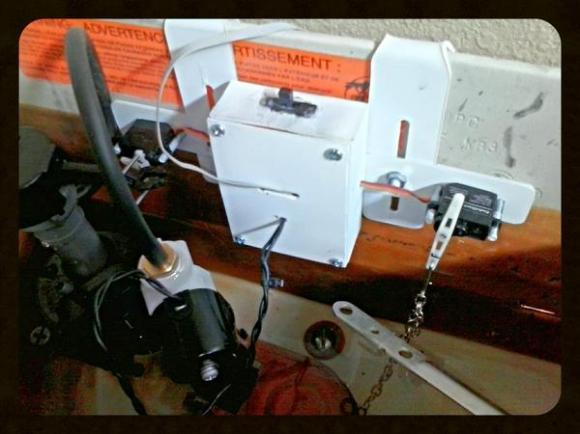
With the severe drought going on in California with no end in sight, [TVMiller] decided he could put an Arduino and a toilet together to try and save at least a few gallons of water per day. The invention fills a toilet to the minimum level, saving around two gallons per day for the average “user”.

A typical toilet functions by using gravity and moving water to create a vacuum, sucking the waste down and out of the toilet. As long as there is nothing, uh, solid in the bowl, the toilet will be able to function on the reduced amount of water. The Arduino cuts the flow of water off before the toilet fills up the entire way.

In the event that anyone -ahem- needs the toilet’s full capacity, there is a button connected to the Arduino that fills the reservoir to capacity. [TVMiller] notes that if 1,825 hackers installed this device on their toilets, we could save a million gallons of water per year and be well on our way to saving the planet.

The project site is full of more information and puns for your viewing pleasure. We might suggest that the “2” button would be very easy to integrate with the toilet terror level indicator as well.


Nerds Helping Sea Turtles

Sea Turtle Nest Monitoring Device

Life as a sea turtle can be rough. Not only are turtles trying to survive predators, destruction of habitat, fishing nets, and pollution, but only about 1% of hatchlings survive to face those challenges in the first place. Enter [Samuel Wantman] and a new volunteer hacker group called Nerds Without Borders, with their first order of business of creating an egg-shaped monitoring device for sea turtle nests.

Sea turtles are protected under the Endangered Species Act, which goes to great lengths to protect certain species from human activity. The ultimate goal of the project is to help people and sea turtles better coexist under this law by more accurately predicting hatching times. A suite of sensors and a cell network antenna are placed in a plastic “egg” that can be buried in a nest after a sea turtle lays the real eggs. The sensors detect vibrations within the eggs as the embryos grow, which is an indication that the tiny turtles are about to break free of their eggs and head for the open ocean!

Click past the break for more on this project.

Continue reading “Nerds Helping Sea Turtles”

Dots And Dashes… On A Roll!

morse code device

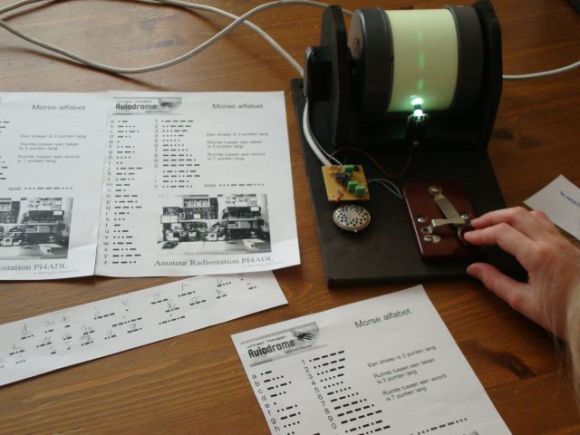
Morse code was once a staple of the communications industry, but with advancing technology it has become relegated almost exclusively to movies and a niche group of ham radio operators. [Jan] has created a device which might not put a stop to this trend, but will at least educate children on the basics of how Morse code works by visually displaying Morse code as it’s generated.

The setup is fairly simple. An old momentary switch (which could easily be used in an actual Morse code setup) activates two pieces of circuitry. The first is a 555 timer circuit that creates an audible tone when the switch is pressed so the user can hear exactly what an operator would hear when decoding a real Morse code message.

The second piece of circuitry is where the real genius lies: a continuously spinning roll of glow-in-the-dark tape is placed in front of a white LED. When the switch is pressed, the LED turns on, which produces dots and dashes on the roll of tape as it passes by. This eliminates the need for rolls of paper or a more complicated moving pen/pencil setup to draw on the paper which might also be less child-proof.

While [Jan] built this as a toy, the children who used it thoroughly enjoyed it! They even decoded some Morse code messages and used the device to practice on it. After a while they’ll easily be able to master the Morse code trainer!

Raspberry Pi Spies On Your Front Door

doorbell pictures

One of [Sander]’s first projects with a Raspberry Pi was to get it to send messages to his iPhone. From there he decided to take it a step further and wire the tiny computer up to his doorbell, creating a system that can send push messages to his phone whenever someone is at the front door.

[Sander]’s doorbell is wireless, and he decided to keep all of its original functionality. All it took to signal the Pi was a simple circuit tied to the doorbell’s status LED which turns off whenever the doorbell is pushed.

The Raspberry Pi runs a python program that handles the GPIO pin which is wired to the doorbell. When the doorbell is pushed, the program processes and sends the push notification while taking pictures of the visitor with an attached webcam. The pictures are included in the message so [Sander] can see who is at the front door. The code for the project is included on his project page.

This project rang a bell for us since we’ve seen projects using a Raspberry Pi and push notifications. None of them so far have included a webcam or utilized an existing wireless doorbell though, and this is a great step forward!

Supersonic NERF Dart Speedometer

ATtiny Chronograph

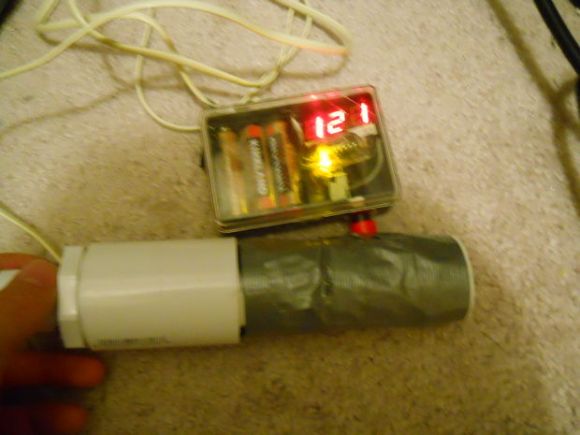
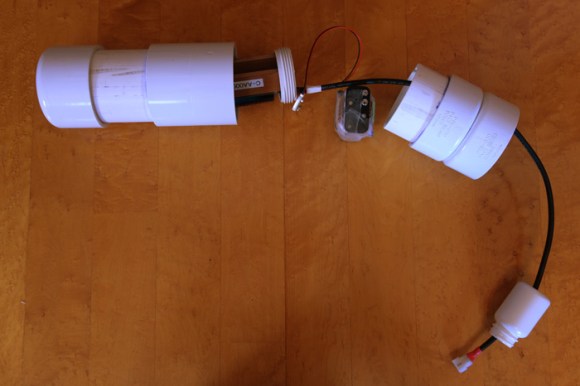
[John] was faced with an interesting problem: after he built his own air cannon, how could he tell exactly how fast his NERF darts were moving? Luckily he had some spare parts on hand and hacked together a fully functional projectile speedometer for less than the cost of an Arduino.

A device is essentially two detectors spaced a precise distance apart from one another. When something passes the first detector, a timer is activated which measures how long it takes the object to reach the second detector. From this, the device calculates the speed. [John] used infrared emitter/detector pairs spaced exactly three inches apart and wired them to an ATtiny2313. After a little bit of coding, he now knows just how fast he can fire those squishy ballistic missiles.

The infrared emitter/detector pairs are mounted to a PVC pipe through which the projectile travels. [John] notes that in theory this could be used to measure almost anything that could fit through the pipe, although this particular device might be damaged by muzzle flash or a pressure wave from an actual gun.

We’ve seen other NERF dart air cannons before, and we wonder if maybe there should be some sort of competition to see who can shoot a NERF dart the fastest now that there’s an easy way to measure speed?


Repurposed Laptop Batteries With A Twist

Arduino with lithium ion battery

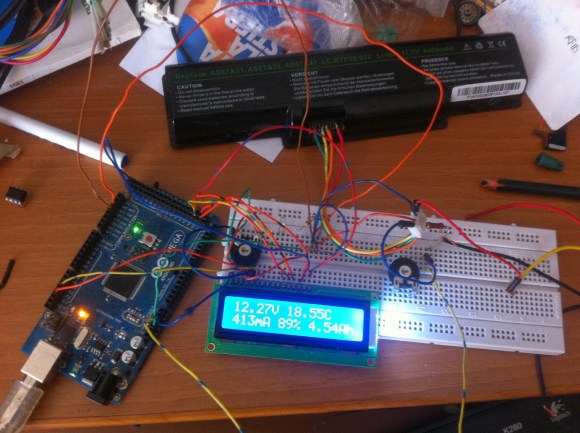
Lithium ion batteries are becoming more and more common these days, but some of the larger capacity batteries can still carry a pretty hefty price tag. After finding Acer’s motherboard schematics online and doing a little reverse-engineering, [Tiziano] has found a way to reuse batteries from his dead laptop, not only saving the batteries from the landfill but also cutting costs on future projects.

These types of batteries have been used for many things in the past, but what makes this project different is that [Tiziano] is able to monitor the status of the batteries and charge them using I2C with an Arduino and a separate power supply, freeing the batteries from the bonds of the now-useless laptop.

With this level of communication between the microcontroller and the battery pack, there is little chance of the batteries catching on fire when they’re used in another project. Since the Arduino can also monitor the current amount of charge in the batteries, there is also a reduced risk that they will be damaged from under- or over-charging.

This wasn’t just as simple as hooking up the positive and negative leads of a power supply to the battery. [Tiziano] also had to model the internal resistance of the motherboard that the battery expects to see, and get the supply voltage just right so the battery’s safety protocols wouldn’t kick in to prevent them from charging. After a few other hurdles were jumped, [Tiziano] now has a large capacity lithium ion battery at his disposal for any future projects.