[Emily]’s Eerie Educational Electric Eyeball Entertains

Like many of us, [Emily’s Electric Oddities] has had a lot of time for projects over the past year or so, including one that had been kicking around since late 2018. It all started at the Hackaday Superconference, when [Emily] encountered the Adafruit Hallowing board in the swag bag. Since that time, [Emily] has wanted to display the example code eyeball movement on a CRT, but didn’t really know how to go about it. Spoiler alert: it works now.

See? It’s educational.

Eventually, [Emily] learned about the TV out library for Arduino and got everything working properly — the eyeball would move around with the joystick, blink when the button is pressed, and the pupil would respond visually to changes in ambient light. The only problem was that the animation moved at a lousy four frames per second. Well, until she got Hackaday’s own [Roger Cheng] involved.

[Roger] was able to streamline the code to align with [Emily]’s dreams, and then it was on to our favorite part of this build — the cabinet design. Since the TV out library is limited to black and white output without shades of gray, Emily took design cues from the late 70s/early 80s, particularly the yellow and wood of the classic PONG cabinet. We love it!

Is Your Pet Eye the worst video game ever, as [Emily] proclaims it to be? Not a chance, and we’re pretty sure that the title still rests with Desert Bus, anyway. Even though the game only lasts until the eye gets tired and goes to sleep, it’s way more fun than Your Pet Rock. Don’t miss the infomercial/explanation/demonstration video after the break. If one video is just not enough, learn more about [Emily’s] philosophy of building weird projects from the Supercon talk she presented. It’s also worth mentioning that this one fits right into the Reinvented Retro contest.

Why are eyeballs so compelling? We can’t say for sure, but boy, this eyeball web cam sure is disconcerting.

Continue reading “[Emily]’s Eerie Educational Electric Eyeball Entertains”

Small Swedish Stores Are Miniature Oases In A National Food Desert

It all started one night in 2016 after [Robert Ilijason] dropped the last remaining jar of baby food in the house, breaking it. On the 20-minute drive to the nearest supermarket, he had an idea: what if there were small, 24-hour convenience-level grocery stores that could fill the glaring need for access to basics across the country?

Sweden has lost a few thousand smaller grocery stores in the last 25 years or so, mostly in rural areas. For many people living outside the cities, the nearest place to buy milk is several miles away, at a huge supermarket that’s either in a city, or close to it. After [Robert] built Sweden’s first 24-hour unmanned convenience store, the idea received quite a bit of media attention.

Five years and a pandemic later, the concept is still going strong. A chain of 30 of these bite-sized bodegas have popped up all over Sweden, run by a company called Lifvs. They have no staff at all, not even a cashier. Instead, shoppers unlock the door with their phones. They scan all their barcodes into an app, which provides a bill every month and is linked to both their bank account and national identity system. Beyond that, security is in the form of a single camera.

Because these tiny stores are staff-less, the prices can be kept relatively low. The only problem is that the technology is a bit of an issue for some older residents. Back in 2016, [Robert Ilijason] was trying to figure out another way for customers to unlock the door, but it doesn’t look like Lifvs has solved that problem yet.

One thing you can’t complain about with a store like this is the selection. We have to wonder if shoppers are more or less likely to encounter fasciated fruit amongst the produce.

Flat-Pack Pasta: Like Ikea Furniture Without The Weird Wrench

When it comes to food packaging, there’s no bigger scam than potato chip bags, right? People complain about the air (nitrogen, actually) inside, but it’s there for a reason — nitrogen pushes out oxygen, so the chips live in a state of factory-fresh dormancy until you rip open the bag and release the gas. If you want flat-pack chips, there’s always those uniformly-shaped potato slurry wafers that come in a can. But even those usually manage to have a few broken ones.

On the other hand, no one complains about the extra space in their box of fusilli — that would be silly. But seriously, successfully shipping fragile foods requires either flat packing or a lot of extra space, especially if that food comes in a myriad of fun 3D shapes like pasta does. Everybody knows that 3D pasta is superior to flat pasta because it holds sauces so much better. The pasta must be kept intact!

The great thing about pasta as a food is that it’s simple to make, and it’s more nutritious than potato chips. Because of these factors, pasta is often served in extreme situations to large groups of people, like soldiers and the involuntarily displaced. But storing large quantities of shapely pasta takes up quite a bit of space. And because of all that necessary air, much of the packaging goes to waste.

So what if you could keep your plethora of pasta in, say, a filing cabinet? A research team led by the Morphing Matter Lab at Carnegie Mellon University have created a way to make flat-pack pasta that springs to life after a few minutes in boiling water.

Continue reading “Flat-Pack Pasta: Like Ikea Furniture Without The Weird Wrench”

Voidstar’s Vitals, Visualized For Video

Great news for fans of [Voidstar Labs] — [Zack] is going to be streaming future builds live on YouTube instead of trying to keep up with a grueling and limiting schedule of releasing a build video every week. The only problem is that the wall behind him is totally blank and boring, which matters quite a bit for pretty much any streamer that doesn’t broadcast from a hot tub. Well, not anymore! Now the wall has twenty square feet of rainbow hexagons, because blinkenlights.

But these aren’t just any blinkenlights. They’re informative. They dance to the beat of [Zack]’s bio-metrics, or in other words, they are visualizing how sweaty and anxious [Zack] may be at a given moment, and turning that information into art.

At the heart of this build is a brand-new bio-metric board called the EmotiBit which boasts sixteen sensors in a small package, including a pulse oximeter. The EmotiBit sends vitals to [Zack]’s PC, which is running an oscilloscope app to interpret the signals. Then they are sent over Open Sound Control to an ESP32, which runs the light show.

Like [Zack] says in the video after the break, this isn’t a terribly difficult project, but the construction takes time. [Zack] used aluminum extrusion meant for under-cabinet lighting and ran forty strips of fourteen DotStar LEDs each. The nodes are printed in carbon-fiber PLA and hold the lights away from the wall so it looks cooler. Worried about the current draw? It’s okay, because the brightness and number of lit LEDs at any one time is limited. Add in the fact that none of the LEDs are ever turned off — they fade by one percent each loop — and you have some really cool animations. Check them out after the break.

Want some localized blinkenlights to wear about town? Wear your heart on your sleeve and show them how hard you’re crushing the elliptical at the gym.

Continue reading “Voidstar’s Vitals, Visualized For Video”

Custom Music Box Cylinder Puts A Spin On Romance

Music boxes are awesome little mechanical devices. These days, they even make some with slightly more modern tunes, like the Zelda and Star Wars themes.  But they don’t have everything, of course — certainly not that one song from that TV series that [RandomPrototypes]’ girlfriend absolutely adores.

But it’s 2021, and there are options for making your own music box. [RandomPrototypes] could have printed the whole thing, but those don’t sound as good with their plastic combs. Then there’s those paper punch ones, but you have to sit there and crank the thing continuously to hear the song. In the end, [RandomPrototypes] mixed methods and made a custom cylinder that’s playable with a standard music box mechanism.

[RandomPrototypes] started by taking the music box apart to measure the cylinder, and then created a software representation of a cylinder that’s designed to pluck the eighteen notes from low to high rather than play a song. Then he used a Python script to turn it in a 3D model. The slicing preview showed a lot of stops and starts and weak points, so [RandomPrototypes] generated the Gcode directly so that it would print in one continuous spiral and be much stronger.

In order to generate a cylinder with the song his girlfriend likes so much, [RandomPrototypes] printed this scale cylinder and used it to record the notes as a single mp3 and make note of the start times of each note. Finally, he built the new score based on the available notes built into the music box comb. If you want to do this yourself, the code is freely available. The hard part will be choosing a music box mechanism, because they tend to come with a single comb that’s designed to play a specific song. You’ll have to figure out which tune has most or all of the notes you need.

If you don’t mind doing the cranking to listen to the tune, then the paper-punched type of music box is going to be much easier. But why do all that punching yourself, when you could build a machine?

Continue reading “Custom Music Box Cylinder Puts A Spin On Romance”

Smart Guitar Will Practically Play Itself

Playing the guitar is pretty difficult to do, physically speaking. It requires a lot of force with the fretting hand to produce clear notes, and that means pressing a thin piece of metal against a block of wood until the nerve endings in your fingertips die off and you grow calluses that yearn to be toughened even further. Even if you do get to this point of being broken in, it takes dexterity in both hands to actually make music. Honestly, the guitar is kind of an unwelcoming instrument, even if you don’t have any physical disabilities.

A Russian startup company called Noli Music wants to change all of that. They’re building a guitar that’s playable for everyone, regardless of physical or musical ability. Noli Music was founded by [Denis Goncharov] who has a form of muscular dystrophy. [Denis] has always wanted to rock out to his favorite songs, but struggles to play a standard guitar.

If you can touch the fretboard, it seems, you can whale away on this axe without trouble. It’s made to be easier to play all around. The strings aren’t fully tensioned, so they’re easy to pluck — the site says they only take 1.7oz of force to actuate.

Right now, the guitar is in the prototype stage. But when it’s ready to rock, it will do so a couple of ways. One uses embedded sensors in the fretboard detect finger positions and sound the appropriate note whether you pluck it or simply fret it. In another mode, the finger positions light up to help you learn new songs. The guitar will have a touchscreen interface, and Noli are planning on building a companion app to provide interactive lessons.

We have to wonder just how exactly this will be able to mimic the physics of guitar playing, especially since it’s designed with all players in mind. How satisfied will seasoned players be with this instrument? Can it do pull-offs and hammer-ons? What about slides? Do the sensors respond to bends? And most importantly, will the built-in speaker be loud enough to drown out the string vibrations? It seems to do just fine on that front, as you can see in the video below.

If the built-in speaker didn’t drown out the strings, it could make for some interesting sounds that stray outside the western chromatic scale, much like this LEGO microtonal guitar.

Continue reading “Smart Guitar Will Practically Play Itself”

Custom Macro Keyboard Looks Good In Wood

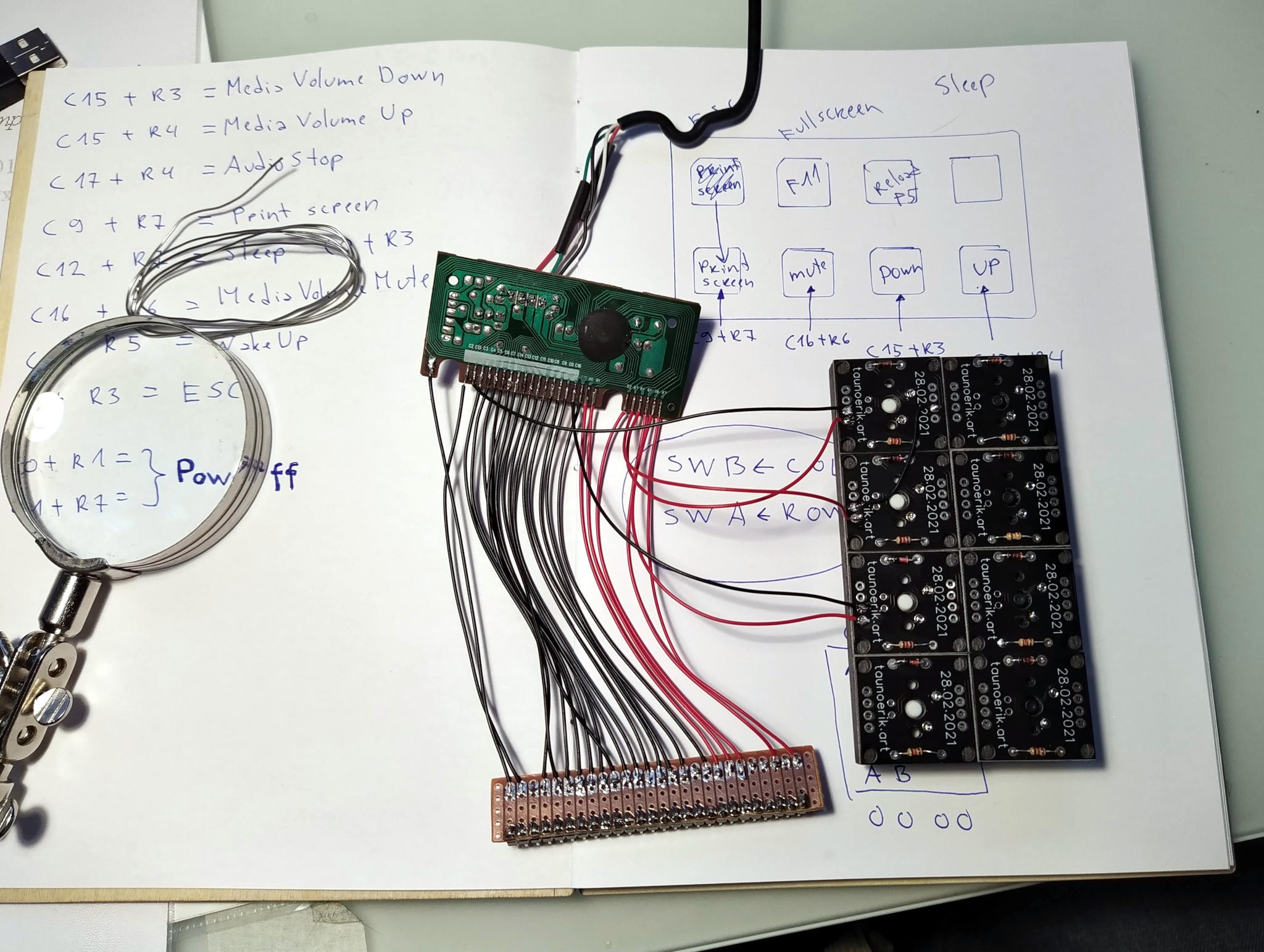
There’s more than one way to make a mechanical macro pad, and this wooden wonder represents one of our favorites. [Tauno Erik] had an old rubber dome rectangle keyboard lying around that still worked, but the poor thing was missing some of its caps. After salvaging the controller, [Tauno Erik] got to work on the tedious task of figuring out the mapping of the matrix, which was made easier with a Python script.

Almost every component of this beauty is wood, including the mounting plate and those thicc and lovely keycaps — their top layer is solid oak, and the bottom bit is birch plywood. In order to interface the ‘caps with the switches, [Tauno Erik] designed and printed connector pieces that sit inside the extra large keycaps and accept the stems of the key switches.

Speaking of switches, we’re not sure if [Tauno Erik] ended up using Cherry green switches, browns, or a mix of both (that would be interesting), but each one is mounted on a custom PCB along with a diode and a pull-up resistor. You can see more build pictures at [Tauno Erik]’s site, and stick around for a visual tour of the completed build after the break.

Wood is a great choice for keycaps, and we imagine they’ll only look better with age and use. A more common use for wood on a keyboard build is in surprisingly comfortable wrist rests.