Spherical Keyboard Build Leaves Hacker Well-Rounded

Often times we as hackers don’t know what we’re doing, and we sally forth and do it anyway. Here at Hackaday, we think that’s one of the best ways to go about a new project, and the absolute fastest way to learn a whole lot as you go. Just ask [Aaron Rasmussen] regarding this spherical, standing 5×6 dactyl manuform keyboard build, which you can see in a three-part short video series embedded after the break.

[Aaron] gets right down to it in the first video. He had to get creative right away, slicing up the dactyl manuform model to fit on a tiny print bed. However, there’s plenty of room inside the sphere for all that wiring and a pair of Elite-C microcontrollers running QMK. Be sure to turn on the sound to hear the accompanying voice-overs.

The second video answers our burning question: how exactly does one angle grind a slippery sphere without sacrificing sheen or shine? We love the solution, which involves swaddling the thing in duct tape and foam.

You may be wondering how [Aaron] is gonna use any kind of mouse while standing there at the pedestal keyboard. While there is space for a mouse to balance on top, this question is answered in the third video, where [Aaron] learns the truth behind the iconic ThinkPad nubbin and applies this knowledge to build a force-feedback joystick/trackpoint mouse. Awesome answer, [Aaron]!

Not ready to go full-tilt, sci-fi prop ergo? Dip your toe in the DIY waters with a handy macropad.

Continue reading “Spherical Keyboard Build Leaves Hacker Well-Rounded”

PSA: Amazon Sidewalk Rolls Out June 8th

Whether you own any Amazon surveillance devices or not, we know how much you value your privacy. So consider this your friendly reminder that Amazon Sidewalk is going live in a few weeks, on June 8th. A rather long list of devices have this setting enabled by default, so if you haven’t done so already, here’s how to turn it off.

Don’t know what we’re talking about? Our own Jenny List covered the topic quite concretely a few months back. The idea behind it seems innocent enough on the surface — extend notoriously spotty Wi-Fi connectivity to devices on the outer bounds of the router’s reach, using Bluetooth and LoRa to talk between devices and share bandwidth. Essentially, when Amazon flips the switch in a few weeks, their entire fleet of opt-in-by-default devices will assume a kind of Borg hive-mind in that they’ll be able to share connectivity.

A comprehensive list of Sidewalk devices includes: Ring Floodlight Cam (2019), Ring Spotlight Cam Wired (2019), Ring Spotlight Cam Mount (2019), Echo (3rd Gen), Echo (4th Gen), Echo Dot (3rd Gen), Echo Dot (4th Gen), Echo Dot (3rd Gen) for Kids, Echo Dot (4th Gen) for Kids, Echo Dot with Clock (3rd Gen), Echo Dot with Clock (4th Gen), Echo Plus (1st Gen), Echo Plus (2nd Gen), Echo Show (1st Gen), Echo Show (2nd Gen), Echo Show 5, Echo Show 8, Echo Show 10, Echo Spot, Echo Studio, Echo Input, Echo Flex. — Amazon Sidewalk FAQ

Now this isn’t a private mesh network in your castle, it’s every device in the kingdom. So don’t hesitate, don’t wait, or it will be too late. Grab all your Things and opt-out if you don’t want your doorbell cam or Alexa machine on the party line. If you have the Alexa app, you can allegedly opt out on all your devices at once.

Worried that Alexa is listening to you more often than she lets on? You’re probably right.

Tiny DeLorean Made From Lighters Is A Total Gas

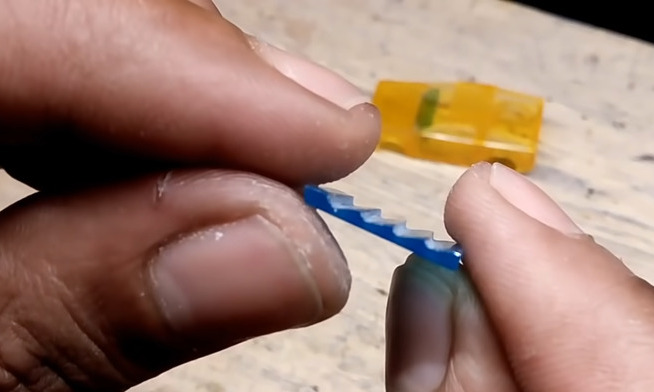
There’s making stuff out of trash, and then there’s mind-blowing stuff like this: a DeLorean built from four disposable cigarette lighters and various other bits and bobs like wire sheathing and cotton bud sticks. If it weren’t for the video evidence embedded below, we would have never believed that [Ank Creative] or anyone else could have turned boxy acrylic into the fastback time machine we all know and love.

Is the back window the most important detail? Maybe.

[Ank Creative] seems to have wasted no parts of the lighters, and even saved themselves a bit of trouble by using curved scraps to make the wheel wells. After installing the windshield, we certainly didn’t expect them to saw the thing in half, but how else are they going to put in the little seats and the steering column when the gull-wing doors aren’t real?

This build is all about unbelievable craftsmanship and deft but daring use of hand tools. Although this totally qualifies as an open source how-to video, you’d have to be quite the sorcerer to pull this one off. Zoom past the break (if you haven’t already) and check out this amazing build.

Disposable lighters are dirt cheap, but they get the job done and you can always see how much gas is left in the tank. On the other hand, a refillable lighter is just that, and if you build it yourself, you can make it actuate like a cap gun.

Continue reading “Tiny DeLorean Made From Lighters Is A Total Gas”

Automated Watering Machine Has What Plants Crave: Fertilizer

We’ve seen countless automated plant care systems over the years, but for some reason they almost never involve the secret sauce of gardening — fertilizer. But [xythobuz] knows what’s up. When they moved into their new flat by themselves, it was time to spread out and start growing some plants on the balcony. Before long, the garden was big enough to warrant an automated system for watering and fertilizing.

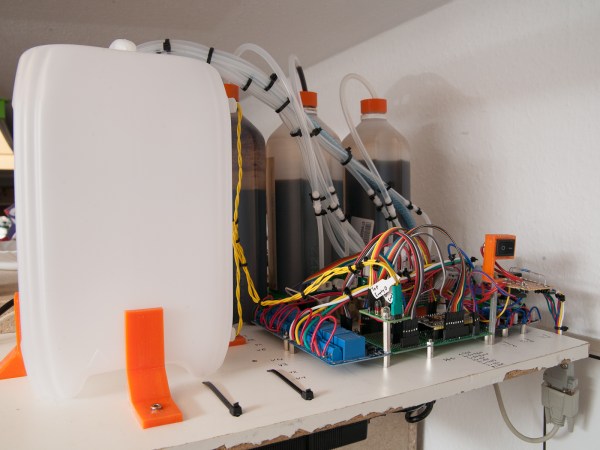
This clever DIY system is based around a 5L gravity-fed water tank with solenoid control and three [jugs] of liquid fertilizer that is added to the water via peristaltic pump. Don’t worry, the water tank has float switches, and [xythobuz] is there to switch it off manually every time so it doesn’t flood the flat.

On the UI side, an Arduino Nano clone is running the show, providing the LCD output and handling the keypad input. The machine itself is controlled with an ESP32 and a pair of four-channel relay boards that control the inlet valve, the four outlet valves, and the three peristaltic pumps that squirt out the fertilizer. The ESP also serves up a web interface that mimics the control panel and adds in the debug logs. These two boards communicate using I²C over DB-9, because that’s probably what [xythobuz] had lying around. Check out the demo video after the break, and then go check on your own plants. They miss you!

Don’t want to buy just any old peristaltic pumps? Maybe you could print your own.

Continue reading “Automated Watering Machine Has What Plants Crave: Fertilizer”

Go Ape With A Banana Macropad

The super fun thing about macro pads is that they’re inherently ultra-personalized, so why not have fun with them? This appealing little keeb may have been a joke originally, but [dapperrogue] makes a valid point among a bunch of banana-related puns on the project page — the shape makes it quite the ergonomic little input device.

Inside this open-source banana is that perennial favorite for macro pads, the Arduino Pro Micro, and eight switches that are wired up directly to input pins. We’re not sure what flavor of Cherry those switches are, hopefully brown or green, but we suddenly wish Cherry made yellow switches. If you want to build your own, the STLs and code are available, and we know for a fact that other switch purveyors do in fact make yellow-stemmed switches.

Contrary to what the BOM says, we believe the sticker is mandatory because it just makes the build — we imagine there would be fewer double takes without it. Hopefully this fosters future fun keyboard builds from the community, and we can’t wait to sink our teeth into the split version!

There are a bunch of ways to make a macropad, including printing everything but the microcontroller.

Via r/mk and KBD

Realistic Mission Control Box Is A Blast For All Ages

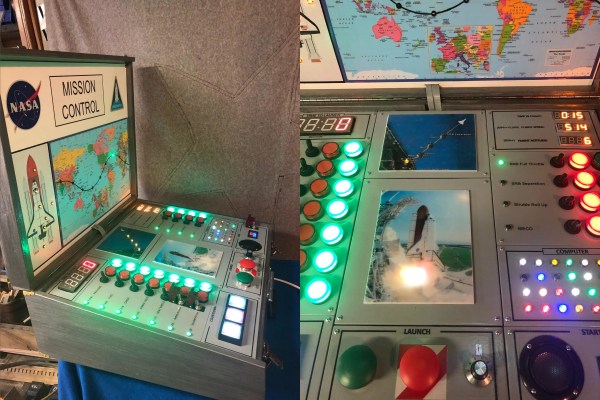
A lot of electronic busy boxes that are built for children are simply that — a mess of meaningless knobs and switches that don’t do much beyond actuating back and forth (which, let’s be honest, is still pretty fun to do). But this Mission Control Center by [gcall1979] knocks them all out of orbit. The simulation runs through a complete mission, including a 10-minute countdown with pre-flight system checks, 8.5 minutes of powered flight to get out of the atmosphere that includes another four tasks, and 90 minutes to orbit the Earth while passing through nine tracking stations across the world map.

That’s a lot time to keep anyone’s attention, but fortunately [gcall1979] included a simulation speed knob that can make everything go up to 15 times faster than real-time. This knob can be twiddled at any time, in case you want to savor the countdown but get into space faster, or you don’t have 90 minutes to watch the world map light up.

The main brain of this well-built box is an Arduino Mega, which controls everything but the launch systems’ mainframe computer — this is represented by bank of active LEDs that blink along with the voice in the sound clips and runs on an Arduino Uno and a couple of shift registers. To keep things relatively simple, [gcall1979] used an Adafruit sound board for the clips.

We love everything about this build, especially the attention to detail — the more important pre-flight tasks are given covered toggle switches, and there’s a Shuttle diagram that lights up as each of these are completed. And what Shuttle launch simulator would be complete without mushroom buttons for launch and abort? Grab your victory cigar and check out the demo video after the break.

Is your child too young to be launching the Shuttle? Here’s an equally cool busy box with toddler brains in mind.

Continue reading “Realistic Mission Control Box Is A Blast For All Ages”

Piggy Bank Slot Machine Puts A Spin On Saving

Saving money is inherently no fun until the time comes that you get to spend it on something awesome. Wouldn’t you be more likely to drop your coins into a piggy bank if there was a chance for an immediate payout that might exceed the amount you put in? We know we would. And the best part is, if you put such a piggy bank slot machine out in the open where your friends and neighbors can play with it, you’ll probably make even more money. As they say, the house always wins.

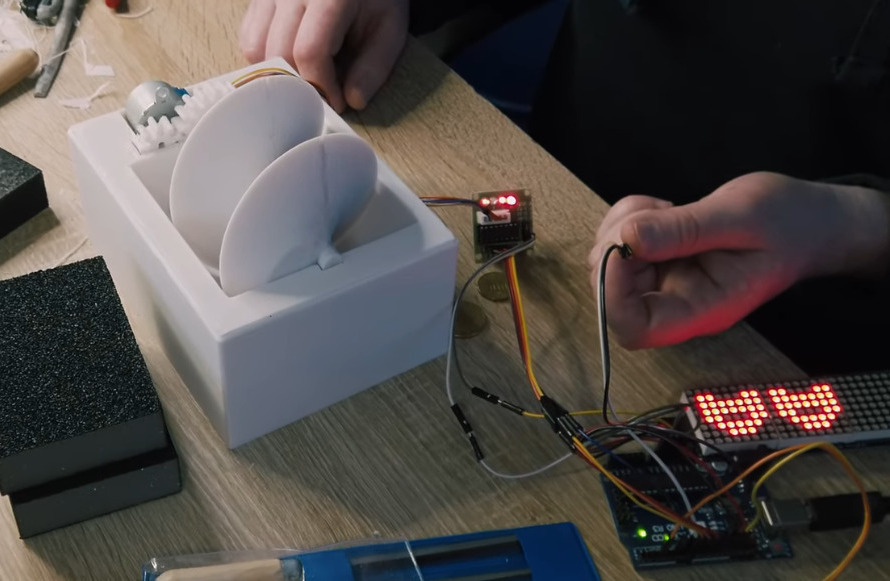
Drop a coin in the slot and it passes through a pair of wires that act as a simple switch to start the reels spinning. Inside is an Arduino Uno and a giant printed screw feeder that’s driven by a small stepper motor and a pair of printed gears. The reels have been modernized and the display is made of four individual LED matrices that appear as a single unit thanks to some smoky adhesive film.

This beautiful little machine took a solid week of 3D printing, which includes 32 hours wasted on a huge piece that failed twice. [Max 3D Design] tried rotating the model 180° in the slicer and thankfully, that solved the problem. Then it was on to countless hours of sanding, smoothing with body filler, priming, and painting to make it look fantastic.

If you want to make your own, all the files are up on Thingiverse. The code isn’t shown, but we know for a fact that Arduino slot machine code is out there already. Check out the build and demo video after the break.

As much as we like this build’s simplicity, it would be more slot machine-like if there was a handle to pull. Turns out you can print those, too.

Continue reading “Piggy Bank Slot Machine Puts A Spin On Saving”