Over-Engineered Cat Door Makes Purrfect Sense

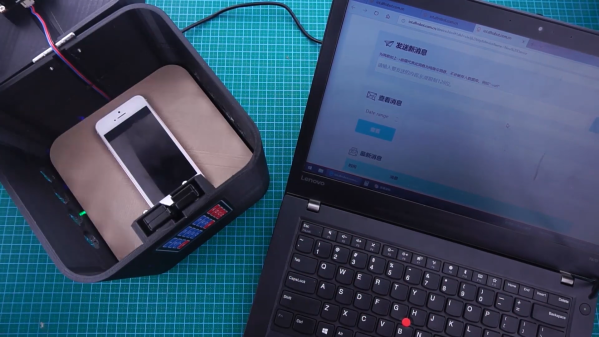
On paper, pet doors are pretty great. You don’t have to keep letting the cat in and out, and there should be fewer scratches on the door overall. Unfortunately, your average pet door is indiscriminate, and will let any old creature waltz right in. Well, [Jeremiah] was tired of uninvited critters, so he built a motorized door with a built-in bouncer. Now, only animals with pre-approved BLE tags can get in.

The bouncer is a Raspi 3 running Node-RED, which scans continuously for BLE advertisements from the cats’ collars. [Jeremiah] settled on Tile tags because they’re reliable and cat-proof. The first version used an Arduino and RFID tags for the cats, but they had to get too close to the door to trigger it.

We love [Jeremiah]’s choice of door actuator, a 12V retractable car antenna. [Jeremiah] uses the antenna itself to lift and lower the removable lockout panel that comes with the door. He removed the circuit that retracts the antenna when power is lost, so that power outages don’t become free-for-alls for shelter-seeking animals.

There’s also a nice feature for slow creatures—the door won’t close until 15 seconds after the last BLE ad, so they cats won’t ever have to Indiana Jones it through the opening. Magnetic switches currently limit the door travel at the top and bottom, though [Jeremiah] will eventually replace them with standard switches. Paw at the break until you get a walk-through video.

Cats will be cats, and the ones that go outside will probably rack up a body count. Here’s a cat door that looks for victims clenched between cat jaws and starts a 15-minute lockout period.

Continue reading “Over-Engineered Cat Door Makes Purrfect Sense”

Black Hole Imaging Scientists Win 2020 Breakthrough Prize

Making a monumental scientific breakthrough is really kind of its own reward. Even so, it’s always nice to get extra recognition in the form of unexpected money. For the 347 scientists around the world who made history when they captured the first image of a black hole, the event itself is pretty sweet. The cake of notoriety recently gained some icing, because the group has been awarded a $3 million Breakthrough Prize.

The prize, known as “the Oscars of science”, was created eight years ago with the goal of furthering scientific advancements in the areas of physical science, mathematics, and life science. Created by tech investor Yuri Milner, the Breakthrough Prize is funded by other deep-pocketed notables like Sergey Brin and the Zuckerbergs. This year’s theme is “seeing the invisible”. Prizes will also be awarded for discoveries toward non-opioid pain relievers and the study of neuro-degenerative disorders.

Each of the black hole imaging scientists will receive $8,645.53 when the prize is awarded in a televised ceremony on November 3rd, which is going down at NASA’s Ames Research Center in Mountain View, CA. In lieu of parading all 347 scientists across the stage, [Shep Doeleman] of the Harvard-Smithsonian Center for Astrophysics and Director of the Event Horizon Telescope project, will accept the award on their behalf.

What exactly are black holes, and how did they come about? Explore their origins with [Will Sweatman] in this feature from 2018.

Black hole wire frame CC0 Public Domain via Phys.org

Black hole image via NASA

Smart Buoy Rides The Citizen Science Wave

Those beautiful and dangerous ocean waves that beckon us to the coast are more than just a pretty sight. They can tell us a lot about weather patterns and what the sea itself is doing. As vital as this information is, the existing methods of doing wave research are pretty expensive. The team at [t3chflicks] wanted to show it can be done fairly cheaply, to encourage more citizen scientists to contribute. More data means a better understanding, and open research benefits even those who don’t actively participate.

They have developed a smart buoy that collects wave data and transmits it back to a base station for real-time display. The buoy runs on an 18650 that gets recharged by four 5V solar panels situated around the top half of the 3D-printed hull. An Arduino inside the buoy controls the sensors, most of which are baked into the GY-86 10-DOF module. The antenna on top sends the data back to a Raspi Zero base station, which charts wave height, wave period, wave power, water and air temperature, and barometric pressure in real-time on a spiffy Vue JS dashboard.

The team had their ups and downs during this project. They wanted to measure wave direction, but it proved a bit too complicated. And memory issues prevented them from backing up the data to an on-buoy SD card. You can catch the more in-depth hardware and software videos on their YouTube channel. We’ve got the smart buoy summary video tied up and floating just after the break.

Want to help buoy wave research, but don’t have a 3D printer? Sealed PVC makes a fine flotation device, as we saw in this water quality-sensing buoy.

Continue reading “Smart Buoy Rides The Citizen Science Wave”

Using Machinery To Make Factory-Fresh Industrial Music

Many machines make music as a side effect, as anyone who owns a 3D printer can confirm. [工場音楽レーベルINDUSTRIAL JP] is working on a project to meld music and machinery in new ways. They are building a record label and a playlist based on the sights and sounds of small factories in Japan. Their videos combine the hypnotizing, rhythmic beauty of precision manufacturing process with music from local artists, and the result is like r/SoundsLikeMusic met up with How It’s Made and created a series of un-narrated industrial fever dreams.

While the focus is on high-tech factories, the content of these moodily-lit videos is pretty diverse. Never before have we been so mesmerized by the folds of an air filter or the pressing of vinyl records. Our favorite might be GOKO BANE, which takes a bumpin’ look around the Goko Spring factory. It makes us want to throw on some rags and dance like they do down in Zion.

Once in a while they will play around with the video speed of the factory process for effect, and it works nicely. If there’s any downside, it’s that no one process is shown from start to finish. But that’s not the point, anyway.

Don’t have access to a factory? Us either. But if you can get stepper motors, it’s pretty easy to make music by driving them forward, or even backward.

Thanks for the tip, [KILLERGEEK].

Homebrew Oscillator Is In A Glass By Itself

Great things happen when we challenge ourselves. But when someone else says ‘I bet you can’t’ and you manage to pull it off, the reward is even greater. After [WilkoL] successfully made a tuning fork oscillator, his brother challenged him to make one out of a wine glass. We’ll drink to that!

First, [WilkoL] needed to find a way to make the wine glass vibrate continuously without having to stand there running a moistened finger around the edge. A piezo speaker mounted close by did the trick. Then he had to detect the sound waves, amplify them, and feed them back in.

After toying with the idea of making a laser microphone, and tossing aside the idea of a regular microphone (because squealing feedback), he settled on using light. LEDs didn’t work, probably because the light is too divergent. But he found out that by aiming a laser just right, the curve of the wine glass modulates the light, and the waves can be detected with a phototransistor.  Then it was just a matter of amplifying the the sound and feeding it back to the piezo.

In the demo video after the break, you can see the vibrations in the glass manifest once he pours in some water. As anyone who’s ever played the water glasses can tell you, this also changes the frequency. [Editor’s note: I expected a much larger change in pitch. Not sure what’s going on here.]

Speaking of, here’s a steampunky glass armonica that uses an old turntable motor to rotate the wine glass, and a pneumatic cylinder to raise and lower the water level.

Continue reading “Homebrew Oscillator Is In A Glass By Itself”

Hack Your Brain To Stop Overeating

Sometimes the easiest advice can be the hardest to follow. For example: if you want to lose weight, you must eat right and exercise. You can avoid both and still lose weight by simply eating less, but that takes willpower.

Losing weight is one of the hardest things a person can do, because we have to eat to survive. That leaves the problem of stopping when we’re full. Here in the united states of high-fat foods and huge portions, that can be really, really difficult, as evidenced by the obesity statistics. But no matter where you live, it’s easy to ignore the ‘stomach full’ signal. It’s kind of slow, anyway. So how do you get yourself tuned into the signal? All it takes is a little classical conditioning.

Slim Band is simple, but effective. Basically, it’s a pack of breath-freshening strips strapped to a timer PCB and set into a watchband. Set the five-minute timer when you start eating, and when it goes off, take out a strip and mintify your mouth. By the time the minty-ness wears off, you should feel full enough to push your plate away. The convenience factor is a big plus—there’s no getting the phone out to set an alarm, or digging for mints in your pocket or purse.

Though the idea began as a personal improvement project, [Chaz] would like to see it widely adopted as a way of fighting obesity and evening out the world’s food distribution in the longer term. We would, too.

Kinetic Lamp Sheds Light On Scientific Principles

This thing right here might be the coolest desk toy since Newton’s Cradle. It’s [Stephen Co]’s latest installment in a line of mesmerizing, zodiac-themed art lamps that started with the water-dancing Aquarius.  All at once, it demonstrates standing waves, persistence of vision, and the stroboscopic effect. And the best part? You can stick your finger in it.

This intriguing lamp is designed to illustrate Pisces, that mythological pair of fish bound by string that represent Aphrodite and her son Eros’ escape from the clutches of Typhon. Here’s what is happening: two 5V DC motors, one running in reverse, are rotating a string at high speeds. The strobing LEDs turn the string into an array of optical illusions depending on the strobing rate, which is controlled with a potentiometer. A second pot sweeps through eleven preset patterns that vary the colors and visual effect. And of course, poking the string will cause interesting interruptions.

The stroboscopic effect hinges on the choice of LED. Those old standby 2812s don’t have a high enough max refresh rate, so [Stephen] sprung for APA102Cs, aka DotStars. Everything is controlled with an Arduino Nano clone. [Stephen] has an active Kickstarter campaign going for Pisces, and one of the rewards is the code and STL files. On the IO page for Pisces, [Stephen] walks us through the cost vs. consumer pricing breakdown.

We love all kinds of lamps around here, from the super-useful to the super-animated.