Hats Off To Another Weird Keyboard From Google Japan

As portable as keyboards have gotten, you still need some place to put the thing — some kind of bag for travel, and a flat surface for using it. Well, it doesn’t get much more portable than a hat keyboard, now does it?

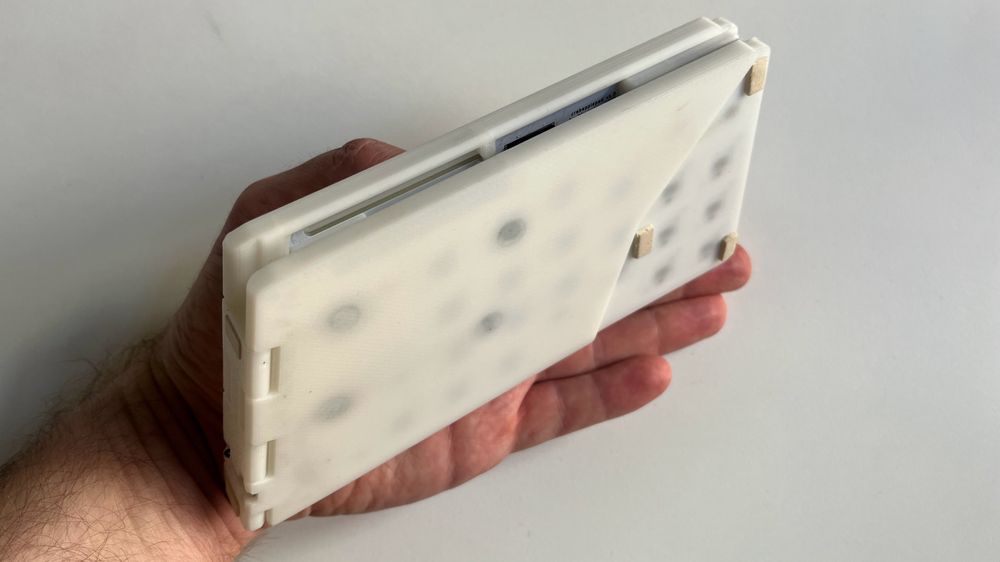
Every October 1st, Google Japan likes to celebrate the 101-key keyboard by building something revolutionary off the top of their heads. (10/1… 101… get it?) This year was no exception — they created the GCAPS, a ballcap-like device with a single switch inside.

In order to use it, you spin the hat left and right until the desired character is reached, and the rotation is detected by a gyroscope. Then you press down on the top of the hat to send the key codes via Bluetooth.

Under the hood, the hat uses an M5Stick C Plus and, to our dismay, a micro switch that wasn’t even made by Cherry. Oh well —  we landed on the clicky side, so that’s great in our book. Surprisingly, there exists a skull cap/hat skeleton thing on which to build a platform for pressing down on the switch. Just like the teaboard and the long boi keyboards, this thing is completely open source.

Since it types in Japanese, there’s no word on whether it types in all caps, though we like to think that it would given the object it represents. Be sure to check out the product reveal video after the break.

Continue reading “Hats Off To Another Weird Keyboard From Google Japan”

Famicom-Inspired NES TV Looks Rad In Red

Take it from us, insomnia is no joke. But the wee hours can have a great effect on creativity, and if you’ve got a project in mind, doing that is way better than just sitting around, zoning out to infomercials and wishing for sleep. Over recent nights, [insomniacfactory] has been working on a Sharp C1 Famicon-inspired NES TV, and the result is simply fabulous.

The Sharp C1 Famicom was CRT television with a Famicom (precursor to the NES) built in. It allegedly had better picture quality than either a Famicom or NES with a separate television, and this was because it had direct internal display connection. The picture quality was so good that video game magazines at the time used it for screenshots.

Starting with a couple of TVs and a plan, [insomniacfactory] got to work, using the guts from a newer donor TV and a 1985 NES main board with the region-free mod and the RF module removed.

[insomniacfactory] also added also added a wiring harness and a side loader connector from a broken Game Genie to the NES main board. After some careful Dremeling out of the 1981 AKAI TV, they had room for the clone console’s cartridge slot and controller plugs.

This project took a lot of careful and fiddly work, especially since the boards are all bracketed in place and easy to remove. But it totally looks like it was worth it, and now [insomniacfactory] can retro game all night for a while before starting the next insomnia-driven project.

Are you in the mood for more iconic NES? Take a guided tour.

Hackaday Prize 2023: Hydrocleaner Nips Pollution In The Bud

It’s unfortunate, but a lot of trash ends up in our rivers and, eventually, our oceans. Cleaning efforts can be costly and require a lot of human power. One of the ways to keep trash out from reaching the ocean is to attack it at the river level. That’s the idea behind [Xieshi Zhang]’s Hydrocleaner, a semi-autonomous river cleaning robot.

One current method for removing trash is by remote-controlled boats with nets attached. These typically travel in one direction, sort of sweeping left and right and probably missing trash in the process.

Hydrocleaner is capable of turning back and forth, ensuring a much more complete clean-up. The camera spots trash, and the twin-pontoon design allows it to flow easily between them and into the net behind. Currently, the brain behind this boat is a Jetson Nano, although this is a work in progress. The eventual idea is that the boat would navigate itself using GNSS guidance and would navigate toward the trash.

Of course, you could always fight trash with trash.

We’d Sure Like To Strum The Chrumm Keyboard

If you want something as personal as a keyboard done right, you have to do it yourself. Not quite satisfied with the multitude of mechanical offerings out there, [summific] decided to throw their hat into the ring and design the Chrumm keyboard. And boy, are we glad they did.

Between the lovely tenting angle and tilt, the gorgeous flexible PCBs, and the pictures that could pass for renders, [summific] has given us something beautiful to behold that we can only dream of thocking on. Even the honeycomb plate is nice. Oh, but this monoblock split is completely open source.

This Raspberry Pi Pico-powered keyboard features a 3D printable case design without visible screws, and a rotary encoder in the middle. Those palm rests are firmly attached from the underside. Why are the thumb cluster keycaps upside down? It’s not meant to drive you insane; it’s because the contour is more finger-friendly that way, according to some people.

[summific] makes this look easy, but it doesn’t matter, because all the hard work is already done. If you want something easier, start with a macropad. Or a macro pad, even.

Via reddit

One-String, One-Trick Pony Plays “the Lick”

Wouldn’t you love to be able to play a song on a stringed instrument even though you don’t have an iota of musical talent? That’s the idea behind Strumli, a single-string instrument built by [Factorem] that plays “the lick”. You know, the lick. Chances are, you’ve heard it somewhere before.

Essentially, it’s a pill-shaped bowl with a soundboard. A high-E guitar string is wound around bearings and tuned with a guitar tuner. The lengths of string between the bearings correspond to each note in the lick. Strum it in the right direction, and Bob’s your uncle.

So how the heck did [Factorem] come up with the proper string lengths needed to play the song? After a bit of fancy math involving the equation that represents the relationship between the measurable frequency of a vibrating string under tension and the tension itself, [Factorem] had the overall length of the string. Then it was a matter of finding the frequencies needed to play the lick, along with their corresponding lengths.

Since the string exerts about 80 pounds of tension across the 3D-printed soundboard, some serious internal bracing is required, which [Factorem] figured out in CAD program. All the files are available if you want to build your own. Be sure to check out the build/demo after the break.

Would you rather just build a little harp? Here’s the inspiration for Strumli — a single-string number with a full octave.

Continue reading “One-String, One-Trick Pony Plays “the Lick””

2023 Halloween Hackfest: Flickering Pumpkin Pin Is Solidly Built

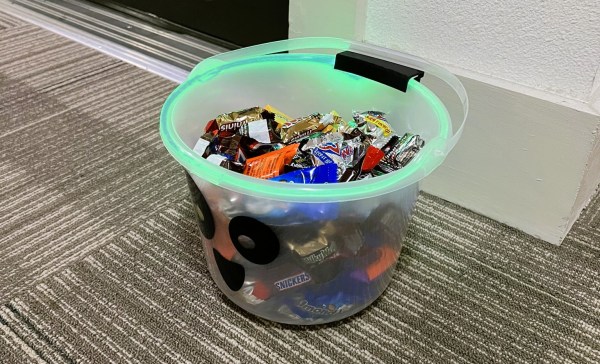
Now first of all, [Steph] grants that you can already take your pick of several LED pumpkin badges out there on IO. That’s not the point. The point is that this flickering pumpkin pin is nicely-built as well as being open source.

Even though it’s fully featured — it flickers, it’s wearable, and it’s lightweight — the build couldn’t be more simple. It’s fancy through-hole LEDs and a coin cell holder, plus a tack pin to stick it through your shirt. But the final result is quite elegant thanks to clever use of PCB layering.

The first version was to get all the layers right to let the light through and embellish the jack-o-lantern’s lines with manufacturer-applied silver solder, but as [Steph] points out, it looked ‘like something a disturbed child might carve into their desk in detention’. So [Steph] enlisted [Mx. Jack Nelson], who improved the artwork.

Pretty much every component does double duty here, including the tack pin — it serves as a switch because it can hold the battery in place. The battery’s edges reflect the glowing light quite nicely around the edge of the pin. And the LEDs beneath the battery prevent it from slipping out. You can see how it goes together in the video after the break.

Continue reading “2023 Halloween Hackfest: Flickering Pumpkin Pin Is Solidly Built”

Peggyboard Will Have You Climbing The Walls Repeatedly

When you can’t climb actual rocks all the time, what do you do to train and keep sharp? You go to a rock-climbing gym, naturally. But what do you do when it’s 2020 and your rock-climbing gym has shuttered for the foreseeable? You build the best darn rock-climbing wall possible, and you outfit it with an LED for every hold and write an app that lets you plan your route and repeat it later.

This is essentially a DIY version of something called a Moonboard, which, aside from being expensive, was quickly going out of stock back in 2020. [Pegor] started the Peggyboard by building a climbing woody, which is a legendary home climbing wall built by a legendary climber about 20 years ago.

The Peggyboard is Raspberry Pi-powered and has a rather nice app going for it, which [Pegor] has kindly decided to open source.

On the initial screen, the user can select a route and assign the holds as either starting holds, foot holds, hand holds, or finishing holds, each with a different color LED. Another screen lets the user choose a previously-saved route, then apply it to the Peggyboard’s LEDs with the light bulb icon.

Don’t know where to get started building your own climbing wall? You can 3D print climbing holds, you know.