2023 Halloween Hackfest: Treat Trough Of Terror Is Actually Pretty Cute

Even though it seems the worst of COVID has passed, October generally kicks off cold and flu season, so why not continue to pass out Halloween treats in a socially-distanced fashion?

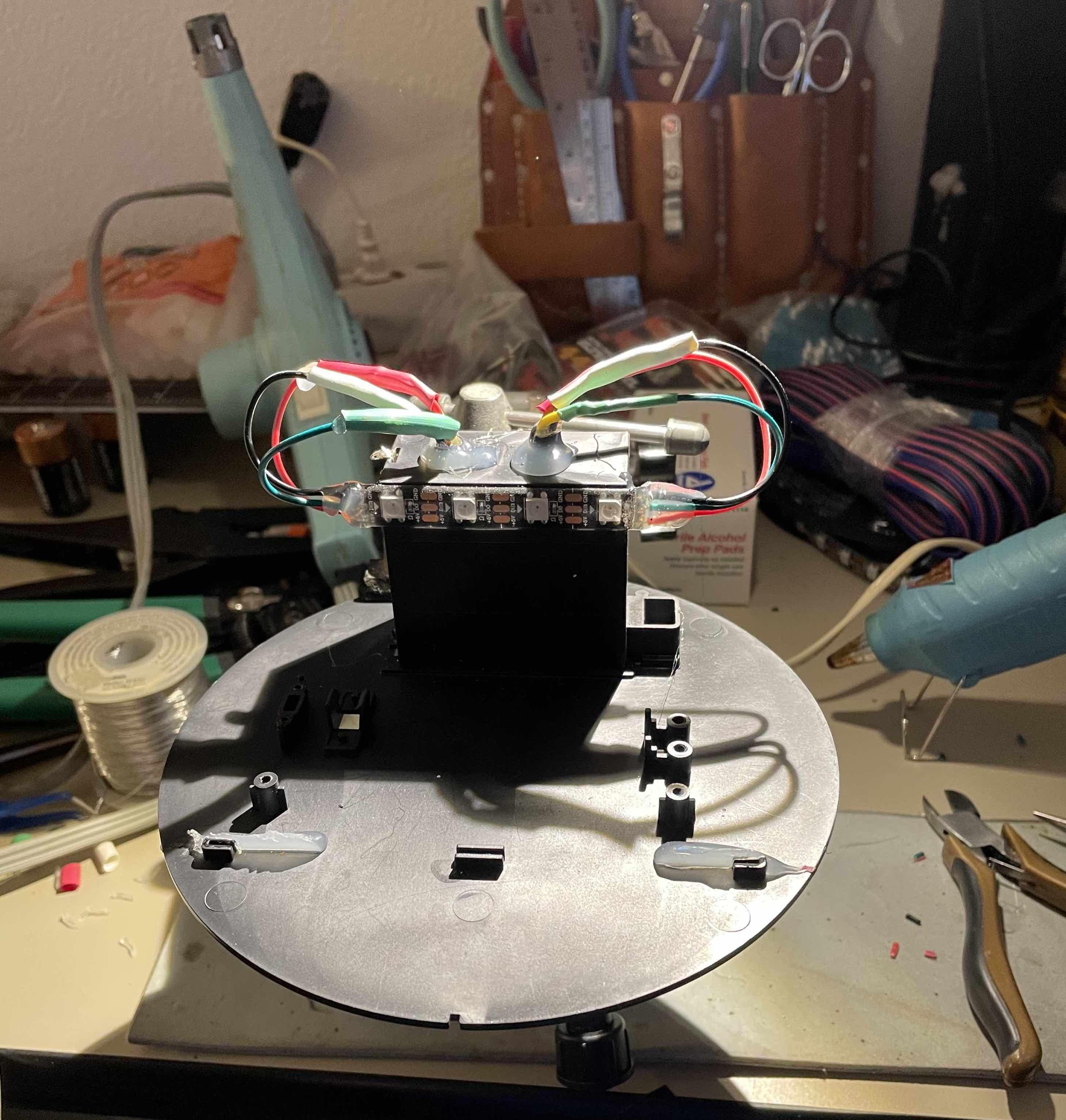
That is, of course the idea behind [Gord Payne]’s Halloween Treat Trough of Terror. Lay a treat at the top of the trough and it will activate the LED strips that follow the treat down to the end, as well as some spooky sounds. The treat in question is detected by an SR-04 ultrasonic distance sensor connected to an Arduino Nano.

All in all this was a highly successful build as far as neighborhood entertainment value goes. Toddlers stared in awe at the blinkenlights, teenagers proclaimed it ‘sick’, and we can only assume that the adults were likely happy to see something aimed at kids that’s not scary.

[Gord] has a nice how-to if you want to build your own, and of course, the Arduino sketch is available. Be sure to check it out in action after the break.

Don’t have room to build a treat slide? Here’s a socially-distanced dispenser that lets them stomp a giant button.

Continue reading “2023 Halloween Hackfest: Treat Trough Of Terror Is Actually Pretty Cute”

2023 Halloween Hackfest: Ouija Robot Is Even Creepier Than The Real Thing

When you’re a kid, nothing says spooky like turning off the lights and bringing out the Ouija board. For decades, this mystifying oracle has purported to channel the dead by spelling out messages using a board with numbers, letters, yes/no, and a heart-shaped windowed bit of plastic called a planchette.

While the action of a standard Ouija board owes itself to something called the ideomotor phenomenon, this motorized Ouija robot by [Ronald McCollum] is powered by tweets.

That’s right, the mannequin hand uses the planchette to spell out the tweets with a rather crisp snap of the wrist. [Ronald] impressively coded all the positions by hand, with each letter being comprised of both a hand position and planchette position.

This project utilizes both an Adafruit Crickit board and a Raspberry Pi, mostly because [Ronald] wanted to use the Crickit for something, and added the Pi to spell out the tweets on the display in real time. Check it out in action after the break, and stick around for a bonus video of the numbers being laser-cut.

Speaking of creepy motion, here’s a refrigerator clock that uses those colorful alphanumeric magnets.

Continue reading “2023 Halloween Hackfest: Ouija Robot Is Even Creepier Than The Real Thing”

You’ve Got Mail: Faster And Faster We Go

When we last left the post office, they had implemented OCR to read even the sloppiest of handwriting. And to augment today’s 99% accuracy rate, there’s a center full of humans who can decipher the rest of those messy addresses with speed and aplomb. Before that, we took a look at many of the machines that make up the automated side of the post office’s movements. But what was being done to improve the customer experience during all of this time?

Quite a bit, as it turns out. In this installment, we’ll take a look at the development of vending machines and programs like Speed Mail, Missile Mail, and V-Mail (no, not voicemail!) as they relate to enhanced customer service over the years.

Continue reading “You’ve Got Mail: Faster And Faster We Go”

Dead E. Ruxpin Appears Alive And Well

What are you doing to scare trick-or-treaters this Halloween? Surely something, right? Well, Hackaday alum [CameronCoward] certainly has his holiday under control with Dead E. Ruxpin, a murderous, cassette tape-controlled animatronic bear.

Readers of a certain vintage will no doubt see the correlation to Teddy Ruxpin, an animatronic bear from the 1980s whose mouth moved as it read stories from cassette tapes. Cleverly, the engineers used one stereo channel for the story’s audio, and the other channel to control the bear’s mouth.

Dead E. Ruxpin takes this idea and expands it, using the same two channels to send audio and control three servo motors that move both arms and the mouth. How is this possible? By sending tones built from one or more frequencies.

Essentially, [Cameron] assigned a frequency to each movement: mouth open/closed, and left and/or right arm up or down. These are all, of course, synced up with specific points in the audio so Dead E. doesn’t just move randomly, he dances along with the music.

The bear is actually a hand puppet, which leaves room for a 3D-printed skeleton that holds the RP2040 and the servos and of course, moves the puppet’s parts. We can’t decide if we prefer the bulging bloodshot eyes, or think the cutesy original eyes would have made a scarier bear. Anyway, check out the build/demo video after the break to see it in action.

Are you now into Teddy Ruxpin? Here’s a bit more about those scare bears. And don’t forget, Halloween Hackfest runs now until October 31st.

Continue reading “Dead E. Ruxpin Appears Alive And Well”

Single-Button Keyboard Has Multiple Uses

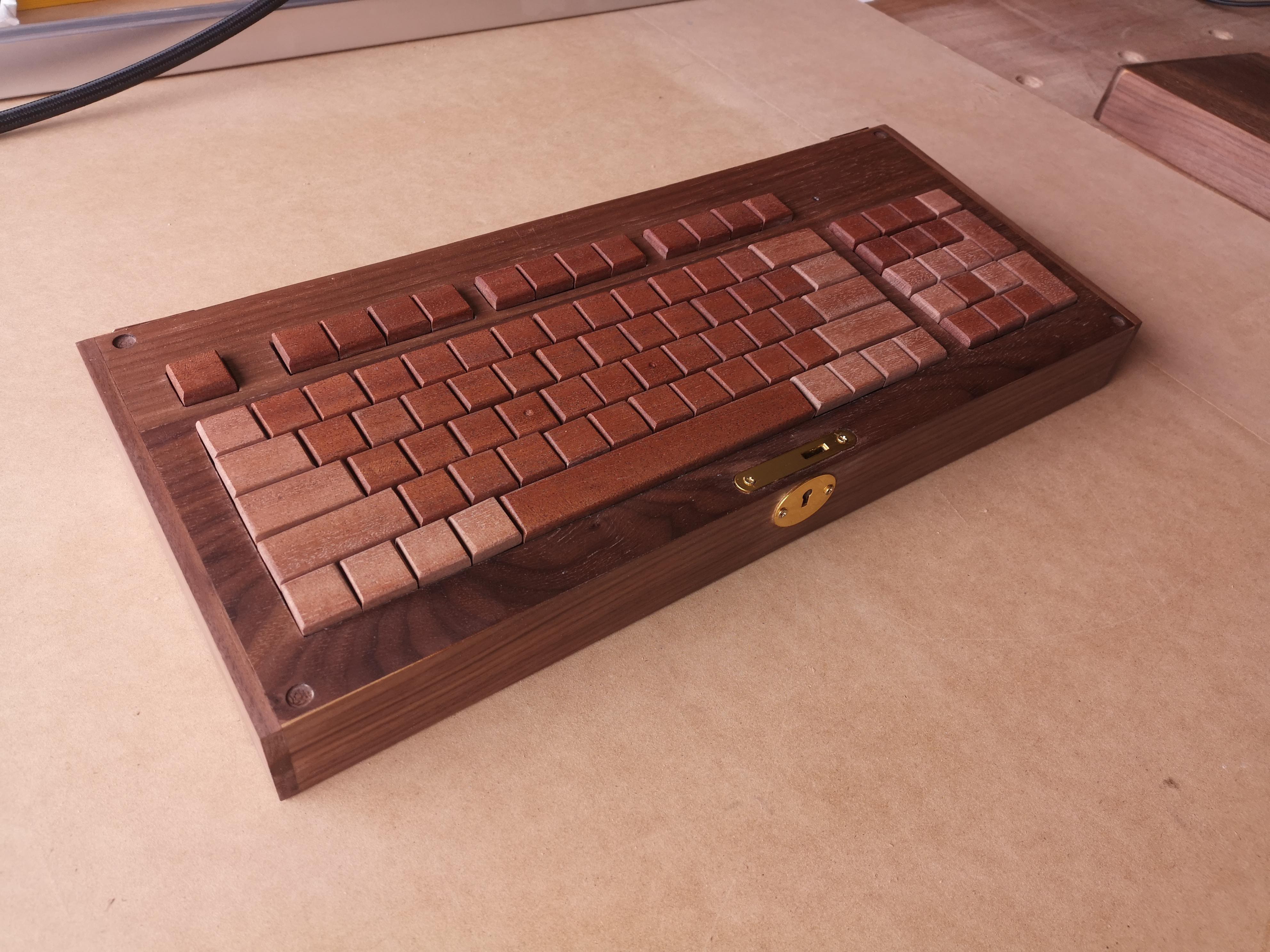
Well now why would I want a single-button keyboard, you might be asking yourself. We say it all depends on how you build the thing, and how you program it. Would you believe that the MagiClick by [Modular] is capable of showing live weather information or the date and time, acting as animated dice, or being a stopwatch and Pomodoro timer? Now you’re beginning to understand.

Before we get much further, yes, this bad boy has two additional buttons on the sides. But the spirit of the thing is in the single large switch in the middle. It’s hiding beneath the 0.85″ 128×128 display, which is protected from pressure and fingerprints by that Pop-o-Matic bubble over the top. While the big button is the main operator used to access the function options, the side buttons are used as auxiliaries to exit and return to the home screen.

MagiClick is based on the ESP32-S3 and is designed to run on CircuitPython. In addition to everything else packed into this thing, there are blinkenlights and a small speaker inside, plus a GPIO expansion header around back. Everything is available on GitHub if you want to build your own.

Not enough keys for you? Well, here’s one with two.

Humans And Balloon Hands Help Bots Make Breakfast

Breakfast may be the most important meal of the day, but who wants to get up first thing in the morning and make it? Well, there may come a day when a robot can do the dirty work for you. This is Toyota Research Institute’s vision with their innovatively-trained breakfast bots.

Going way beyond pick and place tasks, TRI has, so far, taught robots how to do more than 60 different things using a new method to teach dexterous skills like whisking eggs, peeling vegetables, and applying hazelnut spread to a substrate. Their method is built on generative AI technique called Diffusion Policy, which they use to create what they’re calling Large Behavior Models.

Instead of hours of coding and debugging, the robots learn differently. Essentially, the robot gets a large flexible balloon hand with which to feel objects, their weight, and their effect on other objects (like flipping a pancake). Then, a human shows them how to perform a task before the bot is let loose on an AI model. After a number of hours, say overnight, the bot has a new working behavior.

Now, since TRI claims that their aim is to build robots that amplify people and not replace them, you may still have to plate your own scrambled eggs and apply the syrup to that short stack yourself. But they plan to have over 1,000 skills in the bag of tricks by the end of 2024. If you want more information about the project and to learn about Diffusion Policy without reading the paper, check out this blog post.

Perhaps the robotic burger joint was ahead of its time, but we’re getting there. How about a robot barista?

Continue reading “Humans And Balloon Hands Help Bots Make Breakfast”

Powder Your Prints For Baby-Smoothness

Layer lines are a dead giveaway to non-normies that a thing was 3D printed. There are things you can do to smooth them — sanding, chemical smoothing, and fillers come to mind. Although this technique technically uses all three, it starts with something very simple.

In the video after the break, [DaveRig] gets right to the point: baby powder and resin mixed together make a fine smoothing agent when cured. Having read about it online, he decided to give it a try.

Starting with a half sphere that had admittedly pretty big layer lines, [DaveRig] mixed up enough resin and baby powder to make the consistency of milk or cream. Then he put five coats on, curing and sanding with 120 in between each one.

Then it’s on to standard post-processing stuff. You know, wipe it down with alcohol, sand it a little more, wet sand, and then it’s on to the airbrush and clear-coat. The end result looks to be as smooth as your average bowling ball, as you can see in the main photo.

What’s your favorite post-processing method? Have you tried annealing them in salt?

Continue reading “Powder Your Prints For Baby-Smoothness”