Triple Zone Clock Tells Time In Style

Although the cutoff for saying ‘Happy New Year’ is somewhere around today, there’s still plenty of time to reminisce about 2022 and all that we accomplished. Hackaday alum [Jeremy Cook] spent much of last year designing and building a triple-zone PCB clock, dubbed the 742 clock. It is called so because of all the 7-segments, and then 42 from the height in millimeters of each PCB. Also because it’s 24 backwards, and if we may be so bold, because 42.

If this looks familiar, it’s because we covered the single-panel version a few months ago. Much like that one, the triple time zone clock is controlled by a single Wemos D1 mini, and the other two panels are chained to the primary board. This version has a frame made of 20/20 extrusion with nice 3D printed caps on the ends to finish off the look.

As with the single-panel clock, this one uses bared-FR4 PCBs to diffuse the LEDs, and the effect looks really nice. We particularly like the capacitive corners that control the clock and the colors, which change throughout the day when left to their own devices. Be sure to check out the build video after the break.

Are you really into LEDs? Consider building a Berlin clock.

Continue reading “Triple Zone Clock Tells Time In Style”

Test Your Capacity For Circuit Sculpture With Flashing Lights

Have you tried your hand at circuit sculpture yet? Well, if you were waiting for the ideal first project with a great build video to go along with it, keep reading. [4dcircuitry]’s 555-based flashing circuit sculpture ticks all the go-for-it boxen for us — the component list is short, the final circuit looks cool, and well, there are blinkenlights.

Of course, it’s not quite a zero-entry project. Although [4dcircuitry] makes it look oh-so easy build it in the video below, they are using 1206 components and an SOIC-packaged 555 timer here. On the other hand, they start by smartly laying everything out on double-stick tape before applying flux and soldering. Then when it’s time to run the wires that no one wants to see, [4dcircuitry] carefully tweezers it from the tape and flips it over, re-using the tape do solder up the back side.

Don’t have the patience to solder 1206? All component sizes are beautiful, as evidenced by this amazing circuit sculpture clock.

Continue reading “Test Your Capacity For Circuit Sculpture With Flashing Lights”

Hackaday Podcast 199: Ferrofluid Follies, Decentralized Chaos, And NTSC For You And Me

This week, Editor-in-Chief Elliot Williams and Assignments Editor Kristina Panos decided against using one of Kristina’s tin can microphones to record the podcast, though that might be a cool optional thing to do once (and then probably never again).

After a brief foray into the news that the Chaos Communications Congress will be decentralized once again this year, as COVID restrictions make planning this huge event a complete headache (among other notable symptoms), we discuss the news that the EU is demanding replaceable batteries in phones going forward.

After that, it’s time for another What’s That Sound results show, and despite repeated listens, Kristina fails to guess the thing. Even if she’d had an inkling as to what it was, she probably would have said ‘split-flap display’ instead of the proper answer, which is ‘flip-dot display’, as a few people responded. Finally, it’s on to the hacks, where we talk about uses for ferrofluid and decide that it’s one of those things that’s just for fun and should not be applied to the world as some sort of all-purpose whacking device.

Check out the links below if you want to follow along, and as always, tell us what you think about this episode in the comments!

And/or download it and listen offline.

Continue reading “Hackaday Podcast 199: Ferrofluid Follies, Decentralized Chaos, And NTSC For You And Me”

Logic Gate Game Is Fun AND Educational

How well do you know your logic gates? For their final submission for STEM Projects class, [BKriet] gamified the situation using a Raspberry Pi Pico, some blinkenlights, and a not-insignificant amount of 3D printing. The result is Name! That! Gate!, a fun and educational toy that [BKriet] ultimately donated back to the class (that’s a hot move in our book).

The objective of this game is to figure out which logic gate is being used to make the output shown on the screen, given A, B, and/or C as inputs. There are ten stages to the game, and each correct stage awards the player 14 points, for a perfect score of 140. Although a random gate is loaded for every stage, code ensures that no gate is ever repeated during a single game.

This project is completely open source, so the gate is wide open. Don’t have a 3D printer? Here’s a big set of PCB logic gates, but really, you can make logic gates out of almost anything.

Retrotechtacular: Gibson Factory Tour, 1967-Style

If nothing else good came out of 2020, we can say that we at least have “Instrument of the People” — some 1967-era footage of Gibson Guitars’ “craftory”, which was discovered sometime in the fall of 2020. It appears a bit boring at first — a suit slowly approaches the camera on a dimly-lit factory floor and you half-expect an ‘oh, I didn’t see you there’ type of introduction, but no. When he reaches the foreground, he finds a candy apple-red Gibson semi-hollow body guitar waiting for him. After giving the thing a quick once over, he assesses the straightness of the neck and then begins shredding on it, fingerpicking style.

If you like this or any type of guitar music, then hang on to your headstock, because it lilts nonstop throughout this 20-minute tour as we see a parade of nameless, and often headless, players showing their stuff on various styles of Gibson both electric and acoustic.

Continue reading “Retrotechtacular: Gibson Factory Tour, 1967-Style”

Lo-Fi Fun: Beer Can Microphones

Sometimes, you just need an easy win, right? This is one of those projects. A couple months back, I was looking at my guitars and guitar accessories and thought, it is finally time to do something with the neck I’ve had lying around for years. In trying to decide a suitable body for the slapdash guitar I was about to build, I found myself at a tractor supply store for LEGO-related reasons. (Where else are you going to get a bunch of egg cartons without eating a bunch of eggs?) I  noticed that they happened to also stock ammo boxes. Bam! It’s sturdy, it opens easily, and it’s (very) roughly guitar body shaped. I happily picked one up and started scheming on the way home.

Having never built a cigar box guitar before and being of a certain vintage, I’m inclined to turn to books instead of the Internet, so I stocked up from the library. Among my early choices was Making Poor Man’s Guitars by Shane Speal, who is widely considered to be the guru on the subject. In flipping through the book, I noticed the beer can microphone project and was immediately taken by the aesthetic of some cool old 70s beer can with a 1/4″ instrument jack on the bottom, just asking for some dirty blues to be belted into it. I had to build one. Or twelve.

Continue reading “Lo-Fi Fun: Beer Can Microphones”

Morphing Keyboard Gets You Dialed In Just Right

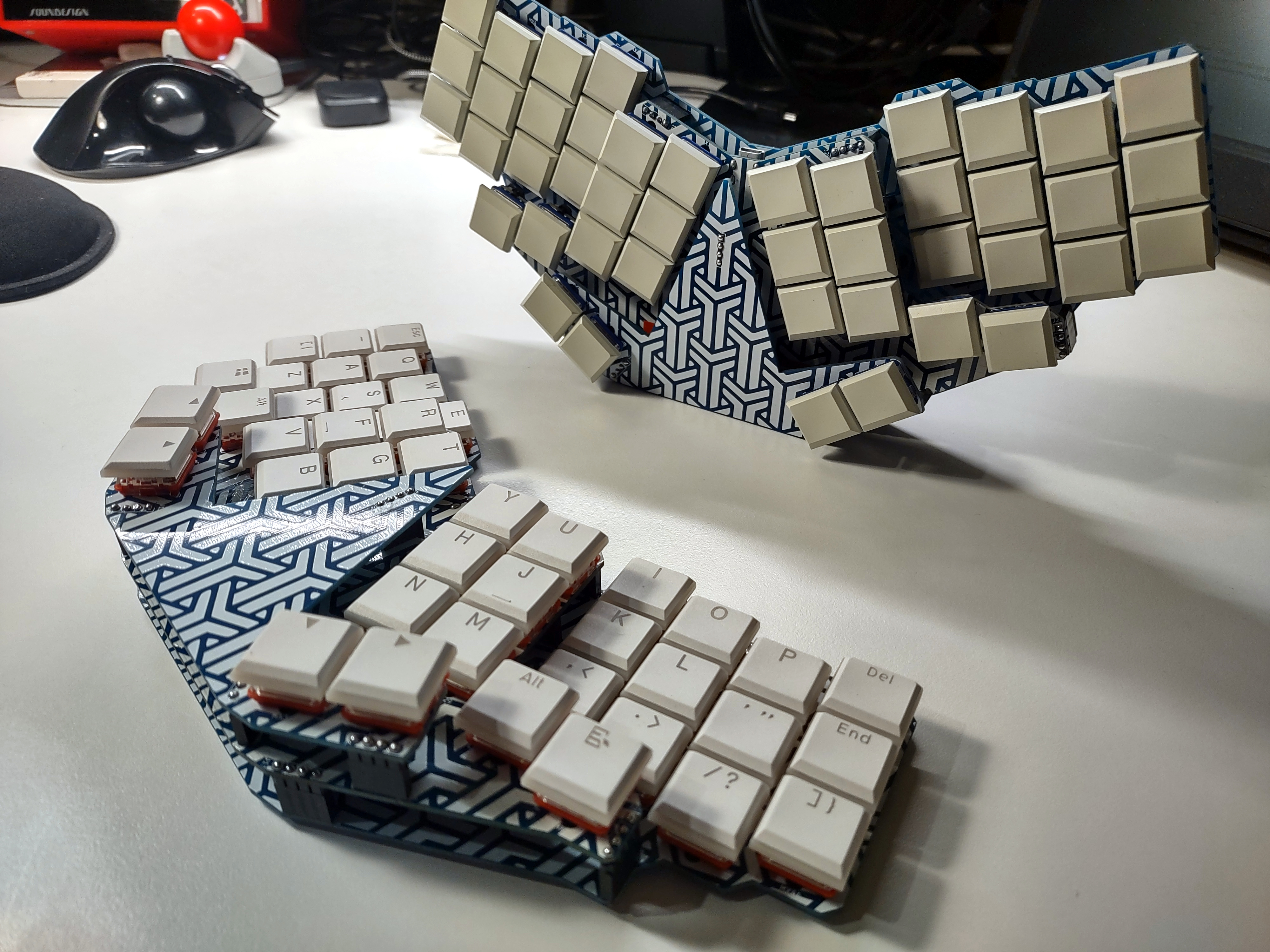
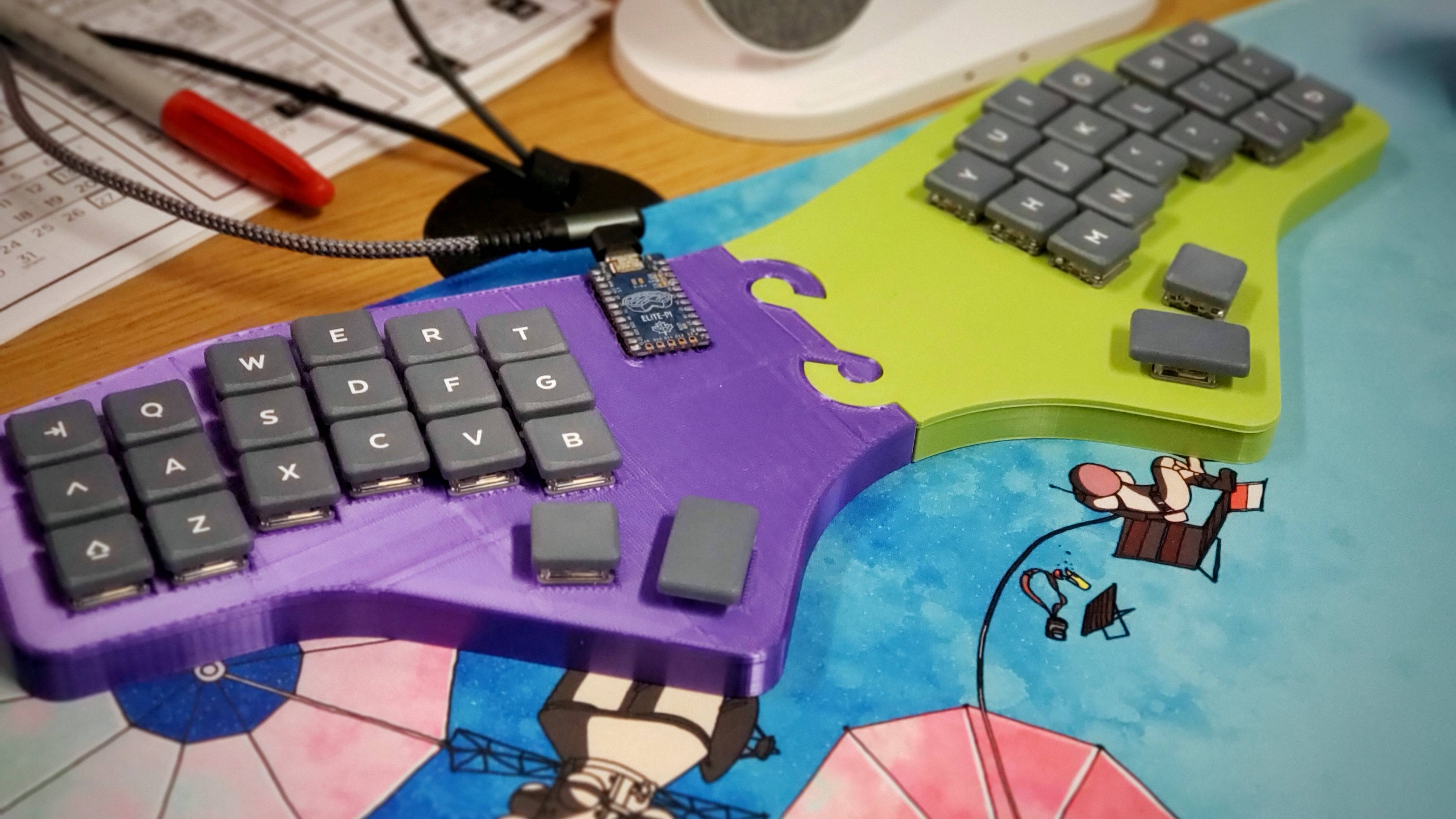
So you’re tired of rectangular, brick wall-staggered keyboards and want to go split and/or ergo. But how? Which style? What do? Here’s what you do: you build one of these here LHM Morph boards and customize the crap out of it, because that’s what it’s for.

So what is this thing, anyway? Is it a even a keyboard? Well, as long as you can press switches and send key commands to a computer, it certainly smells like a keyboard to us. Now that we’ve gotten that out of the way, what’s going on here is that [LifeHackerMax] has built a highly-customizable version of the LHM, their 26-key split. The LHM Morph can be fine-tuned to nearly any degree imaginable, including the tenting angle. The keys are grouped in modules that can slide back and forth to suit your varying finger lengths. As they are half-round, these modules can also be tilted and rotated until they’re just right.

But the super cool thing about the LHM Morph is the way it goes together — like LEGO. It’s completely modular, and you don’t even have to go split if you’re not ready for that. But all the pieces connect via rods made of copper wire. If you’d like to make one for yourself, the 3D files are up on Thingiverse, and the firmware is on GitHub. Be sure to check out the video after the break.

Does this keyboard remind you of anything? [Peter Lyons]’ Squeezebox, perhaps?

Continue reading “Morphing Keyboard Gets You Dialed In Just Right”