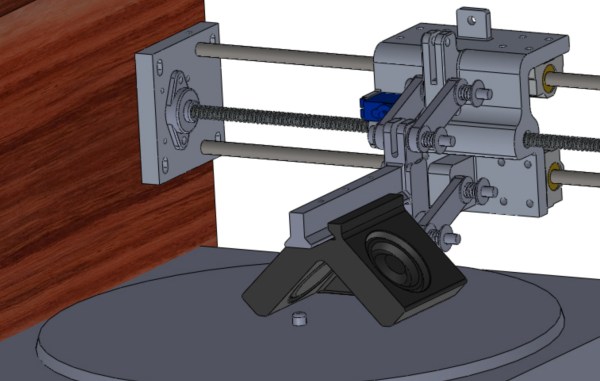
CAD design for a vinyl record cutter.

VinyGo Stereo Vinyl Recorder Will Put You In The Groove

A long time ago, there were these vinyl recording booths. You could go in there and cut a 45PM record as easily as getting a strip of four pictures of yourself in the next booth along the boardwalk. With their 2021 Hackaday Prize entry called VinyGo, [mras2an] seeks to reinvigorate this concept for private use by musicians, artists, or anyone else who has always wanted to cut their own vinyl.

VinyGo is for people looking to make a few dozen copies or fewer. Apparently there’s a polymer shortage right now on top of everything else, and smaller clients are getting the shaft from record-pressing companies. This way, people can cut their own records for about $4 a unit on top of the cost of building VinyGo, which is meant to be both affordable and accessible.

You probably know how a record player works, but how about a record cutter? As [mras2an] explains over on IO, music coming through a pair of speakers vibrates a diamond cutting head, which cuts a groove in the vinyl that’s an exact representation of the music. Once it’s been cut, a regular stylus picks up the groove and plays back the vibrations. Check it out after the break.

[mras2an] plans to enter VinyGo into the Hackaday Prize during the Wildcard round, where anything goes. Does your project defy categorization? Or are you just running a little behind? The Wildcard round runs from Monday, September 27th to Wednesday, October 27th and is your last chance to enter this year’s Prize.

Not your kind of vinyl cutter? We’ve got those, too.

Continue reading “VinyGo Stereo Vinyl Recorder Will Put You In The Groove”

Drill press modded with a treadmill motor, speed controller, lights, and a tachometer.

Drill Press Runs Faster On A Treadmill Motor

Are you tired of the same old video style from your favorite content creators? We can’t say that we were, exactly. But nevertheless, we appreciate this creative departure from [Eric Strebel]’s regular fare as he soups up his drill press with an old treadmill motor and a few extra features.

First off, that commentator in the video is right — 2.6 horsepower is a crazy amount for a drill press. Fortunately, [Eric] also added a variable speed controller and a digital tachometer to keep things in check. As an added bonus, he no longer has to get under the hood and mess with the belts.

We like what [Eric] brings to the drill press motor mod, which is already well-documented on YouTube. We love the re-use of an office chair bracket as a new motor mount. It’s probably our favorite bit aside from the 2-color forward/reverse switch plate idea: print it in whatever letter color you want with proud lettering, paint the whole thing black, and sand off the letters so the color shows. Check it out after the break.

There are many ways to make your own drill press, and one of the easiest is to mount a hand drill.

Did you miss the Industrial Design Hack Chat with [Eric]? It’s okay, you can read the transcript over on IO.

Continue reading “Drill Press Runs Faster On A Treadmill Motor”

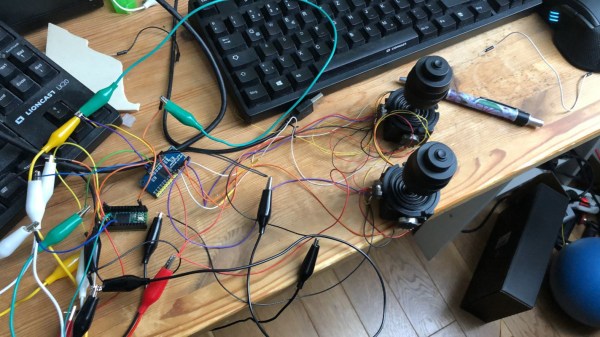
A couple of joysticks wired up to a Teensy for prototyping.

Custom Joystick Build Guide Should Point You In The Right Direction

Over the last two years, [benkster] has been perfecting their ideal flight controller. Like many people, they started out with a keyboard and mouse and eventually moved on to a joystick. While a HOTAS (hands on throttle-and-stick — e.g. a yoke controller with inputs right there on the sides) might have been the next logical step, those things cost too much. Naturally, the answer is to build one, ideally for less money. Hey, it could happen.

The design went from just an idea to a cardboard prototype, and then to a wooden enclosure and later, a 3D-printed case. Since [benkster] learned a great deal along the way, they want to give back to the community with a comprehensive joystick design/build guide so that others don’t have to start from zero, overwhelmed with information.

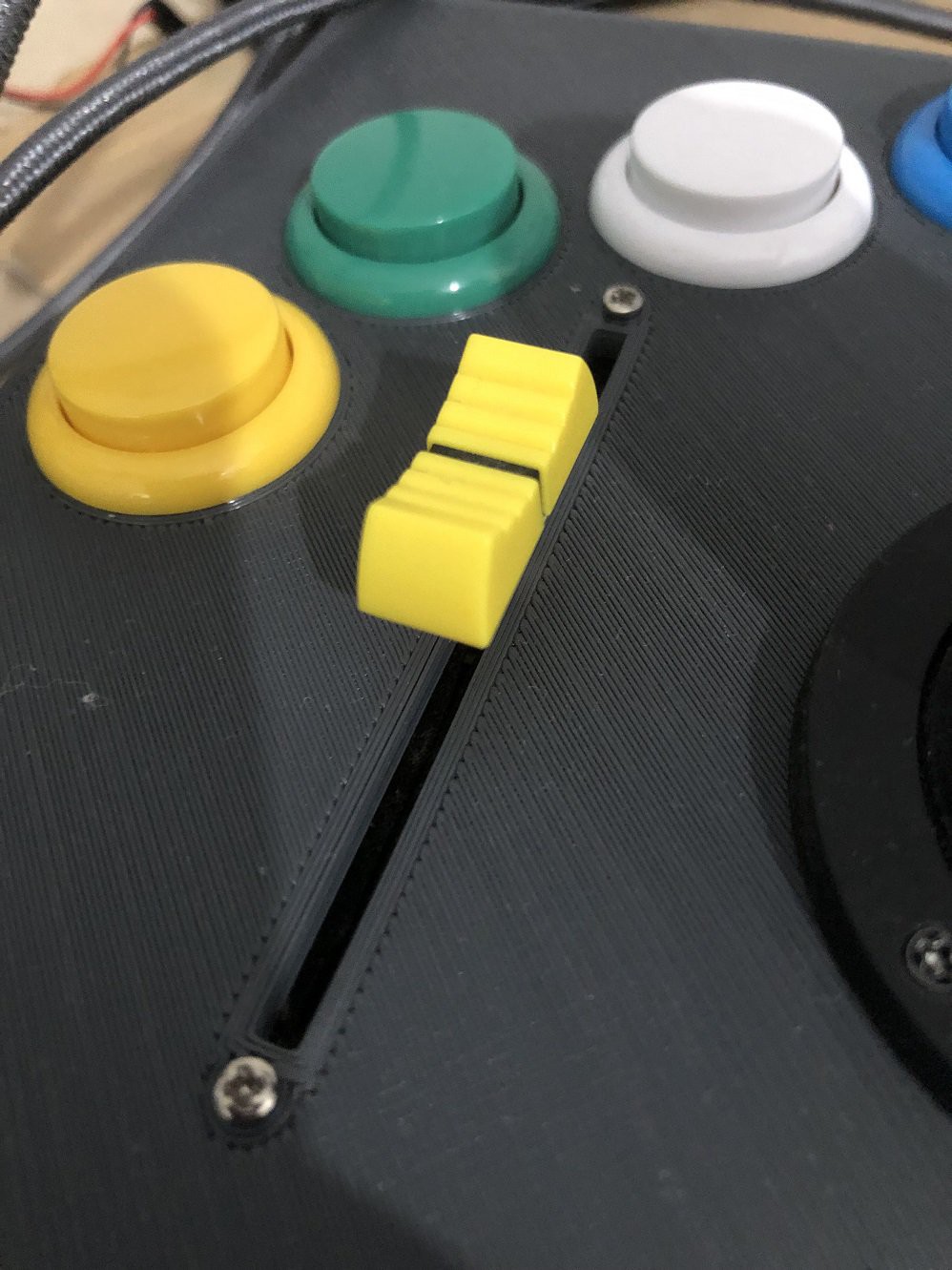
[benkster] wanted three joysticks, a bunch of big buttons, a throttle, a display to show component status (as in, is joystick #3 a joystick right now or a WASD keyboard?), and immersive details everywhere — you know, a million buttons and switches to give it that cockpit feel. [benkster] is using a Teensy 4 to control two 3-axis joysticks and one 2-axis stick. Since this adds up to too many axes for Windows/DirectX to read in, the 2-axis stick is used as a WASD keyboard.

This guide is a great place to start, especially for folks who may be newer to electronics. There are nice introductions to many types of components and tidbits that are relevant outside the world of joysticks.

You want immersive flight simulation away from the PC? Here’s a printable flexure-based ‘stick that snaps right on your Xbox controller and pushes the buttons.

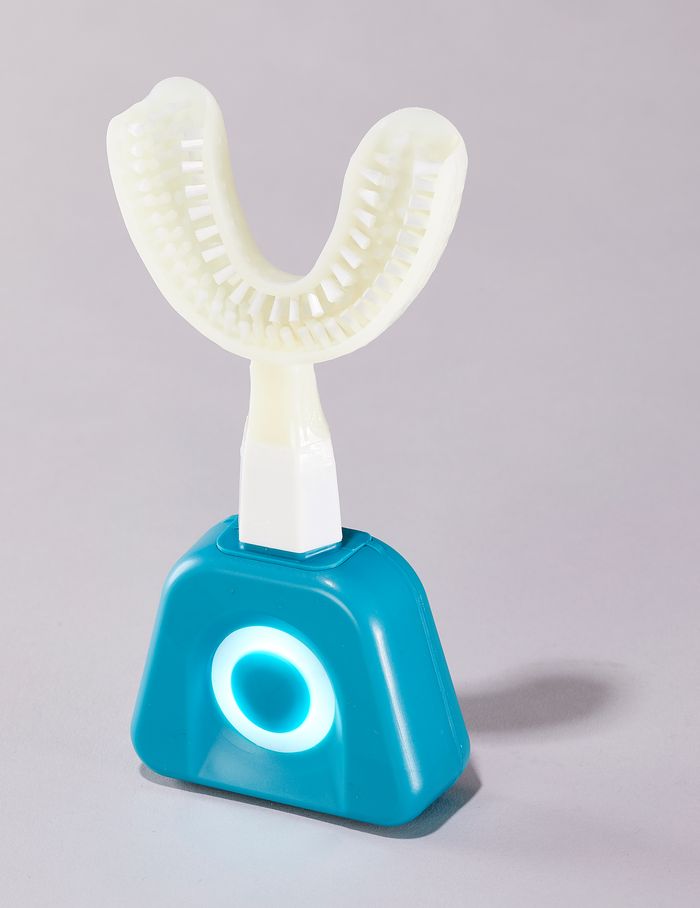
An assortment of whole-mouth toothbrushes that brush all of your teeth at once, in the span of 30 seconds.

Don’t Bristle; Teethbrush Won’t Hurt You

A whole-mouth toothbrush that brushes all of your teeth at once, in the span of 30 seconds.Good dental hygiene is the first line of defense when it comes to your health, and– you’re already bored, aren’t you? It’s totally true, though. Take care of your teeth, and the rest of you has a better chance of staying fairly healthy.

This is like, the one thing we have control over after diet and exercise, and most people just plain fail on this front. They brush for 30 seconds, tops. Or they rarely floss. Maybe they’ve never even considered brushing or scraping their tongue.

Okay, fine. You don’t want to spend the recommended two minutes twice a day working the brush around your mouth. The good news is, technology has finally caught up with you and your habits, if you can call them that. How about using something that can truly be called a teethbrush? As in, it brushes all of your teeth at once? Well, half of your teeth anyway. Allegedly, you can spend as little as 10 seconds on each arch and effectively scour your smile — that’s because the thing vibrates at an astonishing 40,000 per minute or so.

Sounds kind of scary, doesn’t it? Wait ’til you hear how much they cost. One brand is $150 off the bat, and replacement heads are close to $40 each, although they’re supposed to last for six months each (eww!). Most of them have some fancy extras that make the cost more palatable, such as a tooth-whitening mode.

What do you think? Would you use a teethbrush? We’re still on the fence. It could be interesting to develop our own, but you have to crawl before you can run. Guess we’ll start with a manual.

Pandemic Gives Passersby A Window On Cyborg Control

What’s this? Another fabulous creation from [Niklas Roy] and [Kati Hyyppä] that combines art and electronics with our zeitgeist and a lot of recycled bits and bobs? You got it. Their workshop in eastern Berlin used to be a retail shop and has a large display window as a result. This seems perfect for a pair of artists in a pandemic, because they can communicate with the community through the things they display in the window. Most recently, it was this interactive cyborg baby we are choosing to call Cybaby.

You might recognize Cybaby as one of the very hackable Robosapien robots, but with a baby doll head. (It also has a single red eye that really pulls its look together.) In the window, Cybaby comes alive and toddles around against a backdrop that grew and evolved over several weeks this spring and summer. Passersby were able to join the network and control Cybaby from outside with their smartphone to make it walk around, press various buttons that change its environment, and trigger a few sensors here and there. Robosapien has been around for about 20 years, so there is already Arduino code out there that essentially simulates its R/C signals. [Niklas] and [Kati] used a NodeMCU (ESP12-E) to send pulses to the IR input of the robot.

Back on the zany zeitgeist front, there’s a hair salon, a convenience store, and a nightclub for dancing that requires a successful trip through the testing center first (naturally). Oh, and there’s a lab next door to the nightclub that can’t be accessed by Cybaby no matter what it tries or how it cries. Check it out after the break.

There’s a dearth of Robosapien posts for some reason, so here’s what [Niklas] and [Kati] had in their window before the World of Cybaby — a really cool pen plotter that prints out messages sent by people walking by.

Continue reading “Pandemic Gives Passersby A Window On Cyborg Control”

M4 Breadstick Is A Tasty Prototyping Alternative

What does “breadboard-friendly” mean to you? It’s become a game of minimum viability. Sure, it fits in the breadboard, but are there any accessible tie points left for wires and components? What good is a development board if you can’t easily prototype with it?

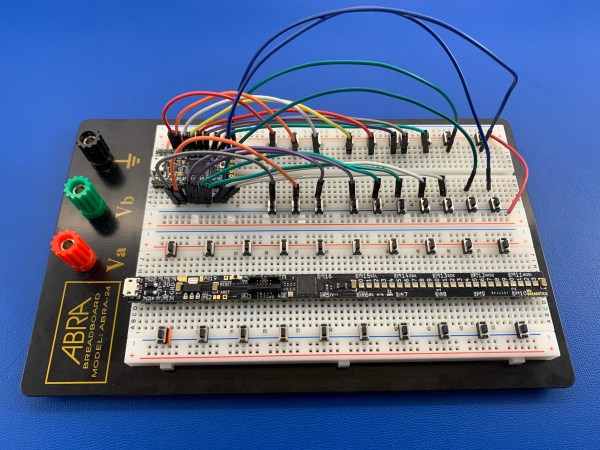
A few years ago, [Michael Rangen] set out to change all of that by creating a long and skinny development board that spaces out the I/O pins and simplifies wiring, making every circuit beautiful and easier to take in visually. The current version is an adaptation of Adafruit’s ItsyBitsy M4 Express. It has 20 I/O pins, all spread out along the length and numbered around the horn like an IC. [Michael] dipped this breadstick in 24 tiny RGB LEDs, all of which are on a dedicated com bus.

We think this is a great idea that will definitely make microcontrollers more hackable. This type of layout would make checking students’ work a breeze, and you can make tidy prototypes with it yourself after class. Today the board runs CircuitPython, and it will be able to run Arduino in the future.

This ESP socket may not leave quite as many tie points open, but it’s way easier than soldering header to it.

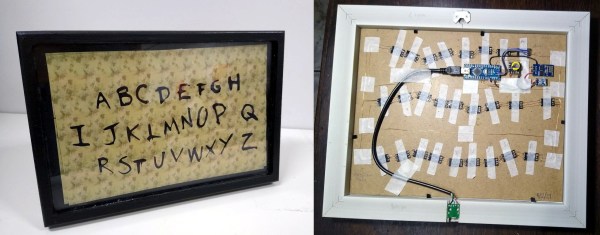
Word clock in the style of the Christmas lights from Stranger Things. If you know, you know.

Stranger Things Message Board Passes The Time By Spelling It Out

Will Netflix’s nostalgic hit Stranger Things be back for a fourth series anytime soon? We could pull out a Ouija board and ask the spirits, but we’d much rather ask closer to the source, i.e. a spirit in the upside down. And you know that the best way to do that is with LEDs — one for each letter of the alphabet so the spirit can spell out their messages.

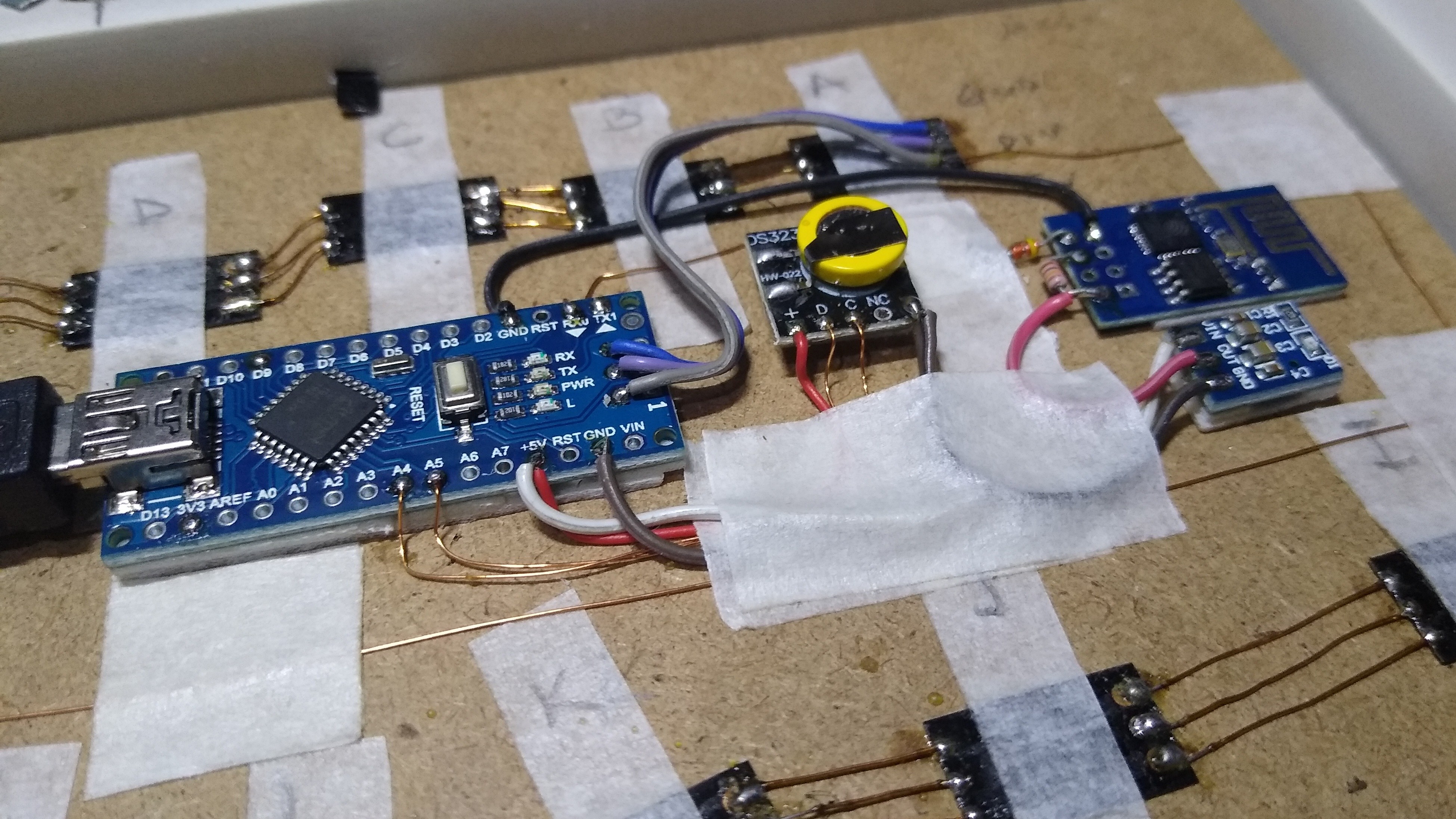
Arduino, ESP01, and real-time clock powering this Stranger Things word clockAlthough contact with the Demogorgon’s world isn’t likely with [danjovic]’s open-source Stranger Things board, you are guaranteed to get the time spelled out for you every minute, as in, ‘it’s twenty-five (or six) to four’. And if you want to freak out your unwitting friends, you can covertly send messages to it from your phone.

There are two versions now — the original desktop version, and one that hangs on the wall and uses a high-quality photo print for the background. Both use an ESP-01 and an Arduino to help drive the 26 RGB LEDs, and use a DS2321 real-time clock for timing. We love the enameled wiring job on the wall-mount version, but the coolest part has to be dual language support for English and Brazilian Portuguese. You can check out demos of both after the break.

We’ve seen many a word clock around here, but this is probably one of the few that’s dripping with pop culture. If it’s stunning modernism you want, take a look at this painstakingly-constructed beauty.

Continue reading Stranger Things Message Board Passes The Time By Spelling It Out”