Arduino Powered Heat Pump Controller Helps Warm Your Toes

Heat pump heating technology is starting to pop up more and more lately, as the technology becomes cheaper and public awareness and acceptance improves. Touted as a greener residential heating system, they are rapidly gaining popularity, at least in part due to various government green policies and tax breaks.

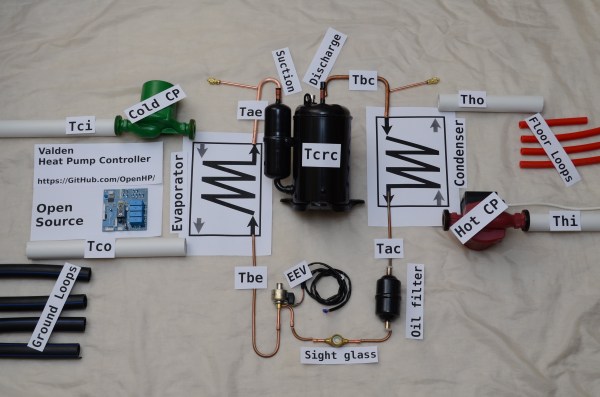
[Gonzho] has been busy the last few years working on his own Arduino Powered Open Source heat pump controller, and the project logs show some nice details of what it takes to start experimenting with heat pumps in general, if that’s your game. Or you could use this to give an old system a new lease of life with an Arduino brain transplant.

In essence they are very simple devices; some kind of refrigerant is passed through a source of heat, absorbing some of it, it then flows elsewhere, and is compressed, which increases its temperature, before that increased heat is lost where the increase in temperature is desired.

This heat source could be a river, a mass of pipes buried in the ground, or simply the air around you. The source and quality of the heat source as well as the desired system operating temperature dictate the overall efficiency, and with ground-source systems it’s even possible to dump excess heat directly into the ground and store it for when required later. This could be the result of a residential cooling system, or even directly sourced from a solar heated setup.

This heat pumping process is reversible, so it is possible to swap the hot and cold ends, just by flipping some valves, and turn your space heater into a space cooler. This whole process can trace its roots back to the super talented Scottish professor, William Cullen who in 1748 was the first person on record to demonstrate artificial refrigeration.

The power needed to run the compressor pump and control gear is usually electrically derived, at least in non-vehicular applications, but the total power required is significantly less than the effective heating (or cooling) power that results.

We’ve covered a few heat pump hacks before, like this guy who’s been heating his house geothermally for years, but not so many platforms designed for experimentation from the ground up.

The associated GitHub project provides the gerber files as well as the Arduino code, so you’ve got a great starting point for your own heat pumping builds.


Streetfighter 2 placed on table top display with separate arcade control box

Game Like It’s 2021 On A McDonald’s Touchscreen Table

Some of you around the world may have come across these Android-based gaming tables installed in your local fast-food outlet, and may even have been lucky enough to paw at one that was actually working at the time.

Originally based on an ancient mini PC, with a 1080p flat panel LCD and a touch overlay, they would have been mind-blowing for small children back in the day, but nowadays we expect somewhat more. YouTuber [BigRig Creates] got his hands on one, in a less than pleasant condition, but after a lot of soap and water, it was stripped down and the original controller junked in favour of a modern mini PC. To be clear, there isn’t much left beyond the casing and display from the original hardware, but we don’t care, as a lot of attention was paid to the software side of things to get it to triple-booting into Windows 10, Android x86 and Linux running emulation station, covering all those table-gaming urges you may have.

Internally, there is a fair amount of room for improvement on the wiring side of things, and [BigRig] is quick to admit that, but that’s what this learning game is all about. Now, many of you will choke on the very idea of playing games on a table system like this, after all, it’s pretty obvious this will be really hard on the back and neck. But, it does offer the easy option to switch from landscape to portrait orientation, simply by walking around the side, so it does have an upside. Also you’ve got a handy place to dump your beer and the takeaway when it arrives, so maybe not such a bad thing to have in your apartment? And, yes, it does run Doom.

We were particularly amused by the custom boot logo as well as the slick custom art in emulation station. It’s attention to detail like this that makes a build a great one and a conversation piece at parties. Now if only he could sort out that wiring job.

Continue reading “Game Like It’s 2021 On A McDonald’s Touchscreen Table”

Ruggedized Solar Power bank

Rugged Solar Generator Packs A Punch

Hackaday Prize 2021 entrant [Philip Ian Haasnoot] has been building a well-polished power bank. But this is no ordinary little power bank the like you would throw in your rucksack for a day out. No, this 2.5 kW luggable power bank is neatly encased in a tough, waterproof Pelican 1550 case, and is suitably decked out with all the power sockets you could possibly need for a long weekend of wilderness camping and photography.

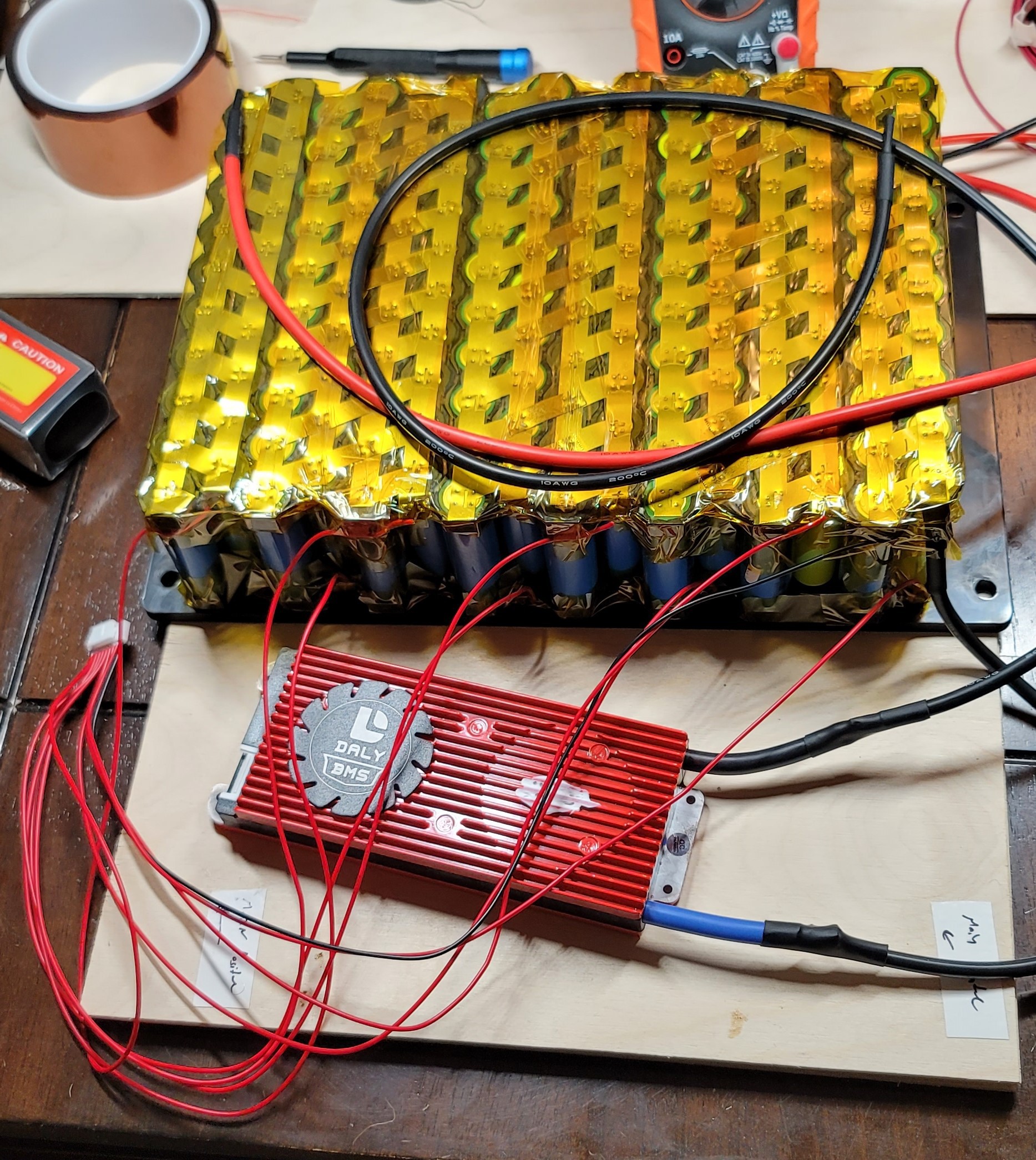
Testing the hand-built 18650 based battery bank
Boy, that’s a lot of tab welding

This box sports USB-C and USB 3.0 connectors for gadget charging, as well as 12 VDC cigarette lighter and XT-60 ports for high-drag devices. Also it provides a pair of 120 VAC sockets via an integrated inverter, which at 1.5 kW could run a small heater if you were really desperate, but more likely useful to keep your laptop going for a while. Now if only you could get Wi-Fi out in the desert!

[Philip] doesn’t actually talk much about the solar panels themselves, but we know the box contains a 600 W MPPT boost converter to take solar power in, and feed the LiPo battery pack in the correct manner.

The battery pack is custom-made from salvaged and tested 18650 cells, as you would expect, which we reckon took an absolute age to make by hand. The whole project is nicely finished, and looks like something we’d be happy to throw in the back of the car before heading out into our local wilderness.

As [Philip] says in the project description, it’s a tough job to carry enough power and keep all his drones, cameras and lighting equipment charged, not mention helping prevent the campsite occupants from freezing overnight during the chilly Arizona nights.

Many power bank designs have graced these fair pages over the years, like this rather polished build, and long may they continue to do so.

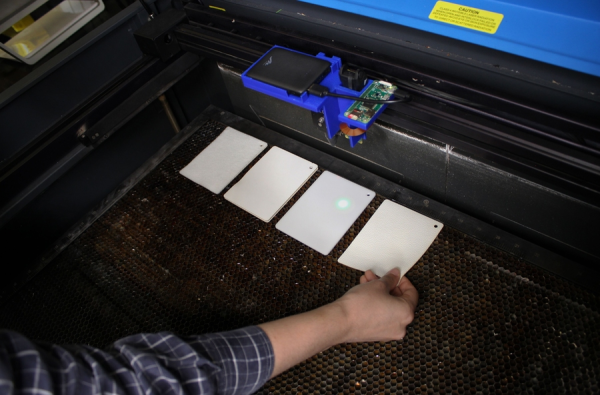
Squares of sample materials placed on the laser bed awaiting the sensing head

Smart Laser Cutter Ad-on Detects Material Optically

Come on now, admit it. You’ve done it. We’ve done it. You know — you were really sure that sheet of plastic stock you found lying around the hackerspace was acrylic right? You dialled in the settings, loaded the design, set the focus and pushed the little green ‘start’ button. Lots of black smoke, fire, and general badness ensued as you lunged for the red ‘stop’ button, before lifting the lid to work out how you’re going to clean this one up.

That was not acrylic. That was polycarbonate.

What you need is the latest gadget from MIT: SensiCut: A smart laser cutter system that detects different materials automatically.

The technique makes use of so-called ‘speckle imaging’ where a material illuminated by a laser will produce a unique pattern of reflected spots, or speckles into a camera. By training a deep neural model with a large set of samples, it was found possible to detect up to 30 types of material with 98% accuracy.

The pre-baked model runs on a Raspberry PI zero with an off-the-shelf camera all powered from a power bank. This allows the whole assembly to simply drop onto an existing laser cutter head, with no wiring needed.

Even if you’re a seasoned laser cutter user, with a well-controlled stock pile, the peace-of-mind this could give would definitely be worth the effort. A more detailed description and more videos may be found by reading the full paper. Here’s hoping they release the system as open source, one day in the not-to-distant future. If not, then, you know what to do :)

Continue reading “Smart Laser Cutter Ad-on Detects Material Optically”

New Part Day: DLP300s The Next Big Thing For Low Cost Resin Printing?

The majority of non-SLA resin 3D printers, certainly at the hacker end of the market, are most certainly LCD based. The SLA kind, where a ultraviolet laser is scanner via galvanometers over the build surface, we shall consider no further in this article.

What we’re talking about are the machines that shine a bright ultraviolet light source directly through a (hopefully monochrome) LCD panel with a 2, 4 or even 8k pixel count. The LCD pixels mask off the areas of the resin that do not need to be polymerised, thus forming the layer being processed. This technique is cheap and repeatable, hence its proliferance at this end of the market.

They do suffer from a few drawbacks however. Firstly, optical convergence in the panel causes a degree of smearing at the resin interface, which reduces effective resolution somewhat. The second issue is one of thermal control – the LCD will transmit less than 5% of the incident light, so for a given exposure at the resin, the input light intensity needs to be quite high, and this loss in the LCD results in significant internal heating and a need for active cooling.  Finally, the heating in the LCD combined with intense UV radiation degrades the LCD over time, making the LCD itself a consumable item.

Continue reading “New Part Day: DLP300s The Next Big Thing For Low Cost Resin Printing?”

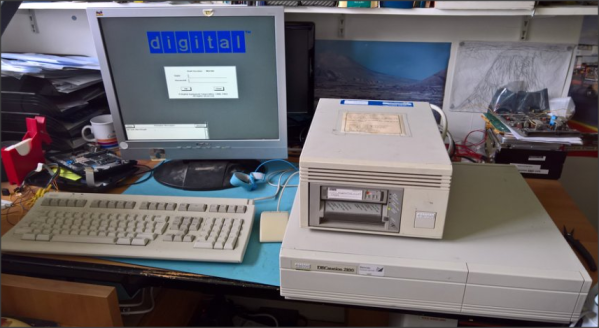
DEC microVAX with tape drive

Bake It To ReMake It: Cooking Old Magnetic Tape To Recover Data

Those of us old enough may remember the heyday of the text adventure game genre from the first time around. London-based Magnetic Scrolls was an early pioneering company producing titles for the first Amiga and Atari ST platforms. Fast-forward to 2017 and [Hugh Steers], the original co-founder and core developer for Magnetic Scrolls has formed an initiative to revive and re-release the original games on modern platforms. Since the 1980s-era DEC MicroVAX used originally for development is not particularly rare in retro computing circles, and media containing source code was found in someone’s loft space, reviving the games was not a tall order.

First, he needed to recover a copy of the original source code from the backup tapes. But there was a problem, it turns out that the decaying tapes used a unstable polyurethane-based binder to stick the oxide material (which is what stores the data) to the backing tape, and this binder can absorb water over the years.

Not much happens until you try to read the tape, then you trip over the so-called sticky-shed syndrome. Secondly you may find that a small amount of the oxide layer sheds from the tape, coating the read head, rollers and guides inside the complicated tape mechanism. This quickly results in it gumming up, and jamming, potentially chewing up the tape and destroying it permanently.

This was further exacerbated by the behaviour of the DEC TK50Z tape drive, which needed to shuttle the whole length of the tape as part of its normal operation.

A temporary solution was to bake the tape in an oven to drive out the moisture and reduce the stickiness enough to run it through the drive safely. Then only the oxide-shedding problem remained. The TK50Z drive was swapped for a TZ30 which shuttles the tape less, but also critically with a simple hack, would allow the heads to be cleaned with IPA between read passes. This was enough to keep the gumming up at bay and allow enough data to be read from the tapes to recover several games worth of code, ready for the re-releasing process.

The video after the break shows [Rob Jarratt] working through the process of the data recovery.

Continue reading “Bake It To ReMake It: Cooking Old Magnetic Tape To Recover Data”

Can Metal Plated 3D Prints Survive 400,000 Volts?

It appears they can. [Ian Charnas] wanted his very own Thor Hammer. He wasn’t happy to settle on the usual cosplay methods of spray painting over foam and similar flimsy materials. He presents a method for nickel plating onto a 3D printed model, using conductive nickel paint to prepare the plastic surface for plating. In order to reduce the use of hazardous chemistry, he simplifies things to use materials more likely to be found in the kitchen.

As the video after the break shows, [Ian] went through quite a lot of experimentation in order to get to a process that would be acceptable to him. As he says, “after all, if something is worth doing, it’s worth over-doing” which is definitely a good ethos to follow. Its fairly hard to plate metals and get a good finish, and 3D printed objects are by their nature, not terribly smooth. But, the effort was well rewarded, and the results look pretty good to us.

But what about the 400 kV I hear you ask? Well, it wouldn’t be Thor’s hammer, without an ungodly amount of lightning flying around, and since [Ian] is part of a tesla coil orchestra group, which well, it just kinda fell into place. After donning protective chainmail to cover his skin, he walks straight into the firing line of a large pair of musical tesla coils and survives for another day. Kind of makes his earlier escapade with jet-powered roller skates look mundane by comparison.

Continue reading “Can Metal Plated 3D Prints Survive 400,000 Volts?”