New Video Series: Learning Antenna Basics With Karen Rucker

We don’t normally embrace the supernatural here at Hackaday, but when the topic turns to the radio frequency world, Arthur C. Clarke’s maxim about sufficiently advanced technology being akin to magic pretty much works for us. In the RF realm, the rules of electricity, at least the basic ones, don’t seem to apply, or if they do apply, it’s often with a, “Yeah, but…” caveat that’s sometimes hard to get one’s head around.

Perhaps nowhere does the RF world seem more magical than in antenna design. Sure, an antenna can be as simple as a straight piece or two of wire, but even in their simplest embodiments, antennas belie a complexity that can really be daunting to newbie and vet alike. That’s why we were happy to recently host Karen Rucker’s Introduction to Antenna Basics course as part of Hackaday U.

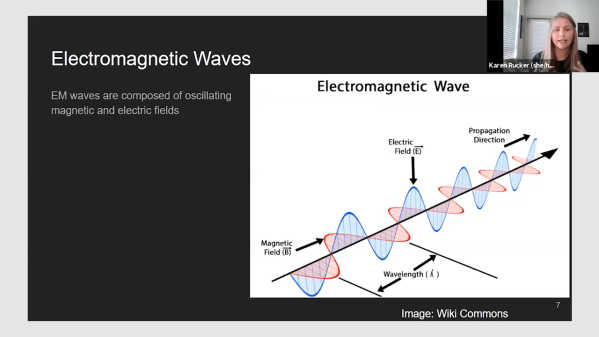
The class was held over a five-week period starting back in May, and we’ve just posted the edited videos for everyone to enjoy. The class is lead by Karen Rucker, an RF engineer specializing in antenna designs for spacecraft who clearly knows her business. I’ve watched the first video of the series and so far and really enjoy Karen’s style and the material she has chosen to highlight; just the bit about antenna polarization and why circular polarization makes sense for space communications was really useful. I’m keen to dig into the rest of the series playlist soon.

The 2021 session of Hackaday U may be wrapped up now, but fear not — there’s plenty of material available to look over and learn from. Head over to the course list on Hackaday.io, pick something that strikes your fancy, and let the learning begin!

Continue reading “New Video Series: Learning Antenna Basics With Karen Rucker”

Black Starts: How The Grid Gets Restarted

Gripped as we are at the time of this writing by a historic heatwave, it’s hard for those of us in the western United States to picture a time when cold and ice reigned across the land. But really, it was only about four months back that another bit of freakish weather was visited across most of the country, including places ill-equipped to deal with the consequences. The now-fabled “February Freeze” left millions, mostly in Texas, scrabbling about in the dark and cold as a series of cascading engineering failures took apart their electrical grid, piece by piece, county by county.

The event has been much discussed and dissected, as an event with such far-reaching impact should be. Like much discussion these days, precious little of it is either informed or civil, and that’s not good news for those seeking to understand what happened and how to prevent it from happening again, or at least to mitigate the effects somewhat. Part of that is understandable, given the life-disrupting and often life-threatening situations the disaster forced people to suddenly face. It’s also difficult for people to discuss an event so widespread in its scope and impact — there’s just too much for anyone to wrap their head around.

To make the present discussion a little easier, we’ll be focusing on one aspect of the February grid crash that’s often bandied about but rarely explained: that the Texas grid was mere minutes away from collapsing completely, and that it would have taken weeks or months to restore had it been able to slip away. Is that really possible? Can the power grid just “go away” completely and suddenly? The answer, sadly, is yes, but thankfully a lot of thought has been put into not only preventing it from happening but also how to restart everything if it does happen, by performing what’s known as a “Black Start.”

Continue reading “Black Starts: How The Grid Gets Restarted”

Retrotechtacular: The Secret Life Of The Electric Light

Normally, when we pick out something to carry the “Retrotechtacular” banner, it’s a film from the good old days when technology was young and fresh, and filmmakers were paid by one corporate giant or another to produce a film extolling the benefits of their products or services, often with a not-so-subtle “celebrate the march of progress” undertone.

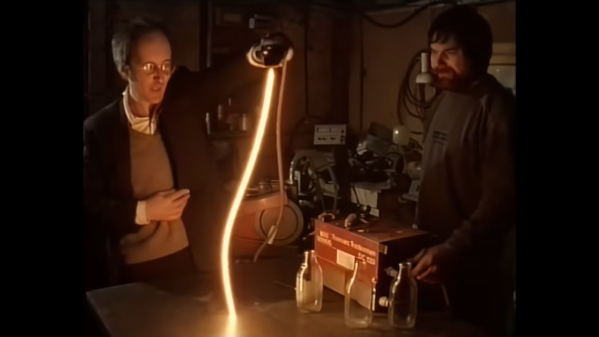
So when we spied this remastered version of The Secret Life of the Electric Light an episode from [Tim Hunkin]’s fabulous educational The Secret Life of Machines TV series, we didn’t really think it would be good Retrotechtacular fodder. But just watching a few minutes reminded us of why the series was must-see TV back in the 1990s (when it first aired widely here in the States), especially for the budding geek. When viewed with eyes more used to CGI animations and high production values, what [Tim] and his collaborator, the late [Rex Garrod], accomplished with each of these programs is truly astounding. Almost every bit of the material, as well as the delivery, has an off-the-cuff quality to it that belies what must have taken an enormous amount of planning and organization to pull off. [Tim] and [Rex] obviously went to a lot of trouble to make it look like they didn’t go to a lot of trouble, and the result is films that home in on the essentials of technology in a way few programs have ever managed, and none since. And the set-piece at the end of each episode — often meeting its pyrotechnic destruction — always were real crowd-pleasers. They still are.

We have to say the remastered versions of The Secret Life episodes, all of which appear to be posted at [Tim]’s YouTube channel, look just great, and the retrospectives at the end of each episode where he talks about the travails of production are priceless. Also posted are his more recent The Secret Life of Components, which is a treasure trove of practical tips for makers and backyard engineers that’s well worth watching too.

Continue reading “Retrotechtacular: The Secret Life Of The Electric Light”

SCADA Security Hack Chat

Join us on Wednesday, July 14 at noon Pacific for the SCADA Security Hack Chat with Éireann Leverett!

As a society, we’ve learned a lot of hard lessons over the last year and a half or so. But one of the strongest lessons we’ve faced is the true fragility of our infrastructure. The crumbling buildings and bridges and their tragic consequences are one thing, but along with attacks on the food and energy supply chains, it’s clear that our systems are at the most vulnerable as their complexity increases.

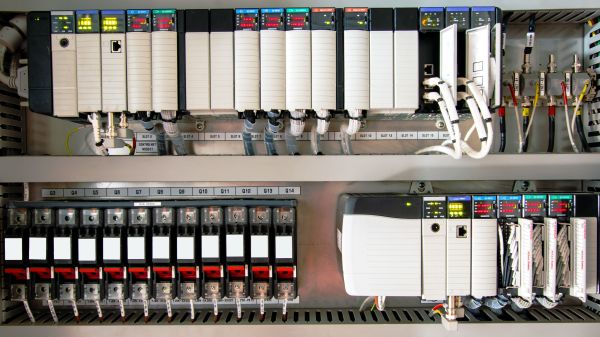
And boy are we good at making complex systems. In the United States alone, millions of miles of cables and pipelines stitch the country together from one coast to the other, much of it installed in remote and rugged places. Such far-flung systems require monitoring and control, which is the job of supervisory control and data acquisition, or SCADA, systems. These networks have grown along with the infrastructure, often in a somewhat ad hoc manner, and given their nature they can be tempting targets for threat actors.

Finding ways to secure such systems is very much on Éireann Leverett’s mind. As a Senior Risk Researcher at the University of Cambridge, he knows about the threats to our infrastructure and works to find ways to mitigate them. His book Solving Cyber Risk lays out a framework for protecting IT infrastructure in general. For this Hack Chat, Éireann will be addressing the special needs of SCADA systems, and how best to protect these networks. Drop by with your questions about infrastructure automation, mitigating cyber risks, and what it takes to protect the endless web of pipes and wires we all need to survive.

join-hack-chatOur Hack Chats are live community events in the Hackaday.io Hack Chat group messaging. This week we’ll be sitting down on Wednesday, July 14 at 12:00 PM Pacific time. If time zones have you tied up, we have a handy time zone converter.

Hackaday Links Column Banner

Hackaday Links: July 11, 2021

Well, at least the acronym will stay the same. It looks like black is the new blue for Windows 11, as the BSOD screen gets its first makeover in years. It’s an admittedly minor change, since the on-screen text is virtually identical to the BSOD from recent versions of Windows 10, and the new death-knell even sports the same frowny-face emoji and QR code. Really, the white-on-black color scheme is the only major difference we can see — even the acronym will stay the same. It’s not really that newsworthy, we suppose, although it does make us miss the extremely busy BSODs from back in the Windows NT days.

As the semiconductor shortage continues, manufacturers are getting desperate to procure the parts they need to make their products. And if there’s one thing as certain as death and taxes, it’s that desperation provides opportunity to criminals. A thread over on EEVBlog details an encounter one company had with an alleged scammer, who sent an unsolicited offer to them for a large number of ordinarily hard-to-find microprocessors at a good price. Wisely, the company explored the offer in some depth and found that “Brian” (the representative who contacted them) is actually named Nick Martin and, according to an article on the Electronic Resellers Association International (ERAI) website, is apparently associated with a number of fraudulent operations. Their list of allegedly fraudulent deals made by Mr. Martin stretches back to 2018 and totals over $300,000 of ill-gotten gain.

Last year, friend-of-Hackaday and laser artist Seb Lee-Delisle spent a lot of time and effort getting together an amazing interactive laser light show for the night skies of cities in the UK. Laser Light City, with powerful lasers mounted on the tops of tall buildings, was a smashing success that brought a little cheer into what was an otherwise dreadful time. But we have to admit that the videos and other materials covering Laser Light City left us wanting more — something like that, with a far-flung installation on rooftops and the ability for audience members to control it all from their phone, really needs a deeper “how it works” treatment. Thankfully, Seb has released a video that dives into the nuts and bolts of the show, including a look at ludicrously powerful lasers with beams that can still be seen in broad daylight.

Continue reading “Hackaday Links: July 11, 2021”

Home Automation For Fans Of Quick-and-Dirty Solutions

At Hackaday, we celebrate all kinds of projects, but we’ll have to admit that the polished and professional-looking builds tend to catch our eye a lot more than perhaps they should. There’s plenty of love to be had for the rougher builds, though, of which this quick-and-dirty home automation system is a perfect example.

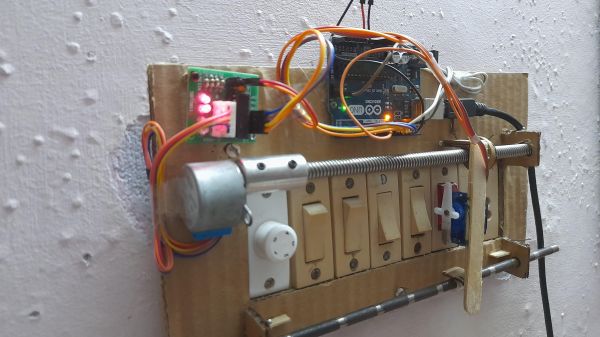
Before anyone rushes to state the obvious with, “Should have used some relays,” consider that [MAKE_IT_WITH_ME]’s stated goal was to get the basics of a home automation system built with pretty much nothing but what can be found in one of those Arduino starter kits. And further, consider that landlords might not look kindly on tenants who wire a bunch of SSRs or Sonoff switches into the walls of their building. So this minimalist build is perfect for certain use cases. Its interface to the building’s electrical system is 100% mechanical, via a servo that travels along the bank of switches on a stepper-driven leadscrew. The servo has a modified horn to properly flick the rocker-style switches, and although changing from switch to switch is a bit slow, it works surprisingly well. The video below shows it in action.

While we can see it possibly working as-is for Decora-style switches that are seen in some markets, we’d think some mods would be in order for the more standard toggle-style switch — perhaps a finger extending out from the horn, along with a second servo to tilt the whole assembly away from the wall to allow it to clear the switch bats.

Continue reading “Home Automation For Fans Of Quick-and-Dirty Solutions”

C64 Demo, No C64

Never underestimate the ingenuity of the demoscene. The self-imposed limitations lead to incredible creativity, and, the range of devices they manage to get their demos running on never ceases to amaze us. But we never thought we’d see a C64 demo without one central component: the C64.

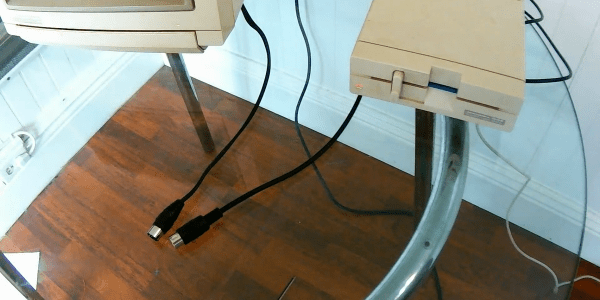
Full disclosure: [Matthias Kramm]’s demo, called “Freespin”, does need a C64 to get started. The venerable 6502-based computer runs a loader program on a 1541 disk drive.  But from then on, it’s all floppy drive. And [Matthias] has laid bare all his tricks.

The video below shows the demo in full, including a heart-stopping on-camera cable mod. By adding a single 100 Ω resistor, [Matthias] turned the serial clock and data lines into a two-bit digital-to-analog converter, good enough to generate signals for both black and white pixels and the sync pulses needed for the display.

No demo would be complete without sound, and Freespin’s tunes come from controlling the drive’s stepper motor, like a one-voice Floppotron.

Watching nothing but a floppy drive run a cool demo is pretty amazing. Yes, we know there’s a full-fledged computer inside the floppy, but the bit-banging needed to make this work was still mighty impressive. It might be cool to see what you could do with multiple drives, but we understand the minimalistic aesthetic as well. And speaking of tiny little demos:  the 256 bytes of [HellMood]’s “Memories” or [Linus Åkesson]’s “A Mind is Born” still leave us speechless.

Continue reading “C64 Demo, No C64”