Ingenuity Completes Fourth Flight On Mars, Gets A New Mission

It’s the same on Mars as it is here — just when you’re getting used to your job, the bosses go and change things up.

At least that’s our read on the situation at Jezero crater, where the Mars Ingenuity helicopter has just had its mission upgraded and extended. In a Friday morning press conference, the Ingenuity flight team, joined by members of the Perseverance team and some NASA brass, made the announcement that Ingenuity had earned an extra 30 sols of flight time, and would be transitioned from a mere “technology demonstrator” to an “operations demonstration” phase. They also announced Ingenuity’s fourth flight, which concluded successfully today, covering 266 meters and staying airborne for 117 seconds.

Continue reading “Ingenuity Completes Fourth Flight On Mars, Gets A New Mission”

Homemade EDM Machine Moves From Prototype To Production

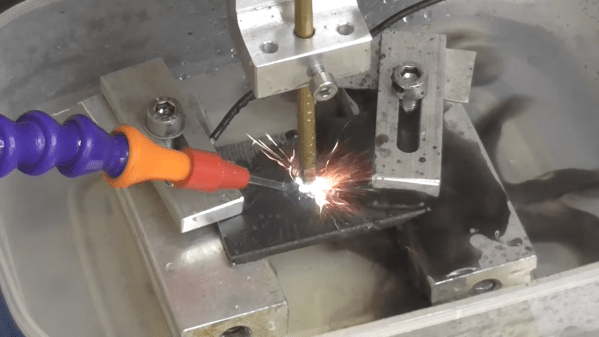
Of all the methods of making big pieces of metal into smaller pieces of metal, perhaps none is more interesting than electrical discharge machining. EDM is also notoriously fussy, what with having to control an arc discharge while precisely positioning the tool relative to the workpiece. Still, some home gamers give it a whirl, and we love to share their successes, like this work-in-progress EDM machine. (Video, embedded below.)

We’ve linked [Andy]’s first videos below the break, and we’d expect there will be a few more before all is said and done. But really, for being fairly early in the project, [Andy] has made a lot of progress. EDM is basically using an electric arc to remove material from a workpiece, but as anyone who has unintentionally performed EDM on, say, a screwdriver by shorting it across the terminals in a live outlet box, the process needs to be controlled to be useful.

Part 1 shows the start of the build using an old tap burning machine, a 60-volt power supply, and a simple pulse generator. This was enough to experiment with the basics of both the mechanical control of electrode positioning, and the electrical aspects of getting a sustained, useful discharge. Part 2 continues with refinements that led very quickly to the first useful parts, machined quickly and cleanly from thin stock using a custom tool. We’ll admit to being impressed — many EDM builds either never get to the point of making simple holes, or stop when progressing beyond that initial success proves daunting. Of course, when [Andy] drops the fact that he made the buttons for the control panel on his homemade injection molding machine, one gets the feeling that anything is possible.

We’re looking forward to more on this build. We’ve seen a few EDM builds before, but none with this much potential.

Continue reading “Homemade EDM Machine Moves From Prototype To Production”

Alone, But Not Lonely: Remembering Astronaut Michael Collins

With many of the achievements of the Space Race now more than half a century behind us, it’s no wonder that we’re steadily losing the men who rode the rockets of the Mercury, Gemini, and Apollo programs into space. They were all very much in their primes at the time, but no matter what you’ve accomplished in life, even if it includes a trip to the Moon, time eventually catches up to you.

Still, it was quite a shock to learn today that astronaut Michael Collins passed away today at the age of 90. Collins made his trip to the Moon aboard Apollo 11, the mission which would see his crewmates Neil Armstrong and Edwin “Buzz” Aldrin descend to the surface in the Lunar Module Eagle and take the historic first steps on its surface in July of 1969.

Continue reading “Alone, But Not Lonely: Remembering Astronaut Michael Collins”

Clever Gas Mixer Gets Just The Right Blend For Homebrew Laser Tubes

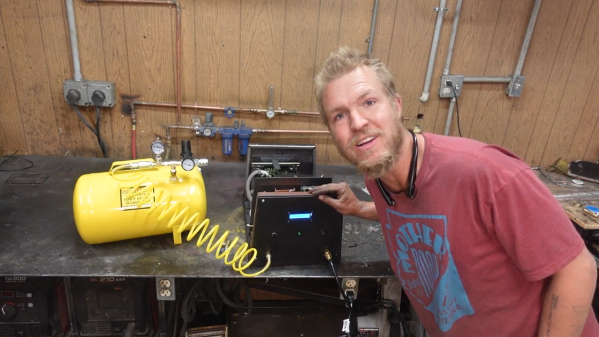
[Lucas] over at Cranktown City on YouTube has been very busy lately, but despite current appearances, his latest project is not a welder. Rather, he built a very clever gas mixer for filling his homemade CO2 laser tubes, which only looks like a welding machine. (Video, embedded below.)

We’ve been following [Lucas] on his journey to build a laser cutter from scratch — really from scratch, as he built his own laser tube rather than rely on something off-the-shelf. Getting the right mix of gas to fill the tube has been a bit of a pain, though, since he was using a party balloon to collect carbon dioxide, helium, and nitrogen at measuring the diameter of the ballon after each addition to determine the volumetric ratio of each. His attempt at automating the process centers around a so-called AirShim, which is basically a flat inflatable bag made of sturdy material that’s used by contractors to pry, wedge, lift, and shim using air pressure.

[Lucas]’ first idea was to measure the volume of gas in the bag using displacement of water and some photosensors, but that proved both impractical and unnecessary. It turned out to be far easier to sense when the bag is filled with a simple microswitch; each filling yields a fixed volume of gas, making it easy to figure out how much of each gas has been dispensed. An Arduino controls the pump, which is a reclaimed fridge compressor, monitors the limit switch and controls the solenoid valves, and calculates the volume of gas dispensed.

Judging by the video below, the mixer works pretty well, and we’re impressed by its simplicity. We’d never seriously thought about building our own laser tube before, but seeing [Lucas] have at it makes it seem quite approachable. We’re looking forward to watching his laser project come together.

Continue reading “Clever Gas Mixer Gets Just The Right Blend For Homebrew Laser Tubes”

Boat Anchor Nixie Clock Plays The Cold Warrior Role Convincingly

The early Cold War years may have been suffused with existential dread thanks to the never-ending threat of nuclear obliteration, but at least it did have a great look. Think cars with a ton of chrome, sheet steel toys with razor-sharp edges, and pretty much the entire look of the Fallout franchise. And now you can add in this boat anchor of an electromechanical Nixie clock, too.

If [Teti]’s project looks familiar, perhaps it’s because the build was meant as an homage to the test equipment of yore, particularly some of the sturdier offerings from Hewlett-Packard. But this isn’t some thrift store find that has been repurposed; rather, the entire thing, from the electronics to the enclosure, is scratch built. The clock circuit is based on 4000-series CMOS chips and the display uses six IN-1 Nixies. Instead of transistors to drive the tubes, [Teti] chose to use relays, which in the video below prove to be satisfyingly clicky and relaxing. Not relaxing in any way is the obnoxious alarm, which would be enough to rouse a mission control officer dozing in his bunker. [Teti] has a blog with more details on the build, the gem of which is information on how he had the front panel so beautifully made.

We can’t say enough about the fit and finish of this one, as well as the functionality. What’s even more impressive is that this was reportedly [Teti]’s first project like this. It really puts us in mind of some of the great 6502 retrocomputer builds we’ve been seeing lately.

Continue reading “Boat Anchor Nixie Clock Plays The Cold Warrior Role Convincingly”

3D-Printed Laser Scanning Confocal Microscope Measures Microns

When one thinks about microscopy, it seems to be mostly qualitative. Looking at a slide teeming with bacteria or protozoans is less about making measurements and more about recognizing features and describing their appearance. Not all microscopes are created equal, though, with some being far more optimized for making fine measurements of the microscopic realm.

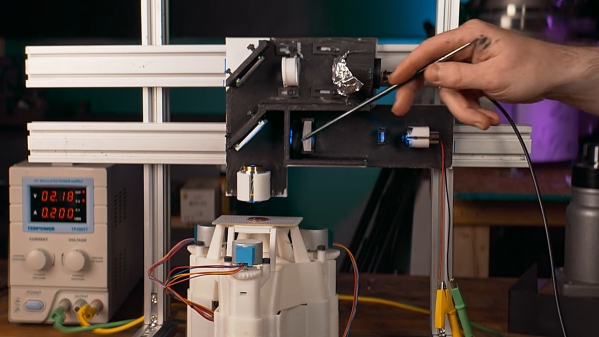
This 3D-printed confocal laser scanning microscope is a good example of an instrument for measuring really small stuff. As [Zachary Tong] points out, confocal scanning microscopy uses a clever optical setup to collect light from a single, well-defined point within a sample; rather than getting an image of all the points within a two-dimensional focal plane, the scanning function moves the focal point around through the sample in three dimensions, capturing spatial data to go along with the optical information.

The stage of [Zach]’s microscope is based on OpenFlexure’s Delta Stage, an open-source, 3D-printed delta-bot motion control platform that’s capable of positioning samples with sub-micron precision. Above the stage are the deceptively simple optics, with a laser diode light source, an objective lens, and a photodiode detector behind a pinhole. The detector feeds a homebrew trans-impedance amplifier that captures data at millions of points as the sample is moved through a small three-dimensional space. All that data gets crunched to find the Z-axis position corresponding to the maximum intensity at each point.

It takes a while to gather all this data — up to several days for even a small sample — but it works pretty well. [Zach] already has some ideas for reducing noise and speeding up the scan time; perhaps a stage based on DVD parts like this one would be faster than the delta stage. We look forward to seeing his improvements.

Continue reading “3D-Printed Laser Scanning Confocal Microscope Measures Microns”

Hackaday Links Column Banner

Hackaday Links: April 25, 2021

There’s much news from the Jezero Crater on Mars this week, and all of it was good. Not only did the Ingenuity helicopter make history by making the first powered, controlled flight of an aircraft on another planet, it made a second longer, more complex flight just a couple of days later. This time, the autonomous rotorwing craft flew to a higher altitude than the maiden flight, hovered for a bit longer, and made a lateral move before landing safely again on the surface. Three more flights of increasing complexity (and risk) are scheduled over the next two weeks, with the next set to happen early Sunday morning. I have to admit that even though the Ingenuity tech demonstration seemed a little like a publicity stunt when I first heard about it, especially when compared to the Perseverance’s main mission of searching for evidence of life on Mars, the Ingenuity team’s successes have made a believer out of me.

Speaking of technology demonstrations, NASA fired up the MOXIE experiment aboard Perseverance for the first time. Intended to explore the possibility of producing oxygen from the thin carbon dioxide-rich Martian atmosphere, the Mars Oxygen In-Situ Resource Utilization Experiment made about 5.4 grams of oxygen total at a rate of about 6 grams an hour. We detailed the technology MOXIE uses, called solid-oxide electrolysis, which depends on a scandium-stabilized zirconium oxide ceramic electrolyte to strip the oxygen from superheated carbon dioxide using an electric current. Should the technology prove itself over the planned total of ten MOXIE runs over the next few months, a scaled up version of the device could someday land on Mars and produce the estimated 55 metric tons of oxygen needed to fuel a return trip from a crewed mission.

By now we’ve all heard about the global semiconductor shortage, or perhaps felt the pinch ourselves while trying to procure parts for a build. It’s easy to count the crunch as yet another follow-on from the COVID-19 shutdowns and the logistics woes the pandemic begat, so one might have hope that with lockdowns easing up around the world, the shortage will soon be over as manufacturers ramp up production. But not so fast — it looks like the machines needed to make the chips are the latest victims of the shortage. According to Nikkei Asia, wire bonding machines, wafer dicers, and laser drilling machines are all in short supply, with orders for new machines booked out for a year. Like toilet paper this time last year, chip makers are hoarding machines, ordering 50 or 100 of them at a time, in the hopes of having enough to meet production goals. And when machines are available, travel restrictions are making it difficult to get on-site installation and support from factory reps. The bottom line — this isn’t over yet, not by a long shot.

We all know the Stack Overflow memes, and few of us who are being honest haven’t squirmed a bit when thinking about just how screwed we’d be without being able to copy a bit of code to get us past that rough part in a project. But just how often do people copy code from Stack Overflow? Quite a lot, actually, if SO’s analysis of the use of copy commands on their pages is to be believed. For two weeks, SO monitored the number of times the Ctrl-C (or Command-C, if that’s your jam) key combination was pressed. They toted up over 40 million copies, most often from the answers to questions and almost always from the code blocks within them. We suppose none of this is exactly unexpected — memes are memes for a reason, after all — but what we found surprising is that one in four visitors to Stack Overflow copied something within five minutes of loading a page. Being charitable, we’d say the speed with which coders accept someone else’s work is an indication that maybe they were almost at an answer themselves and just needed a little reminder. On the other hand, it could be a sign of separation driving them to get something working.

And finally, while we know we’ve recommended videos from Grady at Practical Engineering recently, we couldn’t help but plug another of his videos as a must-watch. This time, Grady tackles the Suez Canal blockage, and he presents it in the same dispassionate, informed way that he previously handled the engineering roots of the Texas blackouts. If you think the Ever Given grounding was just a case of poor seamanship, think again — Grady makes a compelling case for possible hydrodynamic causes of the incident, including “squatting” and the bank effect. He also speculates on the geotechnical forces that held the ship fast, in the process of which he helpfully introduces the concept of dilatancy and how it explains the way your feet seem to “dry out” a zone around them as you walk across the beach.

Continue reading “Hackaday Links: April 25, 2021”