Manual Antenna Tuner Shows How Homebrewing Is Done

If there’s anything about amateur radio that has more witchcraft in it than the design and implementation of antennas, we don’t know what it would be. On the face of it, hanging out a chunk of wire doesn’t seem like it should be complicated, but when you dive into the details, building effective antennas and matching them to the job at hand can be pretty complex.

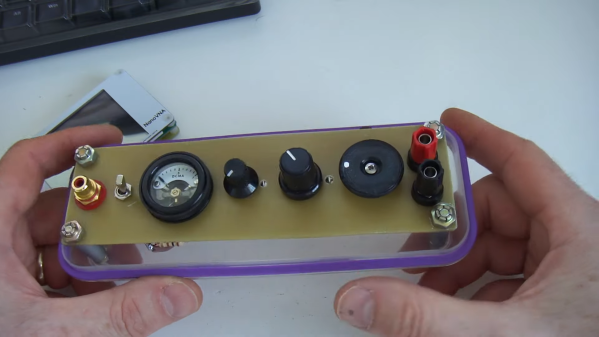
That doesn’t mean antenna topics have to remain a total mystery, of course, especially once someone takes the time to explain things properly. [Charlie Morris (ZL2CTM)] recently did this with a simple antenna tuner, a device used to match impedances between a transmitter and an antenna. As he explains in the first video below, his tuner design is really just a Wheatstone bridge where the antenna forms half of one leg. A toroidal transformer with multiple taps and a variable capacitor forms an LC circuit that matches the high impedance antenna, in this case a multi-band end-fed halfwave, with the nominal 50-ohm load expected by the transceiver. A small meter and a diode detector indicate when the bridge is balanced, which means the transceiver is seeing the proper load.

The second video below shows the final implementation of the tuner; as a fan of QRP, or low-power operation, [Charlie] favors simple, lightweight homebrew gear that can be easily taken into the field, and this certainly fits the bill. A final video shows the tuner in use in the field, with a NanoVNA proving what it can do. As usual, [Charlie] protests that he not an expert and that he’s just documenting what he did, but he always does such a good job of presenting the calculations involved in component selection that any ham should be able to replicate his builds.

Continue reading “Manual Antenna Tuner Shows How Homebrewing Is Done”

Beam Dump Makes Sure Your Laser Path Is Safely Terminated

Between hot things, sharp things, and spinny things, there’s more than enough danger in the average hacker’s shop to maim and mutilate anyone who fails to respect their power. But somehow lasers don’t seem to earn the same healthy fear, which is strange considering permanent blindness can await those who make a mistake lasting mere fractions of a second.

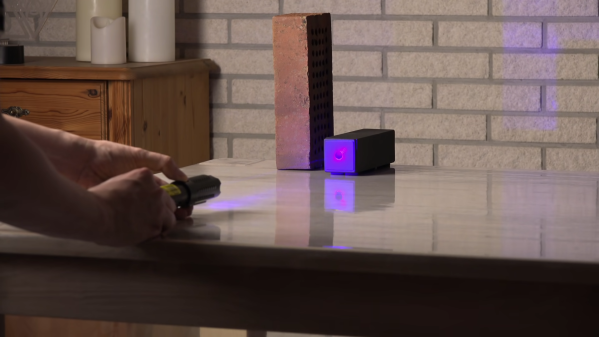
To avoid that painful fate, high-power laser fan [Brainiac75] undertook building a beam dump, which is a safe place to aim a laser beam in an experimental setup. His version has but a few simple parts: a section of extruded aluminum tubing, a couple of plastic end caps, and a conical metal plumb bob. The plumb bob gets mounted to one of the end caps so that its tip points directly at a hole drilled in the center of the other end cap. The inside and the outside of the tube and the plumb bob are painted with high-temperature matte black paint before everything is buttoned up.

In use, laser light entering the hole in the beam dump is reflected off the surface of the plumb bob and absorbed by the aluminum walls. [Brainiac75] tested this with lasers of various powers and wavelengths, and the beam dump did a great job of safely catching the beam. His experiments are now much cleaner with all that scattered laser light contained, and the work area is much safer. Goggles still required, of course.

Hats off to [Brainiac75] for an instructive video and a build that’s cheap and easy enough that nobody using lasers has any excuse for not having a beam dump. Such a thing would be a great addition to the safety tips in [Joshua Vasquez]’s guide to designing a safe laser cutter.

Continue reading “Beam Dump Makes Sure Your Laser Path Is Safely Terminated”

Vertical Mill Completes Scrapyard Lathe Build

One thing’s for sure: after seeing [Roland Van Roy] build a vertical mill from industrial scrap, we’ve got to find a better quality industrial scrapyard to hang around.

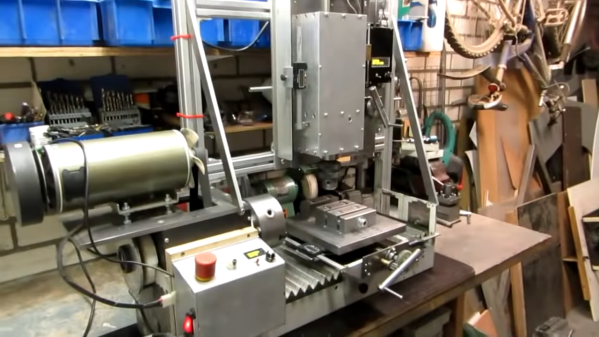
The story of this build started, as many good shop stories do, at the lathe, which in this case was also a scrapyard build that we somehow managed to miss when it first posted. This lathe is decidedly different from the common “Gingery method” we’ve seen a few times, which relies on aluminum castings. Instead, [Roland] built his machine from plate stock, linear slides, and various cast-off bits of industrial machines.

To make his lathe yet more useful, [Roland] undertook this build, which consists of a gantry mounted over the bed of the lathe. The carriage translates left and right along the bed while the spindle, whose axis lines up perfectly with the center axis of the lathe, moves up and down. [Roland] added a platform and a clever vise to the lathe carriage; the lathe tool post and the tailstock are removed to make room for these mods, but can be added back quickly when needed. Digital calipers stand in for digital read-outs (DROs), with custom software running on a Picaxe and a homebrew controller taking care of spindle speed control.

[Roland] reports that the machine, weighing in at about 100 kg, exhibits a fair amount of vibration, which limits him to lighter cuts and softer materials. But it’s still an impressive build, and what really grabbed us was the wealth of tips and tricks we picked up. [Roland] used a ton of interesting methods to make sure everything stayed neat and square, such as the special jig he built for drilling holes in the T-slot extrusions to the use of cyanoacrylate glue for temporary fixturing.

Continue reading “Vertical Mill Completes Scrapyard Lathe Build”

Ask Hackaday: What’s In Your Fastener Bin?

A Saturday afternoon. The work week was done, the household chores were wrapped up, and with almost a week left until Christmas, there was just enough wiggle room to deny that there was still a ton of work left to prepare for that event. It seemed like the perfect time to escape into the shop and knock out a quick project, one that has been on the back burner since at least March. I’m nothing if not skilled in the ways of procrastination.

This was to be a simple project — adding an aluminum plate to a plastic enclosure that would serve as an antenna entry point into my shack. Easy as pie — cut out an rectangle of aluminum, cut and drill a few holes, call it a day. Almost all of my projects start out that way, and almost every time I forget that pretty much every one of those builds goes off the rails at exactly the same point: when I realize that I don’t have the fasteners needed. That’s what happened with this build, which had been going swimmingly up to that point — no major screw-ups, no blood drawn. And so it was off to the hardware store I trundled, looking for the right fasteners to finish the job.

Finding hardware has long been where my productivity goes to die. Even though I live a stone’s throw from at least half a dozen stores, each with a vast selection of hardware and most open weekends and nights, the loss of momentum that results from changing from build-mode to procure-mode has historically been deadly to my projects. I’m sure I’m not the only one who has run into this issue, so the question is: what can a hacker do to prevent having to run out for just the right fasteners?

Continue reading “Ask Hackaday: What’s In Your Fastener Bin?”

Plant Communication Hack Chat

Join us on Wednesday, January 13th at noon Pacific for the Plant Communication Hack Chat with Lex Kravitz!

As far as conversation goes, plants are usually a pretty poor choice of partners. Sure, we’ve all heard that talking to you houseplants is supposed to be good for them, but expecting them to talk back in any meaningful way is likely to end in disappointment.

Or is it? For as simple and inanimate as plants appear to be, they actually have a rich set of behaviors. Plants can react to stimuli, moving toward attractants like light and nutrients and away from repellents. Some trees can secrete substances to prevent competitors crowding around them, by preventing their seedlings from ever even taking root. And we’ve known for a long time that plants can communicate with each other, through chemical signaling.

Plants are clearly capable of much more than just sitting there, but is there more to the story? Neuroscientist Lex Kravitz thinks so, which is why he has been wiring up his houseplants to sensitive amplifiers and looking for electrical signals. While the bulk of what we know about plant communications is centered on the chemical signals they send, it could be that there’s an electrical component to their behaviors too. Join us as Lex stops by the Hack Chat to talk about his plant communication experiments, and to see if it may someday be possible to listen in on what your plants are saying about you.

join-hack-chatOur Hack Chats are live community events in the Hackaday.io Hack Chat group messaging. This week we’ll be sitting down on Wednesday, January 13 at 12:00 PM Pacific time. If time zones have you tied up, we have a handy time zone converter.

Click that speech bubble to the right, and you’ll be taken directly to the Hack Chat group on Hackaday.io. You don’t have to wait until Wednesday; join whenever you want and you can see what the community is talking about.

Continue reading “Plant Communication Hack Chat”

Laser Blasts Out High-Quality PCBs

With how cheap and how fast custom PCBs have gotten, it almost doesn’t make sense to roll your own anymore, especially when you factor in the messy etching steps and the less than stellar results. That’s not the only way to create a PCB, of course, and if you happen to have access to a 20-Watt fiber laser, you can get some fantastic homemade PCBs that are hard to tell from commercial boards.

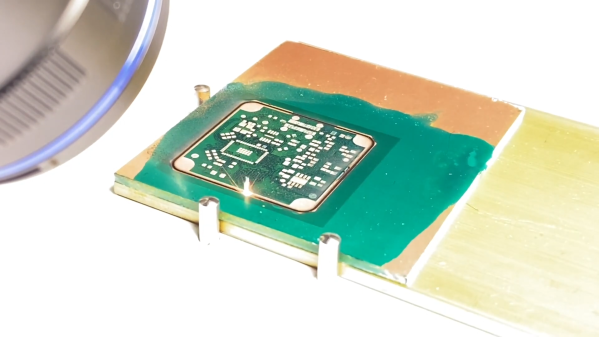
Lucikly, [Saulius Lukse] of Kurokesu fame has just such a laser on hand, and with a well-tuned toolchain and a few compromises, he’s able to turn out 0.1-mm pitch PCBs in 30 minutes. The compromises include single-sided boards and no through-holes, but that should still allow for a lot of different useful designs. The process starts with Gerbers going through FlatCAM and then getting imported into EZCAD for the laser. There’s a fair bit of manual tweaking before the laser starts burning away the copper between the traces, which took about 20 passes for 0.035-mm foil on FR4. We have to admit that watching the cutting proceed in the video below is pretty cool.

Once the traces are cut, UV-curable solder resist is applied to the whole board. After curing, the board goes back to the laser for another pass to expose the pads. A final few passes with the laser turned up to 11 cuts the finished board free. We wonder why the laser isn’t used to drill holes; we understand that vias would be hard to connect to the other side, but it seems like through-hole components could be supported. Maybe that’s where [Saulius] is headed with this eventually, since there are traces that terminate in what appears to be via pads.

Whatever the goal, these boards are really slick. We usually see lasers used to remove resist prior to traditional etching, so this is a nice change.

Continue reading “Laser Blasts Out High-Quality PCBs”

Hackaday Links Column Banner

Hackaday Links: January 10, 2021

You know that feeling when your previously niche hobby goes mainstream, and suddenly you’re not interested in it anymore because it was once quirky and weird but now it’s trendy and all the newcomers are going to come in and ruin it? That just happened to retrocomputing. The article is pretty standard New York Times fare, and gives a bit of attention to the usual suspects of retrocomputing, like Amiga, Atari, and the Holy Grail search for an original Apple I. There’s little technically interesting in it, but we figured that we should probably note it since prices for retrocomputing gear are likely to go up soon. Buy ’em while you can.

Remember the video of the dancing Boston Dynamics robots? We actually had intended to cover that in Links last week, but Editor-in-Chief Mike Szczys beat us to the punch, in an article that garnered a host of surprisingly negative comments. Yes, we understand that this was just showboating, and that the robots were just following a set of preprogrammed routines. Some commenters derided that as not dancing, which we find confusing since human dancing is just following preprogrammed routines. Nevertheless, IEEE Spectrum had an interview this week with Boston Dynamics’ VP of Engineering talking about how the robot dance was put together. There’s a fair amount of doublespeak and couched terms, likely to protect BD’s intellectual property, but it’s still an interesting read. The take-home message is that despite some commenters’ assertions, the routines were apparently not just motion-captured from human dancers, but put together from a suite of moves Atlas, Spot, and Handle had already been trained on. That and the fact that BD worked with a human choreographer to work out the routines.

Looks like 2021 is already trying to give 2020 a run for its money, at least in the marketplace of crazy ideas. The story, released in Guitar World of all places, goes that some conspiracy-minded people in Italy started sharing around a schematic of what they purported to be the “5G chip” that’s supposedly included in the SARS-CoV-2 vaccine. The reason Guitar World picked it up is that eagle-eyed guitar gear collectors noticed that the schematic was actually that of the Boss MetalZone-2 effects pedal, complete with a section labeled “5G Freq.” That was apparently enough to trigger someone, and to ignore the op-amps, potentiometers, and 1/4″ phone jacks on the rest of the schematic. All of which would certainly smart going into the arm, no doubt, but seriously, if it could make us shred like this, we wouldn’t mind getting shot up with it.

Remember the first time you saw a Kindle with an e-ink display? The thing was amazing — the clarity and fine detail of the characters were unlike anything possible with an LCD or CRT display, and the fact that the display stayed on while the reader was off was a little mind-blowing at the time. Since then, e-ink technology has come considerably down market, commoditized to the point where they can be used for price tags on store shelves. But now it looks like they’re scaling up to desktop display sizes, with the announcement of a 25.3″ desktop e-ink monitor by Dasung. Dubbed the Paperlike 253, the 3200 x 1800 pixel display will be able to show 16 shades of gray with no backlighting. The videos of the monitor in action are pretty low resolution, so it’s hard to say what the refresh rate will be, but given the technology it’s going to be limited. This might be a great option as a second or third monitor for those who can work with the low refresh rate and don’t want an LCD monitor backlight blasting them in the face all day.

Continue reading “Hackaday Links: January 10, 2021”