The Hackaday Prize: Field Ready Is Changing The Face Of Humanitarian Relief

It’s one of the enduring images of a humanitarian aid mobilization: military transport planes lined up on runways, ready to receive pallets of every conceivable supply. The cardboard boxes on those shrink-wrapped pallets are filled with everything from baby formula to drinking water, and will join crates filled with the tools and materials needed to shelter, clothe, feed, and heal people in places where civilization has suddenly come into short supply thanks to a disaster, sometimes natural, but often man-made.

What if it didn’t need to be that way? What if, instead of flight after flight of supplies sent in to help rebuild, perhaps just one flight was needed, one stuffed with the tools of our trade: 3D-printers, Arduinos, electronic components, machine tools, and the experts to use them. It certainly wouldn’t make up for the short-term need for food and water, but importing the ability to manufacture the items needed locally would go a long way to repairing infrastructure in the disaster area.

Rethinking disaster response is the core mission of Field Ready, one of the groups we’ve partnered with for the 2020 Hackaday Prize. By way of introduction to this non-profit with a potentially world-changing mission, and to help those who are participating in the 2020 Hackaday Prize challenges, here’s a little bit about Field Ready — what they do, how they see digital manufacturing fitting into their mission, and where they’re going in the future.

Continue reading “The Hackaday Prize: Field Ready Is Changing The Face Of Humanitarian Relief”

Rapid Prototyping Hack Chat

Join us on Wednesday, June 10 at noon Pacific for the Rapid Prototyping Hack Chat with Erika Earl!

When one thinks of the Jet Propulsion Lab, the NASA lab responsible for such amazing feats of engineering as Mars rovers and galaxy-exploring spacecraft like Voyager, one does not necessarily think of it as a hotbed of medical innovation. But when the COVID-19 pandemic started its march around the globe, JPL engineers decided to turn their skills from exploring other worlds to helping keep people alive in this one. Fittingly, the challenge they tackled was perhaps the most technically challenging: to build a ventilator that’s simple enough to be built in large numbers, enough to make a difference to the predicted shortfall, but that does the non-trivial job of keeping people breathing as safely as possible.

The result was VITAL, or Ventilator Intervention Technology Accessible Locally. It was designed, prototyped, and tested on an incredibly ambitious timetable: 37 days total. That number alone would be shocking enough, but when one adds in the disruptions and disconnection forced on the team of JPL engineers by the sudden need to self-isolate and work remotely that came up in the middle of the design process, it’s a wonder the team was able to get anywhere. But they worked through the technical and managerial issues and delivered a design that has now been licensed out to eight manufacturers under a no-fee license.

What does it take to bring something as complex as a ventilator to market in so short a time? To delve into that question, Supply Frame’s Erika Earl, who was part of the VITAL team, will stop by the Hack Chat. We’ll talk to her about being on the JPL team, what the design and prototyping process was like, and how the lessons learned here can apply to any team-based rapid-prototyping effort. You may not be building a ventilator in 37 days, but chances are good you can learn something useful from those who did.

join-hack-chatOur Hack Chats are live community events in the Hackaday.io Hack Chat group messaging. This week we’ll be sitting down on Wednesday, June 10 at 12:00 PM Pacific time. If time zones have you down, we have a handy time zone converter.

Click that speech bubble to the right, and you’ll be taken directly to the Hack Chat group on Hackaday.io. You don’t have to wait until Wednesday; join whenever you want and you can see what the community is talking about.
Continue reading “Rapid Prototyping Hack Chat”

Hackaday Links Column Banner

Hackaday Links: June 7, 2020

For many of us who were in college at the time, the 1989 release of Will Wright’s classic SimCity sounded the death knell of our GPAs. Being able to create virtual worlds and then smite them with a tornado or a kaiju attack was the stuff of a procrastinator’s dreams. We always liked the industrial side of the game best, and took great pains in laying out the factory zones, power plants, and seaports. Those of a similar bent will be happy to know that Maxis, the studio behind the game, had a business simulations division, and one of their products was a complete refinery simulator the studio built for Chevron called, unsurprisingly, SimRefinery. The game, which bears a striking resemblance to SimCity, has been recovered and is now available for download, which means endless procrastination by playing virtual petrochemical engineer is only a mouse click away.

Speaking of time wasters, we stumbled upon another simulation this week that sucked away a couple of hours of productivity. As RTL-SDR.com reports, YouTuber called Information Zulu has a 24/7 live stream showing arrivals and departures at Los Angeles International Airport. That may sound boring, but the cameras used to watch the runways are virtual, and the planes are animated based on ADS-B data being scooped up by an RTL-SDR dongle. We pinged Information Zulu and asked for a rundown of the gear behind the system, but never heard back. If we do, we’ll post a full article on what we learned, because the level of detail is amazing. The arriving and departing planes sport the correct livery for the airline, the current weather conditions are shown, taxiing is shown in real time, and there’s even an audio feed from air traffic control.

If you’re looking to gain back a little of the productivity lost to the last two items, Digi-Key might be able to help with their new PCB Builder service. All you have to do is upload your gerbers and select your materials, and they’ll give you options for a bunch of different quick-turn fabrication houses. Looks mighty convenient.

Steve Mould dropped a video this week about vibration analysis. That might not sound very exciting, but the fascinating bit is how companies are now using motion amplification video techniques to show how and where industrial equipment is moving, even if those motions are too subtle to be seen by the naked eye. It’s frankly terrifying to see how pipes flex and tanks expand and contract, and how pumps and motors move relative to each other. The technique used is similar to the way a person’s pulse can be detected on a video by the subtle color change as blood rushes into capillaries. We’d love to see someone tackle a homebrew version of this so we can all see what’s going on around us.

And finally, we want to remind everyone that the Hackaday Prize is back, and that you should get your entries going. What’s new this year is the Dream Team challenges, where four worthy non-profits organizations will each assemble a three-person team to work on a specific pain-point in their process. The application deadline has been extended to June 9, and there are two $3,000 microgrants, one in June and one in July, for each team member. So look through the design briefs and see if your skills match their needs.


Adjustable Jig Eases PCB Stencil Alignment Process

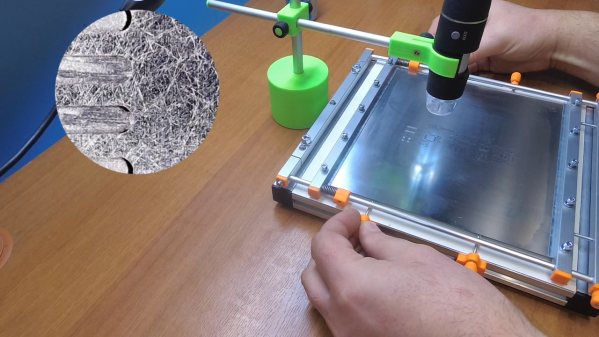
PCB stencils make application of solder paste a snap, but there’s a long, fussy way to go before the paste goes on. You’ve got to come up with some way to accurately align the stencil over the board, which more often than not involves a jury-rigged setup using tape and old PCBs, along with a fair amount of finesse and a dollop of luck.

Luckily, [Valera Perinski] has come up with a better way to deal with stencils. The Stencil Printer is a flexible, adjustable alignment jig that reduces the amount of tedious adjustment needed to get things just so. The jig is built mostly from aluminum extrusions and 3D-printed parts, along with a bunch of off-the-shelf hardware. The mechanism has a hinged frame that holds the stencil in a fixed position above a platen, upon which rests the target PCB. The board is held in place by clamps that ride on threaded rods; with the stencil flipped down over the board, the user can finely adjust the relative positions of the board and the stencil, resulting in perfect alignment. The video below is mainly a construction montage, but if you skip to about the 29:00 mark, you’ll see the jig put through its paces.

Granted, such a tool is a lot more work than tape and spare PCBs, but if you do a lot of SMD work, it may be worth the effort. It’s certainly less effort than a solder-paste dispensing robot.

Continue reading “Adjustable Jig Eases PCB Stencil Alignment Process”

Homebrew Coil Winder Makes Toroids A Snap To Wind

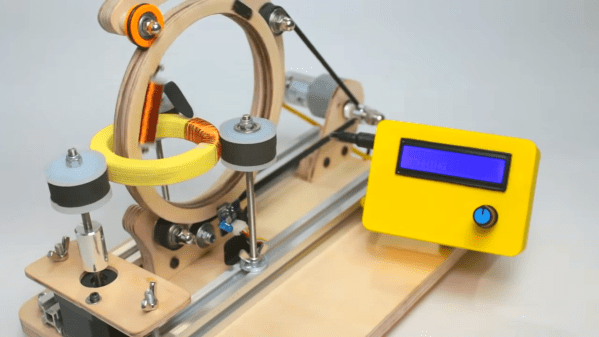
Anyone who has ever wound a toroidal coil by hand can tell you that it’s not exactly a fun job. Even with the kinds of coils used in chokes and transformers for ham radio, which generally have relatively few windings, passing all that wire through the toroid time after time is a pain. And woe unto anyone who guesses wrong on how much wire the job will take.

To solve those problems, [Sandeep] came up with this clever and effective toroid winder. The idea is to pass a small spool of magnet wire through the toroid’s core while simultaneously rotating the toroid to spread the windings out as evenly as possible. That obviously requires a winding ring that can be opened up to allow the toroid form to be inserted; [Sandeep] chose to make his winding ring out of plywood with a slit in it. Carrying the wire spool, the winding ring rotates on a C-shaped fixture that brackets the toroid, which itself rotates under stepper motor control on a trio of rollers. An Arduino controls the rotation of both motors, controlling the number of windings and their spread on the form. lacking a ferrite core for testing, [Sandeep] used a plywood ring as a stand-in, but the results are satisfying enough to make any manual coil-winder envious.

We love tools like this that make a boring job a snap. Whether it’s cutting wires for wiring harnesses or winding guitar pickups, tools like these are well worth the time spent to build them. But we suppose when it comes to toroid winding, one could always cheat.

Continue reading “Homebrew Coil Winder Makes Toroids A Snap To Wind”

Tiny Laser Cutter Puts Micro Steppers To Work

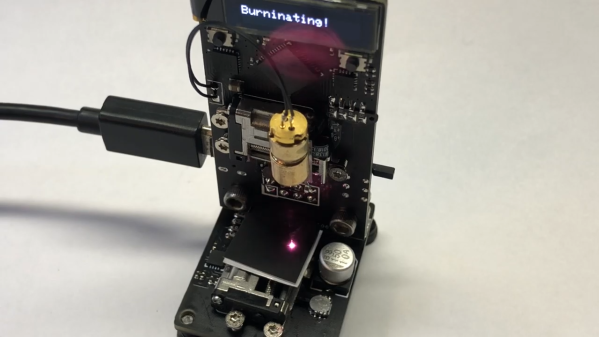
The influx of cheap laser cutters from China has been a boon to the maker movement, if at the cost of a lot of tinkering to just get the thing to work. So some people just prefer to roll their own, figuring that starting from scratch means you get exactly what you want. And apparently what [Mike Rankin] wanted was a really, really small laser cutter.

The ESP32 Burninator, as [Mike] lovingly calls his creation, is small enough to be in danger of being misplaced accidentally. The stage relies on tiny stepper-actuated linear drives, available on the cheap from AliExpress. The entire mechanical structure is two PCBs — a vertical piece that holds the ESP32, an OLED display, the X-axis motor, and the driver for the laser, which comes from an old DVD burner; a smaller bottom board holds the Y-axis and the stage. “Stage” is actually a rather grand term for the postage-stamp-sized working area of this cutter, but the video below shows that it does indeed cut black paper.

The cuts are a bit wonky, but this is surely to be expected given the running gear, and we like it regardless. It sort of reminds us of that resin 3D-printer small enough to fit in a Christmas ornament that [Sean Hodgins] did a while back. We’d suggest not trying to hang this on a tree, though.

Continue reading “Tiny Laser Cutter Puts Micro Steppers To Work”

Machine Learning Takes The Embarrassment Out Of Videoconference Wardrobe Malfunctions

Telecommuters: tired of the constant embarrassment of showing up to video conferences wearing nothing but your underwear? Save the humiliation and all those pesky trips down to HR with Safe Meeting, the new system that uses the power of artificial intelligence to turn off your camera if you forget that casual Friday isn’t supposed to be that casual.

The following infomercial is brought to you by [Nick Bild], who says the whole thing is tongue-in-cheek but we sense a certain degree of “necessity is the mother of invention” here. It’s true that the sudden throng of remote-work newbies certainly increases the chance of videoconference mishaps and the resulting mortification, so whatever the impetus, Safe Meeting seems like a great idea. It uses a Pi cam connected to a Jetson Nano to capture images of you during videoconferences, which are conducted over another camera. The stream is classified by a convolutional neural net (CNN) that determines whether it can see your underwear. If it can, it makes a REST API call to the conferencing app to turn off the camera. The video below shows it in action, and that it douses the camera quickly enough to spare your modesty.

We shudder to think about how [Nick] developed an underwear-specific training set, but we applaud him for doing so and coming up with a neat application for machine learning. He’s been doing some fun work in this space lately, from monitoring where surfaces have been touched to a 6502-based gesture recognition system.

Continue reading “Machine Learning Takes The Embarrassment Out Of Videoconference Wardrobe Malfunctions”