The Great Northeast Blackout Of 1965

At 5:20 PM on November 9, 1965, the Tuesday rush hour was in full bloom outside the studios of WABC in Manhattan’s Upper West Side. The drive-time DJ was Big Dan Ingram, who had just dropped the needle on Jonathan King’s “Everyone’s Gone to the Moon.” To Dan’s trained ear, something was off about the sound, like the turntable speed was off — sometimes running at the usual speed, sometimes running slow. But being a pro, he carried on with his show, injecting practiced patter between ad reads and Top 40 songs, cracking a few jokes about the sound quality along the way.

Within a few minutes, with the studio cart machines now suffering a similar fate and the lights in the studio flickering, it became obvious that something was wrong. Big Dan and the rest of New York City were about to learn that they were on the tail end of a cascading wave of power outages that started minutes before at Niagara Falls before sweeping south and east. The warbling turntable and cartridge machines were just a leading indicator of what was to come, their synchronous motors keeping time with the ever-widening gyrations in power line frequency as grid operators scattered across six states and one Canadian province fought to keep the lights on.

They would fail, of course, with the result being 30 million people over 80,000 square miles (207,000 km2) plunged into darkness. The Great Northeast Blackout of 1965 was underway, and when it wrapped up a mere thirteen hours later, it left plenty of lessons about how to engineer a safe and reliable grid, lessons that still echo through the power engineering community 60 years later.

Continue reading “The Great Northeast Blackout Of 1965”

Hackaday Links Column Banner

Hackaday Links: October 12, 2025

We’ve probably all seen some old newsreel or documentary from The Before Times where the narrator, using his best Mid-Atlantic accent, described those newfangled computers as “thinking machines,” or better yet, “electronic brains.” It was an apt description, at least considering that the intended audience had no other frame of reference at a time when the most complex machine they were familiar with was a telephone. But what if the whole “brain” thing could be taken more literally? We’ll have to figure that out soon if these computers powered by miniature human brains end up getting any traction.

Continue reading “Hackaday Links: October 12, 2025”

Ask Hackaday: Why Is TTL 5 Volts?

The familiar five volts standard from back in the TTL days always struck me as odd. Back when I was just a poor kid trying to cobble together my first circuits from the Forrest Mims Engineer’s Notebook, TTL was always a problem. That narrow 4.75 V to 5.25 V spec for Vcc was hard to hit, thanks to being too poor to buy or build a dedicated 5 V power supply. Yes, I could have wired up four 1.5 V dry cells and used a series diode to drop it down into range, but that was awkward and went through batteries pretty fast once you got past more than a few chips.

As a hobbyist, the five volt TTL standard always seemed a little capricious, but I strongly suspected there had to be a solid reason behind it. To get some insights into the engineering rationale, I did what anyone living in the future would do: I asked ChatGPT. My question was simple: “How did five volts become the standard voltage for TTL logic chips?” And while overall the answers were plausible, like every other time I use the chatbot, they left me wanting more.

Continue reading “Ask Hackaday: Why Is TTL 5 Volts?”

Hackaday Links Column Banner

Hackaday Links: October 5, 2025

What the Flock? It’s probably just some quirk of The Almighty Algorithm, but ever since we featured a story on Flock’s crime-fighting drones last week, we’ve been flooded with other stories about the company, some of which aren’t very flattering. The first thing that we were pushed was this handy interactive map of the company’s network of automatic license plate readers. We had no idea how extensive the network was, and while our location is relatively free from these devices, at least ones operated on behalf of state, county, or local law enforcement, we did learn to our dismay that our local Lowe’s saw fit to install three of these cameras on the entrances to their parking lot. Not wishing to have our coming and goings documented, we’ll be taking our home improvement dollars elsewhere for now.

Continue reading “Hackaday Links: October 5, 2025”

A Cut Above: Surgery In Space, Now And In The Future

In case you hadn’t noticed, we live in a dangerous world. While our soft, fleshy selves are remarkably good at absorbing kinetic energy and healing the damage that results, there are very definite limits to what we humans can deal with, beyond which we’ll need some help. Car crashes, falls from height, or even penetrating trauma such as gunshot wounds — events such as these will often land you in a trauma center where, if things are desperate enough, you’ll be on the operating table within the so-called “Golden Hour” of maximum survivability, to patch the holes and plug the leaks.

While the Golden Hour may be less of a hard limit than the name implies, it remains true that the sooner someone with a major traumatic injury gets into surgery, the better their chances of survival. Here on planet Earth, most urban locations can support one or more Level 1 trauma centers, putting huge swathes of the population within that 60-minute goal. Even in rural areas, EMS systems with Advanced Life Support crews can stabilize the severely wounded until they can be evacuated to a trauma center by helicopter, putting even more of the population within this protective bubble.

But ironically, residents in the highest-priced neighborhood in human history enjoy no such luxury. Despite only being the equivalent of a quick helicopter ride away, the astronauts and cosmonauts aboard the International Space Station are pretty much on their own when it comes to any traumatic injuries or medical emergencies that might crop up in orbit. While the ISS crews are well-prepared for that eventuality, as we’ll see, there’s only so much we can do right now, and we have a long way to go before we’re ready to perform surgery in space

Continue reading “A Cut Above: Surgery In Space, Now And In The Future”

Hackaday Links Column Banner

Hackaday Links: September 28, 2025

In today’s “News from the Dystopia” segment, we have a story about fighting retail theft with drones. It centers on Flock Safety, a company that provides surveillance technologies, including UAVs, license plate readers, and gunshot location systems, to law enforcement agencies. Their flagship Aerodome product is a rooftop-mounted dock for a UAV that gets dispatched to a call for service and acts as an eye-in-the-sky until units can arrive on scene. Neat idea and all, and while we can see the utility of such a system in a first responder situation, the company is starting to market a similar system to retailers and other private sector industries as a way to contain costs. The retail use case, which the story stresses has not been deployed yet, would be to launch a drone upon a store’s Asset Protection team noticing someone shoplifting. Flock would then remotely pilot the drone, following the alleged thief back to their lair or hideout and coordinating with law enforcement, who then sweep in to make an arrest.

Continue reading “Hackaday Links: September 28, 2025”

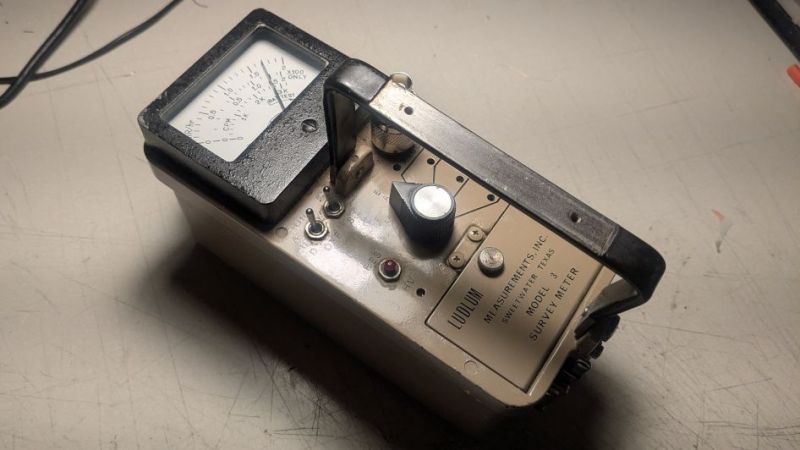
Meter Mods Make Radioactive Prospecting More Enjoyable

While we often get a detailed backstory of the projects we cover here at Hackaday, sometimes the genesis of a build is a bit of a mystery. Take [maurycyz]’s radiation survey meter modifications, for instance; we’re not sure why such a thing is needed, but we’re pretty glad we stumbled across it.

To be fair, [maurycyz] does give us a hint of what’s going on here by choosing the classic Ludlum Model 3 to modify. Built like a battleship, these meters would be great for field prospecting except that the standard G-M tube isn’t sensitive to gamma rays, the only kind of radiation likely not to be attenuated by soil. A better choice is a scintillation tube, but those greatly increase the background readings, making it hard to tease a signal from the noise.

To get around this problem and make rockhounding a little more enjoyable, [maurycyz] added a little digital magic to the mostly analog Ludlum. An AVR128 microcontroller taps into the stream of events the meter measures via the scintillation tube, and a little code subtracts the background radiation from the current count rate, translating the difference into an audible tone. This keeps [maurycyz]’s eyes on the rocks rather than on the meter needle, and makes it easier to find weakly radioactive or deeply buried specimens.

If you’re not ready to make the leap to a commercial survey meter, or if you just want to roll your own, we’ve got plenty of examples to choose from, from minimalist to cyberpunkish.