Automate The Freight: Medical Deliveries By Drone

Being a cop’s kid leaves you with a lot of vivid memories. My dad was a Connecticut State Trooper for over twenty years, and because of the small size of the state, he was essentially on duty at all times. His cruiser was very much the family vehicle, and like all police vehicles, it was loaded with the tools of the trade. Chief among them was the VHF two-way radio, which I’d listen to during long car rides, hearing troopers dispatched to this accident or calling in that traffic stop.

One very common call was the blood relay — Greenwich Hospital might have had an urgent need for Type B+ blood, but the nearest supply was perhaps at Yale-New Haven Hospital. The State Police would be called, a trooper would pick up the blood in a cooler, drive like hell down I-95, and hand deliver the blood to waiting OR personnel. On a good day, a sufficiently motivated and skilled trooper could cover that 45-mile stretch in about half an hour. On a bad day, the trooper might end up in an accident and in need of blood himself.

Continue reading “Automate The Freight: Medical Deliveries By Drone”
Vintage Plotter Handles Chaos With Ease

No lab in almost any discipline was complete in the 70s and 80s without an X-Y plotter. The height of data acquisition chic, these simple devices were connected to almost anything that produced an analog output worth saving. Digital data acquisition pushed these devices to the curb, but they’re easily found, cheap, and it’s worth a look under the hood to see what made these things tick.

The HP-7044A that [Kerry Wong] scored off eBay is in remarkably good shape four decades after leaving the factory. While the accessory pack that came with it shows its age with dried up pens and disintegrating foam, the plotter betrays itself only by the yellowish cast to its original beige case. Inside, the plotter looks pristine. Completely analog with the only chips being some op-amps in TO-5 cans, everything is in great shape, even the high-voltage power supply used to electrostatically hold the paper to the plotter’s bed. Anyone hoping for at least a re-capping will be disappointed; H-P built things to last back in the day.

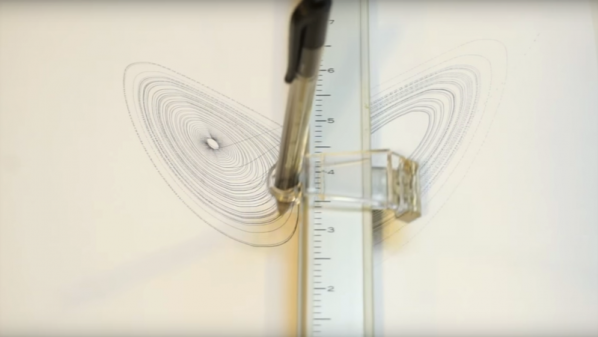
[Kerry] puts the plotter through its paces by programming an Arduino to generate a Lorenz attractor, a set of differential equations with chaotic solutions that’s perfect for an X-Y plotter. The video below shows the mesmerizing butterfly taking shape. Given the plotter’s similarity to an oscilloscope, we wonder if some SDR-based Lissajous patterns might be a fun test as well, or how it would handle musical mushrooms.

Continue reading “Vintage Plotter Handles Chaos With Ease”

Get Into Biohacking On The Cheap With This Electrophoresis Rig

If you want to get into electronics, it’s pretty straightforward: read up a little, buy a breadboard and some parts, and go to town. Getting into molecular biology as a hobby, however, presents some challenges. The knowledge is all out there, true, but finding the equipment can be a problem, and what’s out there tends to be fiendishly expensive.

So many would-be biohackers end up making their own equipment, like this DIY gel electrophoresis rig. Electrophoresis sorts macromolecules like DNA or proteins by size using an electric field. For DNA, a slab of agarose gel is immersed in a buffer solution and a current through the tank moves the DNA through the gel. The shorter the DNA fragment, the easier it can wiggle through the pores in the gel, and the faster it migrates down the gel. [abizar]’s first attempt at a DIY gel rig involved a lot of plastic cutting and solvent welding, so he simplified the process by using the little plastic drawers from an old parts cabinet. With nichrome and platinum wires for electrodes for the modified ATX power supply, it’s just the right size and shape for the gel, which is cast in a separate mold. The video below shows the whole build, and while [abizar] doesn’t offer much detail on recipes or techniques, there are plenty of videos online to guide you.

Need more apparatus to deck out your lab? We’ve got you covered there too.

Continue reading “Get Into Biohacking On The Cheap With This Electrophoresis Rig”

Pool Playing Robot Destined For Trouble In River City

You’d think pool should be an easy game for a robot to play, right? It’s all math — geometry to figure out the angles and basic physics to deal with how much force is needed to move the balls. On top of that, it’s constrained to just two dimensions, so it should be a breeze.

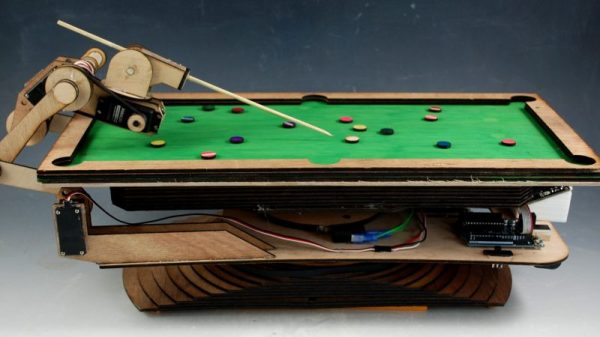
Any pool player will tell you there’s much, much more to the game in real life, but still, a robot to play pool against would be a neat trick. As a move toward that goal, [BVarv] wisely decided on a miniature mockup of a pool-playing robot, and in the process reinvented the pool table itself. Realizing that a tracked or wheeled robot would have a tough time maneuvering around the base of a traditional pool table, his model pool table is a legless design that looks like something from IKEA. But the pedestal support allows the robot to be attached to the table and swing around in a full circle, and this allowed him to work through the kinematics as shown in the charming stop-action video below.

[BVarv] has gotten as far as motion control on the swing axis, as well as on the arms that will eventually hold the cue. He plans overhead image analysis for identifying shots, and of course there’s the whole making it full-size thing to do. We’d love to play a game or two against a bot, so we hope he gets there. In the meantime, how about a little robo-air hockey?

Continue reading “Pool Playing Robot Destined For Trouble In River City”

The Dangers Of Engineering While Unlicensed

Citizen engineers, beware the Beaver State. If you want to discuss engineering in a public setting, you’d better have a license. If you don’t, you could end up like Oregon resident Mats Järlström — paying a $500 fine and being threatened with even larger civil penalties and jail time.

The story of how Järlström became ensnared in this unfortunate series of events begins innocently enough, and it’s a story that any Hackaday reader can probably relate to. After his wife received a traffic ticket in the mail from a red-light camera in the town of Beaverton, Järlström began pondering the math of traffic signal timing. After a little digging, he found the formula used for calculating the time traffic signals stay in the yellow stage. Moreover, he found a flaw in the formula, which dates back to 1959, that could lead to incorrect violations issued by automated traffic cameras.

Continue reading “The Dangers Of Engineering While Unlicensed”

Powerful, Professional Brushless Motor From 3D-Printed Parts

Not satisfied with the specs of off-the-shelf brushless DC motors? Looking to up the difficulty level on your next quadcopter build? Or perhaps you just define “DIY” as rigorously as possible? If any of those are true, you might want to check out this hand-wound, 3D-printed brushless DC motor.

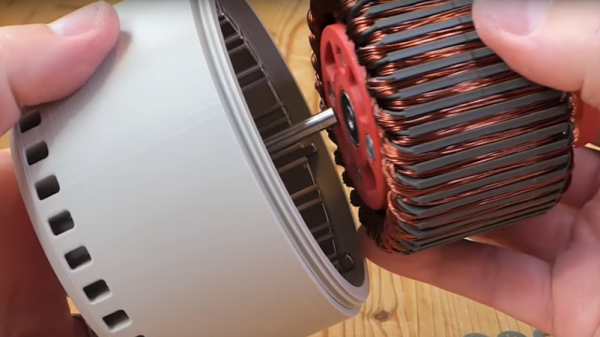
There might be another reason behind [Christoph Laimer]’s build — moar power! The BLDC he created looks more like a ceiling fan motor than something you’d see on a quad, and clocks in at a respectable 600 watts and 80% efficiency. The motor uses 3D-printed parts for the rotor, stator, and stator mount. The rotor is printed from PETG, while the stator uses magnetic PLA to increase the flux and handle the heat better. Neodymium magnets are slipped into slots in the rotor in a Halbach arrangement to increase the magnetic field inside the rotor. Balancing the weights and strengths of the magnets and winding the stator seem like tedious jobs, but [Cristoph] provides detailed instructions that should see you through these processes. The videos below shows an impressive test of the motor. Even limited to 8,000 rpm from its theoretical 15k max, it’s a bit scary.

Looking for a more educational that practical BLDC build? Try one cobbled from PVC pipes, or even this see-through scrap-bin BLDC.

Continue reading “Powerful, Professional Brushless Motor From 3D-Printed Parts”

“Look Ma, No Gyros!”: A Self-Balancing Mechanical Velociraptor

You’ve got to walk before you can run, right? Perhaps not, if this bipedal dino-like running robot is any indication.

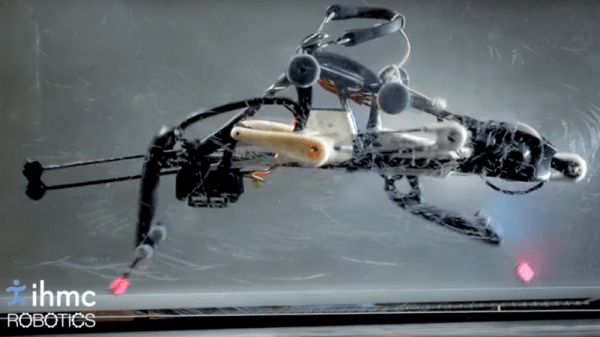
Officially dubbed a “Planar Elliptical Runner,” the bot is a test platform for bipedal locomotion from the Institute for Human and Machine Cognition. Taking inspiration from the gait of an ostrich — we think it looks more like a T. rex or velociraptor, but same difference — [Jerry Pratt]’s team at IHMC have built something pretty remarkable. Contrary to all the bipedal and quadrupedal robots we’ve seen, like Boston Dynamics’ Big Dog and PETMAN, which all fairly bristle with sensors and actuators, the PER is very stripped down.

A single motor runs the entire drive chain using linkages that will look familiar to anyone who has taken an elliptical trainer apart, and there’s not a computer or sensor on board. The PER keeps its balance by what the team calls “reactive resilience”: torsion springs between the drive sprocket and cranks automatically modulate the power to both the landing leg and the swing leg to confer stability during a run. The video below shows this well if you single-frame it starting at 2:03; note the variable angles of the crank arms as the robot works through its stride.



The treadmill tests are constrained by a couple of plastic sheets, but the next version will run free. It’s not clear yet how directional control will be achieved, not is it obvious how the PER will be able to stop running and keep its balance. But it’s an interesting advance in locomotion and we look forward to seeing what IHMC’s next trick will be.

Continue reading ““Look Ma, No Gyros!”: A Self-Balancing Mechanical Velociraptor”