Tint Your Epoxy Resin With Toner Powder

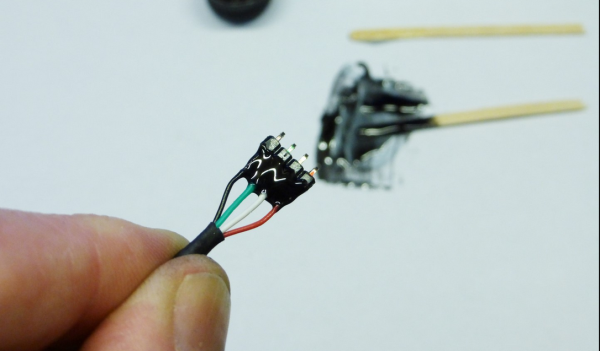
Epoxy resin is useful stuff. Whether for gluing stuff together or potting components, epoxy is a cheap and versatile polymer that finds its way into many hackish projects. But let’s face it – the stock color of most commercially available epoxies lacks a certain pizzazz. Luckily, [Rupert Hirst] at Tallman Labs shows us that epoxy is easily tinted with toner powder from a laser printer or copier.

Looking for a way to make his epoxy blend into a glue-up, [Rupert] also demonstrates that colored epoxy makes a professional looking potting compound. There’s just something about the silky, liquid look of a blob of cured black epoxy. [Rupert] harvested his toner powder from a depleted printer cartridge; only a smidgen is needed, so you should be able to recover plenty before recycling the cartridge. We’ve got to admit that seeing toner handled without gloves gives us the willies, though. And don’t forget that you can find cyan, magenta and yellow cartridges too if basic black isn’t your thing.

Sometimes it’s better to leave your epoxy somewhat clear, like when you’re potting an LED matrix for a pendant. But this neat trick might just spiff up your next project a bit.

[Thanks, Jake]
Recycled Factory Recycles Soda Bottles

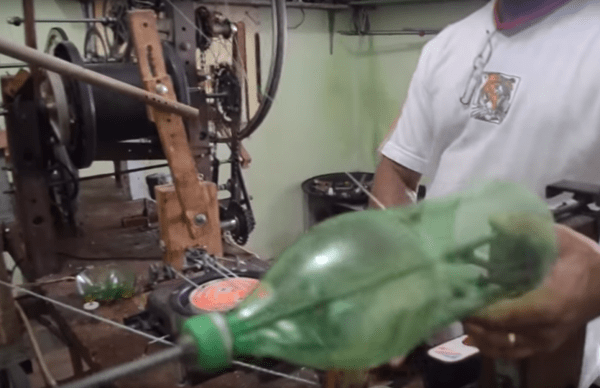
All over the world, mountains of polyethylene terephthalate (PET) plastics are available for recycling in the form of soda bottles. And wherever there is enough cheap raw material, a market is sure to emerge for it. One brilliant inventor in Brazil has decided to capitalize on this market by building a magnificent factory to turn PET bottles into threads, rope, and other products.

Not a word of English is spoken in the video, and our Portuguese stops at obrigado, but you don’t really need to understand what’s being said to know what’s going on. Built from what looks to be the running gear of several bicycles and motors from various cast-off appliances, our nameless genius’ machines slit the PET bottles into fine threads, winds the thread onto spools, and braids the threads into heavier cords. We love the whole home-brew vibe of the machines; especially clever is the hacked desk calculator wired to a microswitch to count revolutions, and the salvaged auto jack used to build a press for forming the broom heads. All in all it’s a pretty amazing little factory cranking out useful products from zero-cost raw material.

We’d love to have more context about what’s being said in the video, so we’ll put this one out there for our Portuguese-speaking readers. Maybe we can get a partial translation in the comments? If so, then obrigado.

[Thanks W4RIS]

Liquid Metal Changes Shape To Tune Antenna

Antennas can range from a few squiggles on a PCB to a gigantic Yagi on a tower. The basic laws of physics must be obeyed, though, and whatever form the antenna takes it all boils down to a conductor whose length resonates at a specific frequency. What works at one frequency is suboptimal at another, so an adjustable antenna would be a key component of a multi-band device. And a shape-shifting liquid metal antenna is just plain cool.

The first thing that pops into our head when we think of liquid metal is a silvery blob of mercury skittering inside the glass vial salvaged out of an old thermostat. The second image is a stern talking-to by the local HazMat team, so it’s probably best that North Carolina State University researchers [Michael Dickey] and [Jacob Adams] opted for gallium alloys for their experiments. Liquid at room temperature, these alloys have the useful property of oxidizing on contact with air and forming a skin. This allows the researchers to essentially extrude a conductor of any shape. What’s more, they can electrically manipulate the oxidative state of the metal and thereby the surface tension, allowing the conductor to change length on command. Bingo – an adjustable length antenna.

Radio frequency circuits aren’t the only application for gallium alloys. We’ve already seen liquid metal 3D printing with them. But we need to be careful, since controlling the surface tension of liquid metals might also bring us one step closer to this.

Cheap Function Generator Teardown And Improvement

In general, you get what you pay for, and when [Craig] picked up a cheap function generator off eBay, he didn’t expect much from it. But as he shows us in his blog post and a series of videos below, while the instrument lived down to his expectations, he was able to fix it up a bit.

Having spent only $100USD for the MHS-5200A, [Craig]’s adventure is a complete teardown and analysis of the function generator. While it sort of lives up to its specs, it’s pretty clear that some design decisions resulted in suboptimal performance. At higher frequencies and higher amplitudes, the sine wave output took on a markedly non-sinusoidal character, approaching more of a triangle waveform. The spectrum analyzer told the tale of multiple harmonics across the spectrum. With a reverse-engineered schematic in hand, he traced the signal generation and conditioning circuits and finally nailed the culprit – an AD812 op-amp used as the final amplifier. An in-depth discussion of slew rate follows in part 2, and part 3 covers replacement of the dodgy chip with a better selection that improves the output signal. We’re also treated to improvements to a low-pass filter that fixed a nasty overshoot and ringing problem with the unit’s square wave function.

If hacking the MHS-5200A seems a bit familiar to you, that’s because we covered another reverse-engineering exploit of it recently. That hack of the serial protocol of the instrument was by [WD5GNR], also known as Hackaday’s own [Al Williams]. Cheers to both [Craig] and [Al] for showing us what you can do with a hundred bucks and a little know-how.

Continue reading “Cheap Function Generator Teardown And Improvement”

Modified Mower Hacks The Heavy Stuff

Clearing brush is no fun. Sure, swinging a machete on a hot, humid day sounds great, but when you’re sitting in an oatmeal bath the next day because you didn’t see the poison ivy, you’ll be looking for a better way. [RoboMonkey] did just that with a field-expedient brush trimmer that’s sure to help with his chores.

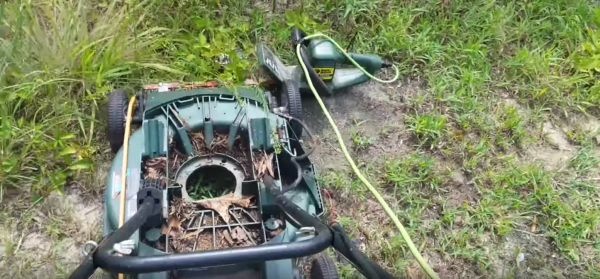
This is a hack in the true Junkyard Wars sense of the word. A cast-off electric push mower deck caught [RoboMonkey]’s eye, and a few spare brackets and bolts later his electric hedge trimmer was attached across the front of the mower. With a long extension cord trailing behind, he was able to complete in 10 minutes what would normally take him an hour to accomplish, without spending a dime on either a specialized brush cutter or a landscaping service. The video after the break reveals that it may not be the most powerful tool in the shed, and it won’t likely stand up to daily use, but for this twice a year chore, it’s more than sufficient. And since the hedge trimmer wasn’t modified, it’s still available for its original purpose. Reduce, reuse, recycle – and repurpose.

While we haven’t seen many brush cutters before, we seen plenty of mower mods. From LiPo electrics to a gas-powered RC unit, the common push-mower seems to be a great platform for all kinds of hacking.

Continue reading “Modified Mower Hacks The Heavy Stuff”

Fail Of The Week: Exploding Fermentation

It’s no secret that hackers like fermentation, both the process and the end results. I myself have a crock of sauerkraut happily bubbling away in the kitchen right now. Fermentation can lead to tasty endpoints, and the process itself, which basically amounts to controlled rotting, is a fascinating set of biochemical reactions. But done wrong, fermentation can result in injury, as it did at CCC this year when a fermentation vessel exploded.

"It was the one on the left, officer. He did it."
“It was the one on the left, officer. He did it.”

Exactly what happened isn’t really clear, except that Food Hacking Base ran a number of workshops at CCC 2015, several of which involved fermented foods or drinks. A Grolsch-style bottle with a ceramic flip-top was apparently used as a fermentation vessel, but unfortunately the seal was not broken. The bottle found its way to another tent at CCC, this one running an SMD soldering workshop. Carbon dioxide gas built up enough pressure in the bottle to shatter it and send shrapnel flying through the workshop tent. According to a discussion thread on the incident, “people got hurt and need to go to the hospital because glas [sic] particles were stuck in their faces, a throat was cut and an eyelid bleeding.” The explosion was quite energetic, because, “we also found a 20cm long piece of glass that went trough [sic] the ceiling of the tent and propelled for another 4-5 meters afterwards.”

We’ve seen lots of Hackaday projects involving instrumentation and automation of fermentation, including some with really large vessels. The potential for destruction if such a vessel isn’t properly vented is pretty high. At the very least, you’ll be left with a really big mess to clean up. Be careful out there – microbes are not to be trifled with. We don’t want to give you the wrong idea about CCC; this year was incredible as [Elliot Williams] reported during his time there.

Now it’s off to the kitchen to check on my kraut.

[Thanks to Morgan for the tip.]

The Race To Develop Technology That Enhances Elder Care

It happens with every generation – we’re born, our parents care for us and nurture us, we grow up, they grow old, and then we switch roles and care for them. Soon it’ll be my turn to be the caregiver to my parents, and I recently got a preview of things to come when my mom fell and busted her ankle. That it wasn’t the classic broken hip was a relief, but even “just” a broken ankle was difficult enough to deal with. I live 40 minutes away from the ‘rents, and while that’s not too bad when the visits are just the weekly dinner at Grammy’s, the time and the miles really start to add up when the visits turn into every other day to make sure Mom’s getting around OK and Dad is eating and sleeping.

I was sorely tempted to hack some kind of solution to give myself a rudimentary telepresence, but I couldn’t think of anything that wouldn’t have either been unacceptably intrusive (think webcams) or difficult to support from an IT perspective. Mom’s pretty handy with the iPad and she Skypes with my brother and his family out in California, but beyond leveraging that I was tapped out for ideas that I could easily deploy and would deliver sufficient value beyond the support burden within the time frame of healing the ankle. Consequently, I spent a lot of time in the car this summer.

This experience got me to thinking about how intergenerational caregiving will change with the rise of pervasive technology. The bad news: we’re still going to get old, and getting old sucks. The good news is, I think technology is going to make things easier for caregivers and elders alike. We have an incredible range of technology experiences among the generations present right now, from my parents who can remember phones without dials and nights spent listening to the radio, to my daughter’s generation that is practically growing up with supercomputers in the palms of their hands. How each generation ages and how it embraces technology as a solution for age-related problems are going to be vastly different.

Continue reading “The Race To Develop Technology That Enhances Elder Care”