Ask Hackaday: Frequency Hopping On The NRF24l01+?

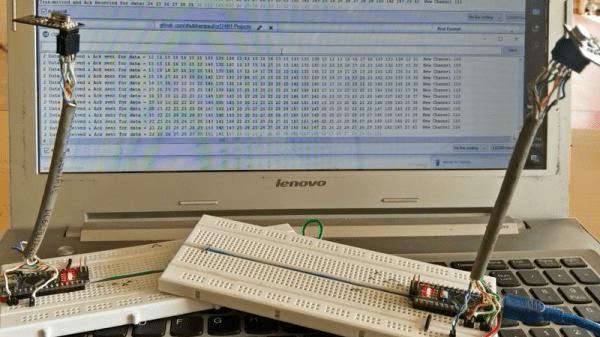
We’ve seen a lot of hacks with the nRF24l01+ 2.4 GHz radio modules. The tiny chips pack a lot of bang for the buck. Since the radios can switch frequencies relatively quickly, [Shubham Paul] decided to take advantage of this feature to make a rudimentary frequency-hopping communications channel.

The code is actually incredibly simple. Both the transmitter and receiver simply scan up and down over the defined channels. Because the clock speeds of any given pair of Arduinos are likely to be slightly different, it’s not a surprise that the radios eventually drift out of sync. Right now, as a quickie solution, [Shubham] is using a serial-port resynchronization: both are connected to the same computer, and he just tells them to get on the same channel. That’s not a horribly satisfying workaround. (But it’s a great start!)

Keeping two radios that are continually swapping channels in sync is no easy task, but it could possibly be made easier by taking advantage of the nRF’s acknowledge mode. If the delay between a sent acknowledge message and a received one were constant, these events (one on TX and one on RX) could be used to re-sync the two hopping cycles. All of this would probably require more temporal resolution than you’re going to get out of a microprocessor running Arduino code, but should be possible using hardware timers. But this is pure speculation. We briefly looked around and couldn’t find any working demos.

So Hackaday, how would you remotely sync two nRF24s on the cheap? Or is this a crazy idea? It might help to make transmissions more reliable in the face of 2.4 GHz band interference. Has anyone implemented their own frequency hopping scheme for the nRF24l01+?


Zelda And The Ocarina Of Things

Voice recognition is this year’s model for home automation, but aside from feeling like you’re onboard the Aries 1b arguing with HAL 9000, it just doesn’t do it for our geeky selves. So what’s even geekier? How about carrying around an ocarina in your pocket so that you can get a Raspberry Pi to unlock the door for you? (YouTube video, embedded below.) Yeah, that’ll do.

[Sufficiently Advanced]’s video gets us 90% of the way toward replicating this build. There’s a tube with a microphone and a Raspberry Pi inside. There are a bunch of ESP8266-powered gadgets scattered around the house that take care of such things as turning on and off the heater, watering plants, and even pressing a (spare) car remote with a servo.

We’d love to know what pitch- or song-recognition software the Raspberry Pi is running. We’ve wanted to implement a whistling-based home automation interface since seeing the whistled. We can hold a tune just fine, but we don’t always start out on the same exact pitch, which is a degree of freedom that [Sufficiently Advanced]’s system doesn’t have to worry about, assuming it only responds to one ocarina.

If you’re questioning the security of locking and unlocking your actual apartment by playing “Zelda’s Lullaby” from outside your window, you either overestimate the common thief or you just don’t get the joke. The use case of calling (and hopefully finding) a cell phone is reason enough for us to carry a bulky ocarina around everywhere we go!

Continue reading “Zelda And The Ocarina Of Things”

Flashing An ARM With No Soldering

[Sami Pietikäinen] was working on an embedded Linux device based on an Atmel SAMA5D3x ARM-A5 processor. Normally, embedded Linux boxes will boot up off of flash memory or an SD card. But if you’re messing around, or just want to sidestep normal operation for any reason, you could conceivably want to bypass the normal boot procedure. Digging around in the chip’s datasheet, there’s a way to enter boot mode by soldering a wire to pull the BMS pin. As [Sami] demonstrates, there’s also a software way in, and it makes use of mmap, a ridiculously powerful Linux function that you should know about.

Continue reading “Flashing An ARM With No Soldering”

DIY Conductive Glass You Could Actually Make

Transparent, conductive glass is cool stuff and enables LCD panels and more. But the commercial method involves sputtering indium-tin oxide, which means a high vacuum and some high voltages, which is doable, but not exactly hacker-friendly. [Simplifier] has documented an alternative procedure that uses nothing more than a camp-stove hotplate and an airbrush. And some chemistry.

Make no mistake, this is definitely do-it-outside chemistry. The mixture that [Simplifier] has settled on includes stannous (tin) chloride and ammonium bifluoride in solution. This is sprayed uniformly onto the heated glass (350-400° C), and after it’s evaporated there is a thin, strong, and transparent layer of fluorine-doped tin oxide. [Simplifier] reports resistances down in the single-digit Ohms per square, which is pretty awesome. [Simplifier] didn’t get the mix down perfectly on the first pass, of course, so it’s also interesting to read up on the intermediate steps.

Our thoughts immediately spring to masking sections of glass off and building DIY transparent circuits and panels, but we suspect that we’re getting ahead of ourselves. Still, this is an incredible early result, and we hope that it opens up the way to crazy transparent-conductive applications. What would you do if you could make glass circuits? Well, now you can, and it doesn’t look too hard.

Continue reading “DIY Conductive Glass You Could Actually Make”

Do You Know The CR816?

Hackaday readers (and writers) are an odd bunch. While the rest of the tech press falls over for the newest, shiniest CPU on the market, we’re the type who’s more interested the unexplored dark corners of metaphorical Silicon Alley. So when someone comes to us with a good writeup of a chip that we’d never heard about, we’re all ears.

[Remy]’s writeup of the CoolRISC 816 microcontroller CPU makes it obvious that he shares our taste for the esoteric. It has a 22-bit “RISC” instruction set. It has a dedicated 8-to-16 bit multiplier. Some of the instructions are so un-reduced that [Remy] calls bunk on its RISC claims. All of the operations, including the un-RISC ones, run in a single cycle. And the CoolRISC does this by cheating — the last stages of the pipeline run not on every clock tick, but on the rising and falling flanks of the clock respectively.

Why all these odd bits? They make the job of the assembly programmer, or compiler designer, a lot easier. With all single-cycle instructions, counting cycles is the same as counting lines of code. The not-really-RISC instructions are great for compiling C into. So what happened? [Remy] speculates that the MSP430, another not-really-RISC microcontroller that came out about the same time, ate the CoolRISC’s lunch. The MSP430 is a 16-bit machine, and chances are good that you’ve heard of TI. The same may not be true of Xemics, maker of the CoolRISC.

But still it’s nice to have someone saying the eulogy for this strange little chip. Or maybe the reports of the CR816’s death are premature — it seems to be inside TI’s bq20x80 chip that’s used in a number of battery power monitors. Oh, the irony! Indeed, watch [Charlie Miller] tear into a battery and find a CR816.

Have any of you used a CR816? What’s the strangest microcontroller architecture that you’ve ever seen?

Welcome To The Drone Wars

DroneClash” is a competition to be held on December 4th (save the date!) in a hangar at Valkenburg airfield in the Netherlands. The game? Teams try to destroy each others’ quadcopters, navigate through a “Hallway of Doom, Death, and Destruction”, and finally enter a final phase of the game where they try to defend their “queen” drone while taking out those of their opponents.

This sounds like crazy and reckless fun. Surprisingly, it’s being sponsored by the Technical University of Delft’s Micro Air Vehicle (MAV) lab. The goal is to enable a future of responsible drone use by having the ability “to take them out if necessary”.

Drone development has grown hugely in recent years, and you can see the anti-drone industry growing too. Ideally, these developments keep each other in check and result in a safe and responsible incorporation of drones in our daily lives. We are organising DroneClash to generate new ideas in order to encourage this process.

We do have to ask ourselves why anyone would want to use another quadcopter to take out illegally operated quadcopters — there must be a million more effective means from a policing standpoint.  On the other hand, if we were re-shooting “Hackers” right now, and looking for a futuristic sport, we would swap out rollerblading for drone combat. Registration opens this week. Gentlebots, start your engines.

Continue reading “Welcome To The Drone Wars”

[Kwan]’s Clock Displays Seconds, And Thirds

We have no idea if the background story is true or not, but we’re not going to let something like “truth” get in the way of a good story. The way [Kwan3217] tells it, first there were hours on sundials. Then when these were divided into sixty minute sections, they were called “minutes”. “Seconds” comes from a second division by sixty, into “second minutes”. The “third” division into sixty would give a time unit that lasts a sixtieth of a second.

[Kwan3217] built a clock that displays these third minutes. Weighing in at just a tiny bit over 16.6666 milliseconds each, the thirds’ hand is going to be spinning pretty fast, so he used LEDs. And if you’re going to display thirds, you’ve got to get them right, so he backs the clock up with GPS. There’s a full video playlist about it, and phenomenal detail in the project logs. Continue reading “[Kwan]’s Clock Displays Seconds, And Thirds”