Hackit: Laser Cut Your Own Jigsaw Puzzle

If you have a laser printer, you’ve got your Christmas presents sorted out. At least if your family likes jigsaw puzzles. The idea is very simple, laminate a photograph onto some laser-cuttable board, and then run the laser over the outline of the pieces. Bam! Instant puzzle.

The trick is generating the puzzle outline, and of course there’s an online application for that. It’s got options that let you customize the piece count and shapes, and then download the result as an SVG image.

Unfortunately, it’s closed-source and makes the pieces a little bit too uniform for our liking — many of the pieces have exactly the same shape as each other. Are you up to the challenge of writing a better one? We’d love to see it, because the idea of a simple puzzle overlay for laser cutters is too good. Help us get started with some brainstorming in the comments below. How do you go about generating meaningfully unique jigsaw edges algorithmically?

Once you’ve got the puzzle cut out, you can seal up the surface nicely, toss it in a box, and then you’ve got a personalized present. To put it together, we suggest an accompanying DIY pick-and-place tool. (And kudos to [Kristina] for the best headline of 2015 on that one!)

Thanks to Hackaday alum [George Graves] for the tip!
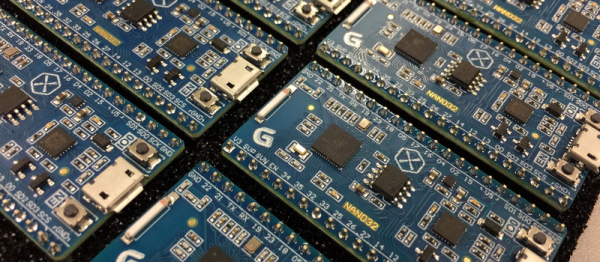
ESP32 Modules Popping Up Everywhere, In Stock Almost Nowhere

We know what it’s like to wait for newly released electronic parts. Clicking refresh every day at your favorite online retailers, reading reviews published by the press who got preview units, and maybe even daring to order implausibly cheap devices from foreign lands. TheĀ ESP32 has many of us playing the waiting game, and we’ll level with you — they’re out of stock most places. But, if you look hard enough you can find one. At least, you could find them before we wrote this quick roundupĀ of ESP32 hardware. If hearing about parts that are just out of reach is your sort of thing, then read on, you masochist!

Continue reading “ESP32 Modules Popping Up Everywhere, In Stock Almost Nowhere”

FingerRing Is Simplest Multichannel Mixer

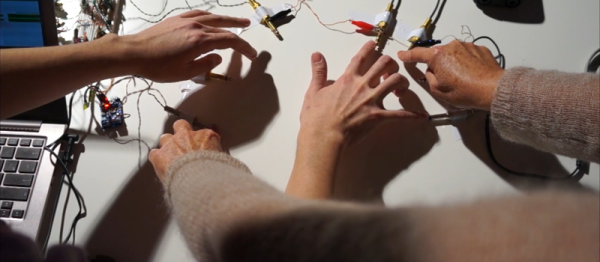
It’s hard to make an audio mixer with any less technology than FingerRing (YouTube video, embedded below). We’re pretty sure that [Sergey Kasich] isn’t going to get a patent on this one. But what he does get is our admiration for pushing a simple idea far enough that it’s obviously useful.

The basic idea is transmitting signals using the human body as a conductor. What [Sergey] does is lay out multiple sound sources and sinks on the table, and then play them like a mixer made musical instrument. Pressing harder reduces the resistance, and makes the sound louder. Connecting to two sources mixes them (in you). Watch the video — he gets a lot of mileage out of this one trick.

Continue reading “FingerRing Is Simplest Multichannel Mixer”

What’s New, ESP-32? Testing The Arduino Library

In case you missed it, the big news is that a minimal Arduino core is up and working on the ESP32. There’s still lots left to do, but the core functionality — GPIO, UART, SPI, I2C, and WiFi — are all up and ready to be tested out. Installing the library is as easy as checking out the code from GitHub into your Arduino install, so that’s exactly what I did.

I then spent a couple days playing around with it. It’s a work in progress, but it’s getting to the point of being useful, and the codebase itself contains some hidden gems. Come on along and take a sneak peek.

Continue reading “What’s New, ESP-32? Testing The Arduino Library”

Put That Amateur Radio License To Use On 915 MHz

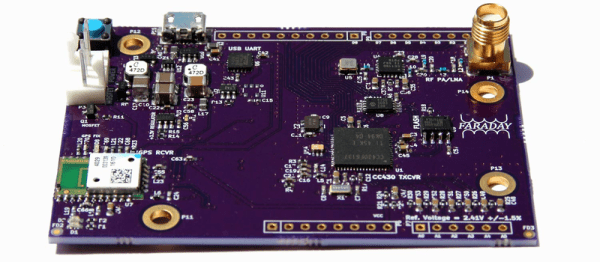
Amateur radio enthusiasts in the US will be interested in Faraday, an open-source digital radio that runs on 915 MHz, which amateur radio enthusiasts may know better as the 33 cm band.

You can transmit on 915 MHz without a license (in the US), taking advantage of the Industrial, Scientific, and Medical (ISM) exemption. This means that there’s commodity hardware available for sending and receiving, which is a plus. But you can’t do so with any real power unless you have an amateur radio license. And that’s what makes Faraday interesting — it makes it very easy to transmit and receive digital data, with decent power and range, if you’re licensed. The band is currently under-utilized, so go nuts!

The hardware design and documentation is online, and so is the firmware. The founders of the project would like you to build out a big network of these devices, possibly meshing them together. Our only regret is that the 33 cm band is only really open for use in the US, both with a license and without. Of course, there’s very little the Faraday team can do about that.

We’re no strangers to digital-mode amateur radio around here. But if you’re an amateur who hasn’t played around with digital modes yet, this might be a good way to get your feet wet.

Thanks to [Daniel] for the tip!

Projection Mapping In Motion Amazes

Projection mapping is pretty magical; done well, it’s absolutely miraculous when the facade of a building starts popping out abstract geometric objects, or crumbles in front of our very eyes. “Dynamic projection mapping onto deforming non-rigid surface” takes it to the next level. (Watch the video below.)

A group in the Ishikawa Watanabe lab at the University of Tokyo has a technique where they cover the target with a number of dots in an ink that is only visible in the infra-red. A high-speed (1000 FPS!) camera and some very fast image processing then work out not only how the surface is deforming, but which surface it is. This enables them to swap out pieces of paper and get the projections onto them in real time.

Continue reading “Projection Mapping In Motion Amazes”

Build The Simplest Bipolar Power Supply

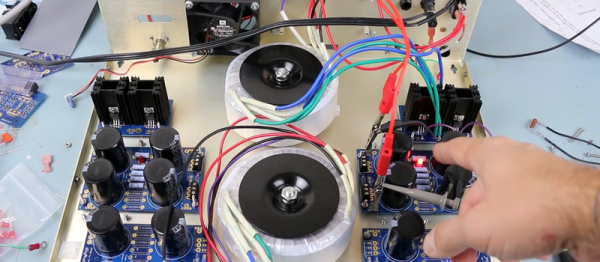
How many integrated circuits do you need to build up a power supply that’ll convert mains AC into a stable DC voltage? Would you believe, none? We just watched this video by [The Current Source] (embedded below), where he builds exactly that. If you’re in the mood for a very well done review of diode bridges as well as half- and full-wave rectifiers, you should check it out.

First off, [TCS] goes through the basics of rectification, and demonstrates very nicely on the oscilloscope how increasing capacitance on the output smooths out the ripple. (Hint: more is better.) And then it’s off to build. The end result is a very simple unregulated power supply — just a diode bridge with some capacitors on the output — but by using really big capacitors he gets down into the few-millivolt range for ripple into a constant load.

The output voltage of this circuit will depend on the average current drawn, but for basically static loads this circuit should work well enough, and the simplicity of just tossing gigantic capacitors at the problem is alluring. (We would toss in a linear regulator somewhere.)

Quibbling over circuit designs isn’t why you’re watching this video, though. It’s because you want to learn something. Check out the rest of his videos as well. [TCS] has only been at it a little while, but it looks like this is going to be a channel to watch.

https://www.youtube.com/watch?v=0iDCsrMM7M0