OpenWRT To Mark 20 Years With Reference Hardware

The OpenWRT project is now two decades old. The project has come a long way since Linksys was forced to release the GNU-licensed code for the original WRT54G router from which the project takes its name. They’ve marked the occasion in an interesting manner: by proposing that the plethora of devices supported by the OS be joined by a fully upstream-supported reference hardware platform.

Spec-wise it’s what you would expect for a hackable router platform in 2024. A MediaTek chipset can be found at its centre, but the hardware is not in this case the important bit. Here will be a platform that won’t have to rely on proprietary manufacturer BLOBs, and which will thus likely continue to have up-to-date kernel support long into the future. So many enticing SBCs fall in this regard, and many retain ossified kernel versions after their manufacturers tire of them as a result.

It appears that the future of this project will be subject to an OpenWRT community vote, and we sincerely hope that it will come to fruition. Meanwhile, we couldn’t resist a peek at the status of the router that started it all, by our reckoning the original WRT54G was last supported by the OS over a decade ago.

Decoding A ROM From A Picture Of The Chip

Before there were home computers, among the hottest pieces of consumer technology to own was a pocket calculator. In the early 1970s a series of exciting new chips appeared which allowed the impossible to become the affordable, and suddenly anyone with a bit of cash could have one.

Perhaps one of the more common series of chips came from Texas instruments, and it’s one of these from which [Veniamin Ilmer] has retrieved the ROM contents. In a way there’s nothing new here as the code is well known, it’s the way it was done which is of interest. A photo of the die was analysed, and with a bit of detective work the code could be deduced merely from the picture.

These chips were dedicated calculators, but under the hood they were simple pre-programmed microcontrollers. Identifying the ROM area of the chip was thus relatively straightforward, but some more detective work lay in getting to the bottom of how it could be decoded before the code could be verified. So yes, it’s possible to read code from an early 1970s chip by looking at a photograph.

A very similar chip to this one was famously reprogrammed with scientific functions to form the heart of the inexpensive Sinclair Cambridge Scientific.

A Very 21st Century Receiver For A Very 20th Century Band

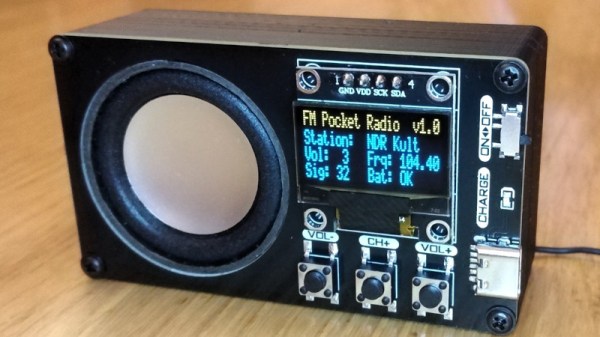
The FM broadcast band has been with us since the middle of the 20th century, and despite many tries to unseat it, remains a decent quality way to pick up your local stations. It used to be that building an FM broadcast receiver required a bit of RF know-how, but the arrival of all-in-one receiver chips has made that part a simple enough case of including a part. That’s not to say that building a good quality FM broadcast receiver in 2024 doesn’t involve some kind of challenge though, and it’s one that [Stefan Wagner] has risen to admirably with his little unit.

Doing the RF part is an RDA5807MP single chip radio, but we’d say the center of this is the CH32V003 RISC-V microcontroller and its software. Twiddling the dial is a thing of the past, with a color display and all the computerized features you’d expect. Rounding it off in the 3D printed case is a small speaker and a Li-Po pouch cell with associated circuitry. This really is the equal of any commercially produced portable radio, and better than many.

Even with the all-in-one chips, there’s still fun in experimenting with FM the old way.

Make Your Own Play Station (The Space Is Important)

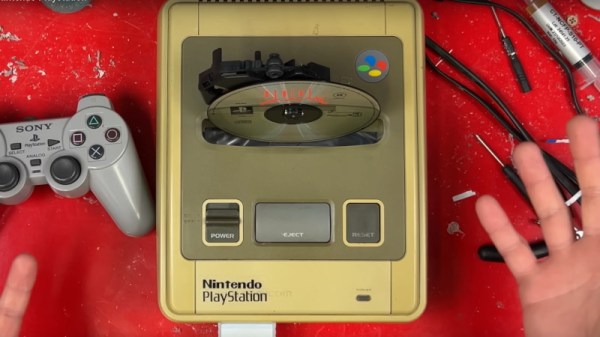
The early history of the Sony Playstation lies in a stillborn collaboration between Nintendo and Sony to produce an SNES with a CD-ROM drive. So the story goes, Nintendo’s Philips deal angered Sony, who decided to make their own console line, and the rest is history. A very small number of prototypes were made, badged as “Play Station,” and should you find one that escaped today, you’re sitting on a fortune. [James] doesn’t have one, but he did have half a Playstation and an SNES shell, so he could make an ungodly child of the two consoles that you can see in the video below the break.

Those Playstation CD-ROM drives were notorious for melting back in the day, so it’s no surprise they’re still for sale today. Thus, he was able to bring the Sony back to life. What follows is an episode of console cutting worthy of a slasher horror movie, as instead of a bit of fine Dremmeling, he brings out an angle grinder and slices away with abandon. We don’t like the Nintendo switch carrying mains voltage, but we’re fine with the PlayStation expansion connector going away. The Nintendo eject button needs a hack to operate the Playstation door open button when pressed. It’s cool to see the board has a mod chip. We used to fit those as a sideline in a previous life. Continue reading “Make Your Own Play Station (The Space Is Important)”

Half Power Bank, Half Spot Welder

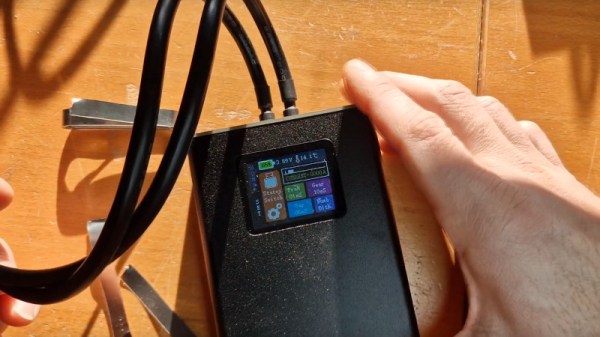
There was a time when every gizmo on AliExpress also had a big white LED so it could also work as a flashlight, but maybe the power bank is the new flashlight. [Aaron Christophel] has a battery spot welder that costs a not unreasonable 30 euros and can also be used as a novelty power bank. He subjects it to a test and teardown in the video below the break.

First of all, he conducts a few weld tests, and we have to say it seems capable of some reasonable results if its parameters are correctly adjusted. Then the end comes off the extruded aluminium case, and the guts of the device are slid out for a teardown.

The power comes from a pair of Li-Po pouch cells, while on the board, there’s an STM32 clone providing the timing for a set of MOSFETs that do the heavy lifting. There’s a colour display for tweaking the settings. Alongside all this, there’s also a small chip for that power bank functionality. Charging is via USB-C, though, of course, it’s not really proper USB-C but a USB-C socket that expects 5 volts. This is a disappointing trend in cheap electronics that sullys the promise of USB-C.

It seems this spot welder is capable of doing the job, which is pleasing after our previous disappointing look at battery welders.

Continue reading “Half Power Bank, Half Spot Welder”

The World Of Web Browsers Is In A Bad Way

There once was a man who invented a means for publishing scientific documents using hypertext. He made his first documents available from his NeXT cube, and a lot of the academics who saw them thought it was a great idea. They took the idea, expanded it, and added graphics, and pretty soon people who weren’t scientists wanted to use it too. It became the Next Big Thing, and technology companies new and old wanted a piece of the pie.

You all know the next chapter of this story. It’s the mid 1990s, and Microsoft, having been caught on the back foot after pursuing The Microsoft Network as a Compuserve and AOL competitor, did an about-turn and set out to conquer the Web. Their tool of choice was Microsoft Internet Explorer 3, which since it shipped with Windows 95 and every computer that mattered back then came with Windows 95, promptly entered a huge battle with Netscape’s Navigator browser. Web standards were in their infancy so the two browsers battled each other by manipulating the underlying technologies on which the Web relied. Microsoft used their “Embrace and extend” strategy to try to Redmondify everything, and Netscape got lost in the wilderness with Netscape 4, a browser on which nightmarish quirks were the norm. By the millennium it was Internet Explorer that had won the battle, and though some of the more proprietary Microsoft web technologies had fallen by the wayside, we entered the new decade in a relative monoculture. Continue reading “The World Of Web Browsers Is In A Bad Way”

Retrotechtacular: The Fell Locomotive

If you were to visit a railway almost anywhere in the world, you would find that unless it was in some way running heritage trains, the locomotives would bear a similarity to each other. Electric traction is the norm, whether it comes from a trackside supply or from a diesel generator. In the middle of the last century, as the industry moved away from steam traction though, this was far from a certainty. Without much in the way of power electronics, it was a challenge to reliably and efficiently control a large traction motor, so there were competing traction schemes using mechanical gearboxes or hydraulic drives. One of these is the subject of an archive film released by the oil company Shell, and it’s a fascinating journey into a technology that might have been.

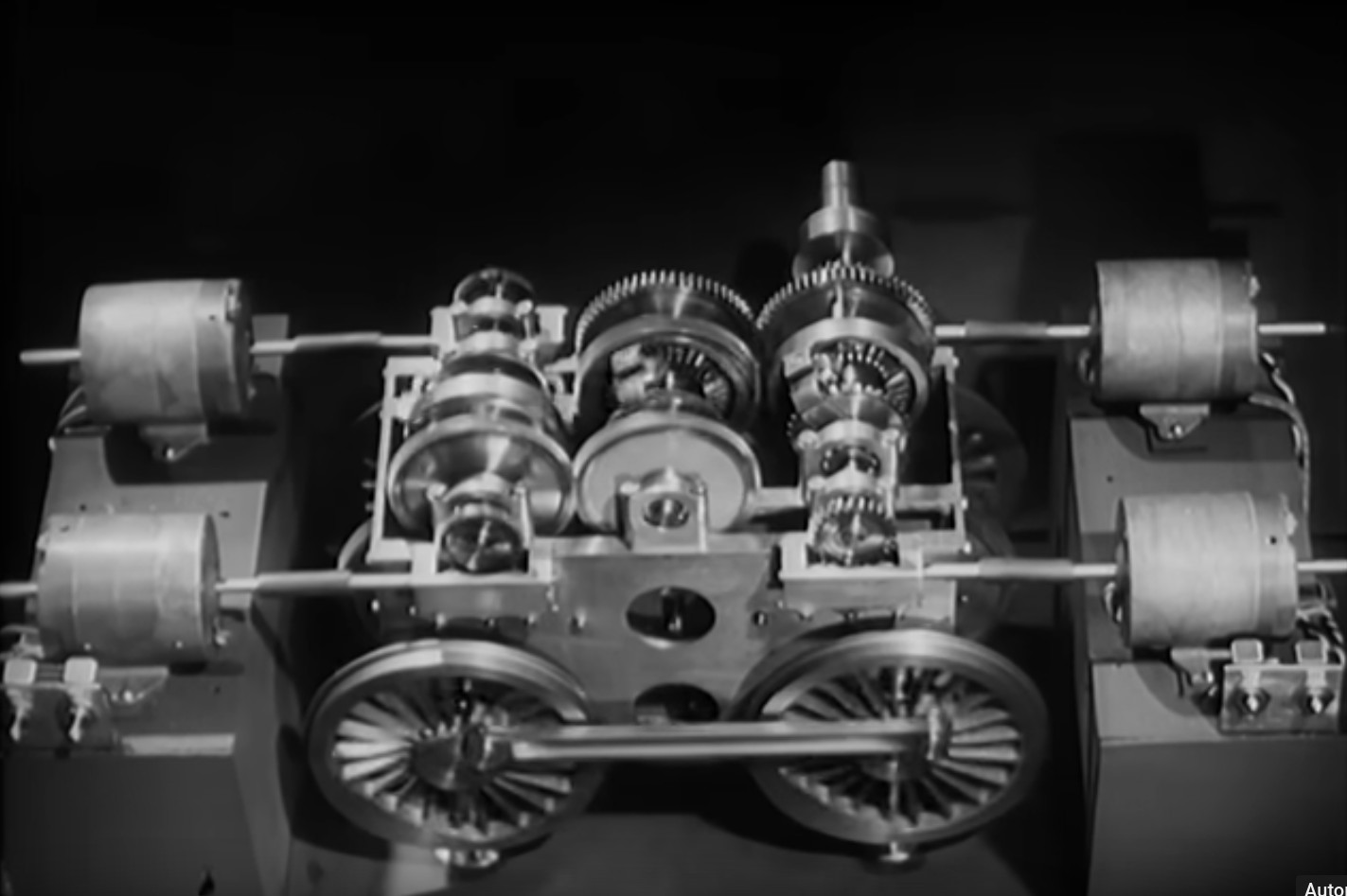
A model of a gearbox, in black and white.
The Fell differential gearbox.

All diesel locomotive designs struggle with the problem of transmitting the huge torque required to start a fully loaded train at low speeds, and because of the huge force required, it’s impossible to design a locomotive-sized conventional gearbox to do the job in the way it might be managed on a truck. Electric and hydraulic drives exploit the beneficial torque characteristics of electric and hydraulic motors, but the mechanical gearbox isn’t quite done for. The subject of the video is British Rail number 10100, otherwise commonly known as the Fell locomotive, and it was a one-off prototype that took to the rails at the start of the 1950s designed to test a very novel gearbox design.

At the heart of the Fell gearbox is a set of differential gears the same as you’d find in the axle of a car, and in the locomotive they are used to combine the output of more than one engine. The loco had four smaller-than-normal diesel traction motors that could be combined, but even then, it wasn’t done. To achieve variable torque, they employed superchargers driven by a set of even-smaller diesel engines, resulting in an ungainly multi-engined beast but with the desired characteristics for both starting heavy trains and for moving them at high speed. Continue reading “Retrotechtacular: The Fell Locomotive”