Large Format Photos Without The Large Price Tag

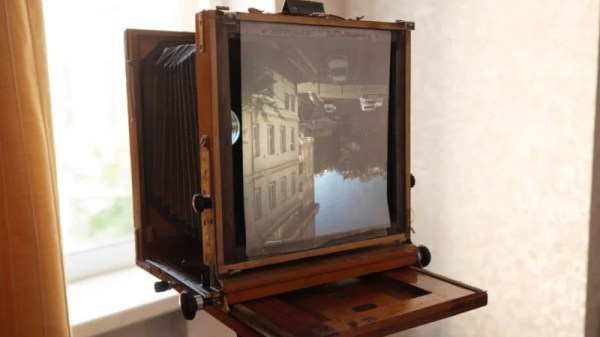
There’s a good reason that the go-to format for most film photographers is 35 mm, in that it provides a mix of convenience and cost. Shooting huge large-format negatives in the style of a 19th-century photographer can return astounding pictures with detail and lens effects unavailable on relatively tiny cameras, but it’s hardly the most convenient or cheapest medium. [Amos Chapple] may have a way to cut those costs though, by using a digital camera to capture the image projected by the camera onto a screen where the film would otherwise be.

He’s following in the footsteps of a Ukrainian photographer who tried the same technique photographing the projected image from the lens side, but that approach gave disappointing results due to the offset angle. Instead he’s placing the camera behind a translucent screen, having his DSLR behind a sheet of waxed paper held at the focal plane.

The results are we’d have to say, stunning. The old Soviet Ukrainian camera he’s using is something of a beast, but his photos of dancers at a folk festival have that other-worldly look to them which might well have something form the 1890s about it. We like it a lot and perhaps it’s tempting to fashion a poor-mans version using a cardboard box, and try for ourselves. Long-time readers will know it’s not the only attempt to digitize a large format camera we’ve seen.

Transistor Radio Repair, More Complex Than It Seems

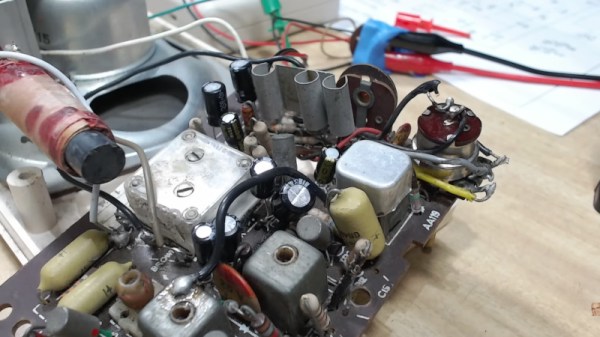
The humble transistor radio is one of those consumer devices that stubbornly refuses to go away, but it’s fair to say that it’s not the mover and shaker in the world of electronics it might once have been. Thus it’s also not a staple of the repair bench anymore, where fixing a pocket radio might have been all in a day’s work decades ago now they’re a rare sight. [David Tipton] has a Philips radio from we’re guessing the later half of the 1960s which didn’t work, and we’re along for the ride as he takes us through its repair.

It’s an extremely conventional design of the era, with a self-oscillating mixer, 455 kHz IF amplifier, and class AB audio amplifier. The devices are a little archaic by today’s standards, with comically low-gain germanium transistors and passives from the Ark. Injecting a signal reveals that the various stages all work, but that mixer isn’t oscillating. A lot of fault-finding ensues, and perhaps with a little bit of embarrassment, he eventually discovers a blob of solder shorting a collector resistor to ground. All isn’t over though, for the volume pot is also kaput. Who knew that the track from a modern component could be transplanted into one from the 1960s?

Continue reading “Transistor Radio Repair, More Complex Than It Seems”

Where Did Electronic Music Start?

A culture in which it’s fair to say the community which Hackaday serves is steeped in, is electronic music. Within these pages you’ll find plenty of synthesisers, chiptune players, and other projects devoted to synthetic sound. Not everyone here is a musician of obsessive listener, but if Hackaday had a soundtrack album we’re guessing it would be electronic. Along the way, many of us have picked up an appreciation for the history of electronic music, whether it’s EDM from the 1990s, 8-bit SID chiptunes, or further back to figures such as Wendy Carlos, Gershon Kingsley, or Delia Derbyshire. But for all that, the origin of electronic music is frustratingly difficult to pin down. Is it characterised by the instruments alone, or does it have something more specific in the music itself? Here follows the result of a few months’ idle self-enlightenment as we try to get tot he bottom of it all.

Will The Real Electronic Music Please Stand Up?

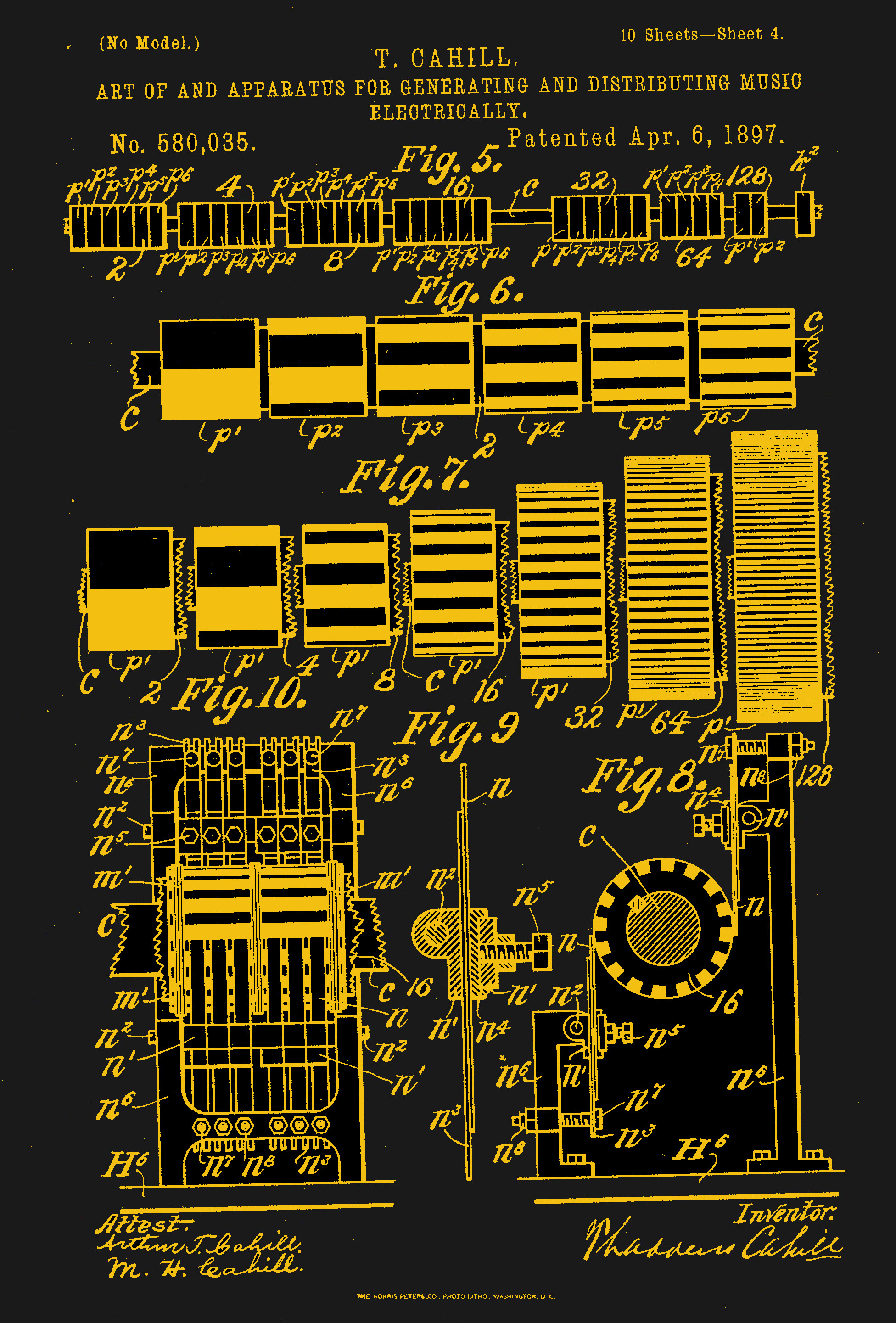
Page from the Telharmonium patent, showing the tone wheels
If you own a synthesiser, the Telharmonium is its daddy.

Anyone reading around the subject soon discovers that there are several different facets to synthesised music which are collectively brought together under the same banner and which at times are all claimed individually to be the purest form of the art. Further to that it rapidly becomes obvious when studying the origins of the technology, that purely electronic and electromechanical music are also two sides of the same coin. Is music electronic when it uses an electronic instrument, when electronics are used to modify the sound of an acoustic instrument, when it is sequenced electronically often in a manner unplayable by a human, or when it uses sampled sounds? Is an electric guitar making electronic music when played through an effects pedal?

The history of electronic music as far as it seems from here, starts around the turn of the twentieth century, and though the work of many different engineers and musicians could be cited at its source there are three inventions which stand out. Thaddeus Cahill’s tone-wheel-based Telharmonium US patent was granted in 1897, the same year as that for Edwin S. Votey’s Pianola player piano, while the Russian Lev Termen’s Theremin was invented in 1919. In those three inventions we find the progenital ancestors of all synthesisers, sequencers, and purely electronic instruments. If it appears we’ve made a glaring omission by not mentioning inventions such as the phonograph, it’s because they were invented not to make music but to record it. Continue reading “Where Did Electronic Music Start?”

Intel’s Chips Light The Way To Faster Processor Arrays

It’s very likely indeed that whatever you are reading this on will have a multi-core processor. They’re now the norm, but the path to they octa-or-more-core chip in your phone has gone from individual processors with PCB interconnects through many generations of ever faster on-chip ones.

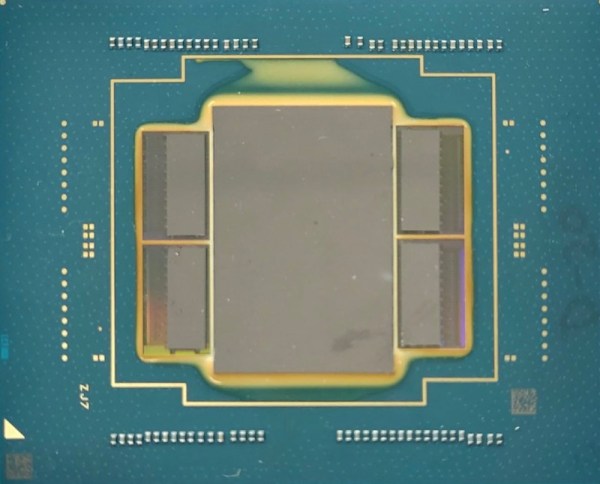
But what if your power needs are so high-end that you need more cores that can be fitted on one chip, but without the slow PCB interconnect to another? If you’re Intel, you develop a multi-core processor with an on-chip photonic interconnect. It talks to the neighboring ones in its cluster at full speed, via light.

The chip in question isn’t one you’ll see in a machine near you, instead it’s inspired by the extremely demanding requirements for DARPA’s HIVE graph analytics program. So this is a machine for supercomputers in huge data centers rather than desktop computers, it will be assembled into multi-die packages with that chip-to-chip optical networking built in. But your computer today is the equal of a supercomputer from not that many years ago, so never say you won’t one day be using its descendant technologies.

Finally, A Machine To Organize Resistors!

Perhaps it’s a side-effect of getting older, but it seems like reading the color bands on blue metal-film resistors is harder than it was on the old brown carbon ones. So often the multimeter has to come out to check, but it’s annoying. Thus we rather like [Mike]’s Resistorganizer, which automates the process of keeping track of the components.

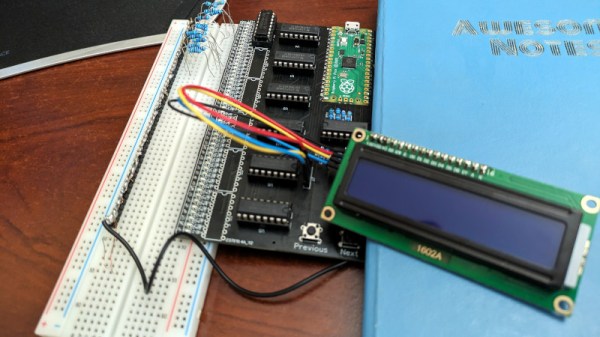
At its heart is a fairly simple concept, with the microcontroller reading the value of a resistor by measuring the voltage from a potential divider. The Resistorganizer extends this using an array of analogue multiplexer chips, and is designed to plug into one side of a breadboard with the idea being that each line can have a resistor connected to earth through it. Of course it’s not quite as simple as that, because to maintain a readable range a set of resistors must be switched in and out to form the other half of the divider for different ranges. Thus another multiplexer chip performs that task.

Finally a set of digital multiplexers handles an LED to see which of the many resistors is currently selected through a pair of buttons, and a dot-matrix LCD display delivers the value. We want one already!

Jenny’s Daily Drivers: Raspberry Pi Desktop

One of the more exciting prospects upon receiving one of the earliest Raspberry Pi boards back in 2012 was that it was a fully-functional desktop computer in the palm of your hand. In those far-off days, the Debian OS distro for the board wasn’t even yet called Raspbian, but it would run a full-on desktop on your TV and you could use it after a fashion to browse the web or do wordprocessing. It wasn’t in any way fast, but it was usable enough to be more than a novelty. I’ve said before on these pages that the Raspberry Pi folks’ key product is their OS rather than their computers. While they rarely have the fastest or highest spec hardware, you can depend on Raspberry Pi OS being updated and supported through the life of the board unlike many of their competitors. I can download their latest OS image and still run it on that 2012 board, which to me ranks as a very laudable achievement.

The OS They Don’t Really Tell You About

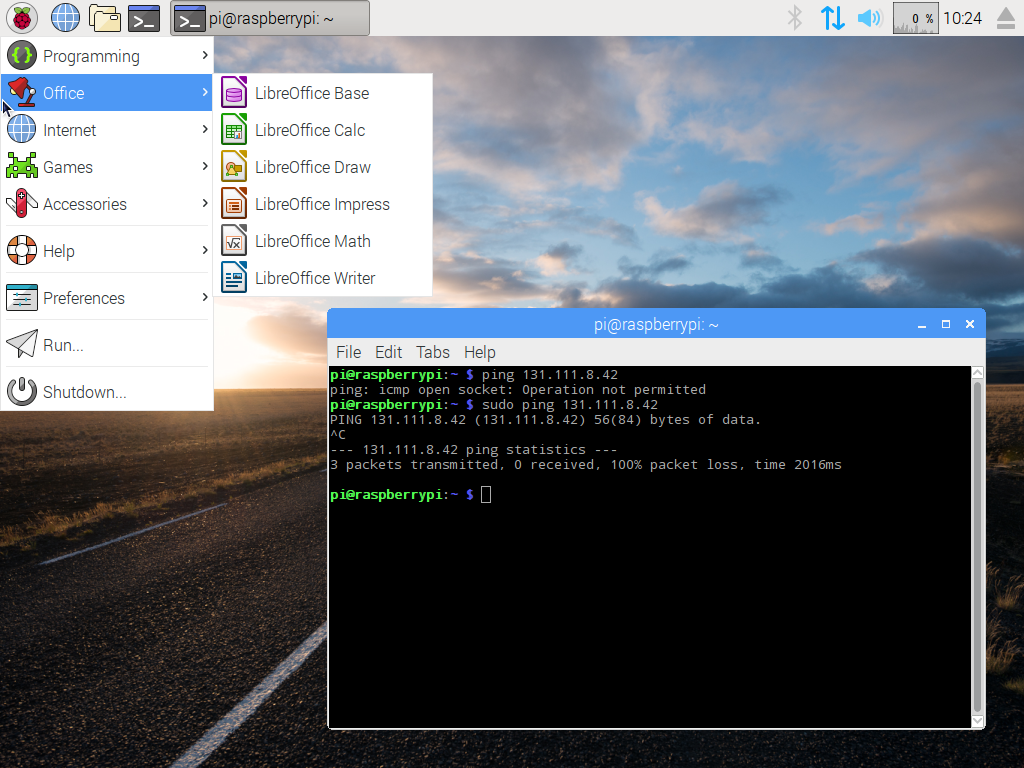
Screenshot of the first i386 Pi desktop
The background image may have changed since the first release back in 2016, but the UI hasn’t.

Raspberry Pi OS doesn’t run on any other ARM single board computers but their own, but it’s not quite accurate to say that it only runs on Raspberry Pi hardware. Since 2016 when it was launched as PIXEL, the folks in Cambridge have also maintained a PC version for 32-bit i386 computers, now called Raspberry Pi Desktop. It may be the Pi product they don’t talk about much, but  you can still find it on their downloads page.

Like the ARM version, it’s based on Debian and presents as close as possible to the environment you’d find on your Pi. I’m interested to see whether it still lives up to the claim of being usable on older hardware, so I’ve downloaded a copy and installed it on my trusty 2007 Dell Inspiron 640. It rocks a 1.6 GHz Core Duo with 4 GB of memory and a SATA SSD so it’s not the lowest spec hardware on the block, but by 2023’s standard it represents a giveaway-spec old laptop. Can I use it as a daily driver? Let’s find out! Continue reading “Jenny’s Daily Drivers: Raspberry Pi Desktop”

Will An 8088 Run DOOM? Now, Yes It Will!

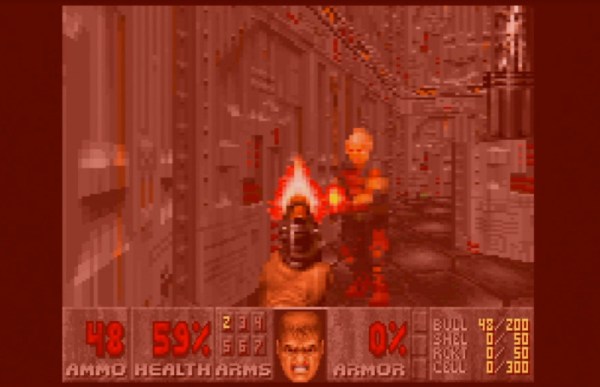
The question on everyone’s lips when a new piece of hardware comes out is this: Will it run DOOM? Many pieces of modern hardware have been coaxed into playing id Software’s 1993 classic, but there have always been some older machines that just didn’t have the power to do it. One of them has now been conquered though, and it’s a doozy. [Frenkel]’s Doom8088, as its name suggests, is a port of the game for the original PC and AT.

As can be seen in this gameplay video, it’s not always the slickest of gaming experiences. But it works, so the question is, how on earth can a machine that was below the spec of the original, run this game? The answer comes in it being a port of GBADoom for the Game Boy Advance, a platform with less memory than a DOS PC. It still relies on extensive hard disk access for every frame though, which leaves it snail-like.

We set out to install it ourselves on one of the web based PC emulators, but fell over on the size of the required Watcom installation. If any of you have the real thing lying around though, we’d love to hear about how the game performed in the comments.

We’ve shown you so many ports of DOOM over the years to have lost count. One of our favourite recent ones uses an extremely unconventional but very retro display.