This Car Has Wooden Performance

If you were to take a look at the car parked closest to where you are sitting, there’s an overwhelming probability that its main structural parts are made of steel. A few might be aluminium and fewer still composite materials, but by and large that’s it for automotive structures. This hasn’t stopped the inventive Russians at [Garage 54] from experimenting though, and in their latest they’ve made a car with a chassis made of wood. Not carefully sawn and assembled wooden structural components, oh no. These are wooden tree trunks and branches.

Of course it’s an opportunity for them to run wild on their very successful schtick of the crazy Eastern European YouTuber, but behind that it’s entertaining to watch how they adapt a drive train — taken we’re guessing from the FIAT 124-derived Zhiguli, or Lada as most of us would know it — to such an unconventional chassis. A lot of wire binding is used, and even then the car has a lot of the flexible about it. We’re not so sure about the differential without oil or indeed the front suspension that appears to be developing a lean, but they do manage to take it out of the forest and onto the road.

Are unconventional and definitely-not-road-legal motors your thing? Here’s another, courtesy of some Dutch lads.

Continue reading “This Car Has Wooden Performance”

Improving A Kodak Film Digitizer

Despite the near-complete collapse of its ecosystem in the face of portable videocassette camcorders in the 1980s, somehow the 8 mm format, smallest of the movie films, has survived the decades. There’s a special aura around an 8 mm image which electronic recordings don’t replicate, plus for film makers there’s an attraction to working with real film. Unsurprisingly almost all of the devices used with 8 mm film have ceased to be manufactured, but a few items escaped the cut. It’s still possible to buy an 8 mm digitizer for example, and it’s one of these with a Kodak brand that [Mac84] has. Unsatisfied with its image quality, he’s set about tinkering with its firmware to give it some video adjustment possibilities and remove its artifact-prone artificial sharpening.

Helped by the device having a handy EEPROM from which to extract the code, he was able to recover the firmware intact. From here on he was in luck, because the digitizer’s Novatek CPU is shared with some dash cams and this had spawned a hacker scene. From there he was able to find the relevant area and adjust those settings, and after a few false starts, re-flash it to the device.

The results can be seen in the video below the break, and perhaps reveal much about what we expect from an image in the digital age. The sharpened images look good, until we see untampered versions which are closer to the original.

If you don’t have a Kodak scanner you can always build one yourself, and meanwhile like many people we are still wondering what happened to that new Super 8 camera they announced in 2018 but never released.

Continue reading “Improving A Kodak Film Digitizer”

Wooden Wide-Angle Wonder Wows World

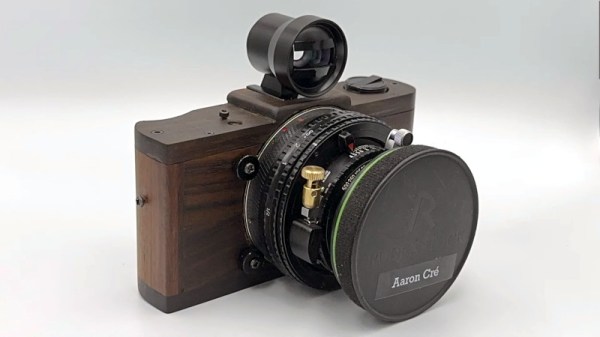
An old-fashioned film camera can be an extremely simple device to make, in that as little as a cardboard box with a pin hole in it will suffice. But that simplicity at heart leaves endless scope for further work, and a home-made camera can be every bit as much a highly-engineered object of beauty as its commercial stablemate. A great example comes from [Aaron Cré], whose desire for something close to a Hasselblad XPan panoramic camera led him to build his own equivalent out of wood.

The video below the break shows in detail how the wooden case is crafted, and how a lens mount ring sawn from a lens adapter is mounted on the front of it. He’s skipped making all the tiresome parts of the camera associated with winding and film transport and instead taken them from a cheap plastic snapshot camera. The original aspect ratio is stretched by cutting the guts of the snapshot camera apart, and extended to make a 75 mm long negative which also exposes over the sprocket holes.

The final camera is carefully finished to the point at which it really looks the part as well as taking those striking wide-angle photographs. We’re not photography buffs enough to identify the lens and shutter combination he’s using, but we can’t help envying him the results. Fancy making your own 35 mm camera too? Here’s another, in case you need inspiration.

Continue reading “Wooden Wide-Angle Wonder Wows World”

Liberté, égalité, Fraternité: France Loses Its Marbles On Internet Censorship

Over the years we’ve covered a lot of attempts by relatively clueless governments and politicians to enact think-of-the-children internet censorship or surveillance legislation, but there’s a law from France in the works which we think has the potential to be one of the most sinister we’ve seen yet.

It flew under our radar so we’re grateful to [0x1b5b] for bringing it to our attention, and it concerns a proposal to force browser vendors to incorporate French government censorship and spyware software in their products. We’re sure that most of our readers will understand the implications of this, but for anyone not versed in online privacy and censorship  this is a level of intrusion not even attempted by China in its state surveillance programme. Perhaps most surprisingly in a European country whose people have an often-fractious relationship with their government, very few French citizens seem to be aware of it or what it means.

It’s likely that if they push this law through it will cause significant consternation over the rest of the European continent. We’d expect those European countries with less liberty-focused governments to enthusiastically jump on the bandwagon, and we’d also expect the European hacker community to respond with a plethora of ways for their French cousins to evade the snooping eyes of Paris. We have little confidence in the wisdom of the EU parliament in Brussels when it comes to ill-thought-out laws though, so we hope this doesn’t portend a future dark day for all Europeans. We find it very sad to see in any case, because France on the whole isn’t that kind of place.

Header image: Pierre Blaché CC0.

Only 8 Chips Make A CPU

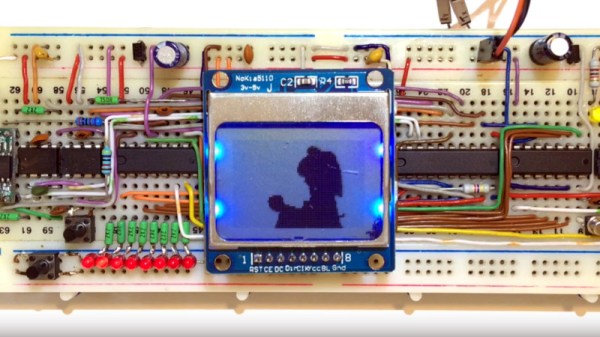
We’re no stranger to homemade CPUs on these pages, but we think that [Jiri Stepanovsky]’s 16-bit serial CPU might be a little special. Why? It has an astonishingly low chip count, with only 8 ICs in total. How on earth does he do it?

While a traditional TTL CPU has a relatively high chip count due to a parallel data bus, registers, and discrete ALU, this one takes a few shortcuts by opting for a one-bit serial bus with serial memory chips and an EPROM serving as a look-up-table ALU. Perhaps the most interesting result of this architecture is that it also allows the CPU to dispense with registers, like the Texas Instruments 16-bit chips back in the day. They all live in memory. You can see it below the break in action, streaming a video to a Nokia-style LCD.

Such a CPU would indeed have been unlikely to have been made back in the day due to the prohibitive cost of buying and programming such a large EPROM. However, old computers like the EDSAC also used a serial data path and mercury delay line memory to manage complexity. But for a solid-state CPU in 2023, we think the design is innovative. We think it would be challenging to reduce the chip count further — and no, we’re not counting designs that use a microcontroller to replicate a block of circuitry; that’s cheating — but we’re sure that somewhere there’s a designer with ideas for slimming the design further.

Continue reading “Only 8 Chips Make A CPU”

Linux, Running On Not A Lot

There are many possible answers to the question of what the lowest-powered hardware on which Linux could run might be, but it’s usually a pre-requisite for a Linux-capable platform to have a memory management unit, or MMU. That’s not the whole story though, because there are microcontroller-focused variants of the kernel which don’t require an MMU, including one for the Xtensa cores found on many Espressif chips. It’s this that [Naveen] is using to produce a computer which may not be the Linux computer with the lowest processor power, but could be the one consuming the least electrical power.

The result is definitely not a Linux powerhouse, but with its Arduino-sourced ESP32 board stacked on an UNO and I2C keyboard and display, it’s an extremely lightweight device. The question remains, though, is it more than a curiosity, and to what can it do? The chief advantage it has over its competitors such as the Raspberry Pi Zero comes in low power consumption, but can its cut-down Linux offer as much as a full-fat version? We are guessing that some commenters below will know the answer.

If you’re curious about the Xtensa version of Linux, it can be found here,

A Time-Lapse Film, Not A Time-Lapse Video

We’re used to time-lapse photography being merely a feature of our smartphone camera app, but of course it has its origins in film. A movie camera would be triggered frame by frame at fixed intervals, with the result being the timelapse. A dead art, you might wonder, were it not for [Kevin Santo Cappuccio], who is capturing his work in timelapse on 16mm film, with a vintage Bolex camera.

For those of us with a penchant for film the camera alone makes it worth a second look, but the actuation mechanism is at the heart of the project. It uses a slightly unusual but nevertheless strangely ubiquitous actuator, in the form of a car door central locking actuator. This in turn is triggered by an Arduino Nano, and he has the ultimate dream of using a 16mm film timelapse as part of a fully-16mm submission video for the Hackaday prize.

We think it’s a pity that more film-based projects don’t end up on these pages, so we’re very pleased indeed to see this one. If you’re curious about the other side of the 16mm system, well we’ve introduced you to the inner workings of a projector before, too.