End Of An Era, As LEGO To Discontinue Mindstorms

When there are so many single board computers and other products aimed at providing children with the means to learn about programming and other skills, it is easy to forget at time before the Arduino or the Raspberry Pi and their imitators, when a computer was very much an expensive closed box.

Into this late-’90s vacuum left in the wake of the 8-bit home computer revolution came LEGO’s Mindstorms kits, a box of interlocking goodies with a special programmable brick, which gave kids the chance to make free-form computerized robotic projects all of their own. The recent news that after 24 years the company will discontinue the Mindstorms range at the end of the year thus feels like the end of an era to anyone who has ridden the accessible microcontroller train since then.

What became Mindstorms has its roots in the MIT Media Lab’s Programmable Brick project, a series of chunky LEGO bricks with microcontrollers and the Mindstorms LEGO brick contacts for motors and sensors. Their Logo programming language implementation was eschewed by LEGO in favor of a graphical system on a host computer, and the Mindstorms kit was born. The brand has since been used on a series of iterations of the controller, and a range of different robotics kits.

In 1998, a home computer had morphed from something programmable in BASIC to a machine that ran Windows and Microsoft Office. Boards such as Parallax’s BASIC Stamp were available but expensive, and didn’t come with anything to control. The Mindstorms kit was revolutionary then in offering an accessible fully programmable microcontroller in a toy, along with a full set of LEGO including motors and sensors to use with it.

We’re guessing Mindstorms has been seen off by better and cheaper single board computers here in 2022, but that doesn’t take away its special place in providing ’90s kids with their first chance to make a proper robot their way. The kits have found their place here at Hackaday, but perhaps most of the projects we’ve featured using them being a few years old now underlines why they are to meet their end. So long Mindstorms, you won’t be forgotten!

Header image: Mairi, (CC BY-SA 3.0).
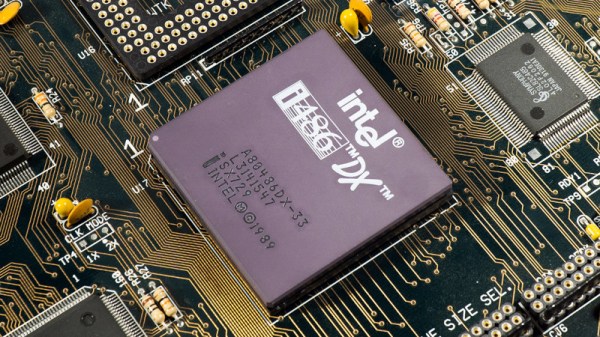
Bye Bye Linux On The 486. Will We Miss You?

A footnote in the week’s technology news came from Linus Torvalds, as he floated the idea of abandoning support for the Intel 80486 architecture in a Linux kernel mailing list post. That an old and little-used architecture might be abandoned should come as no surprise, it’s a decade since the same fate was meted out to Linux’s first platform, the 80386. The 486 line may be long-dead on the desktop, but since they are not entirely gone from the embedded space and remain a favourite among the retrocomputer crowd it’s worth taking a minute to examine what consequences if any there might be from this move.

Is A 486 Even Still A Thing?

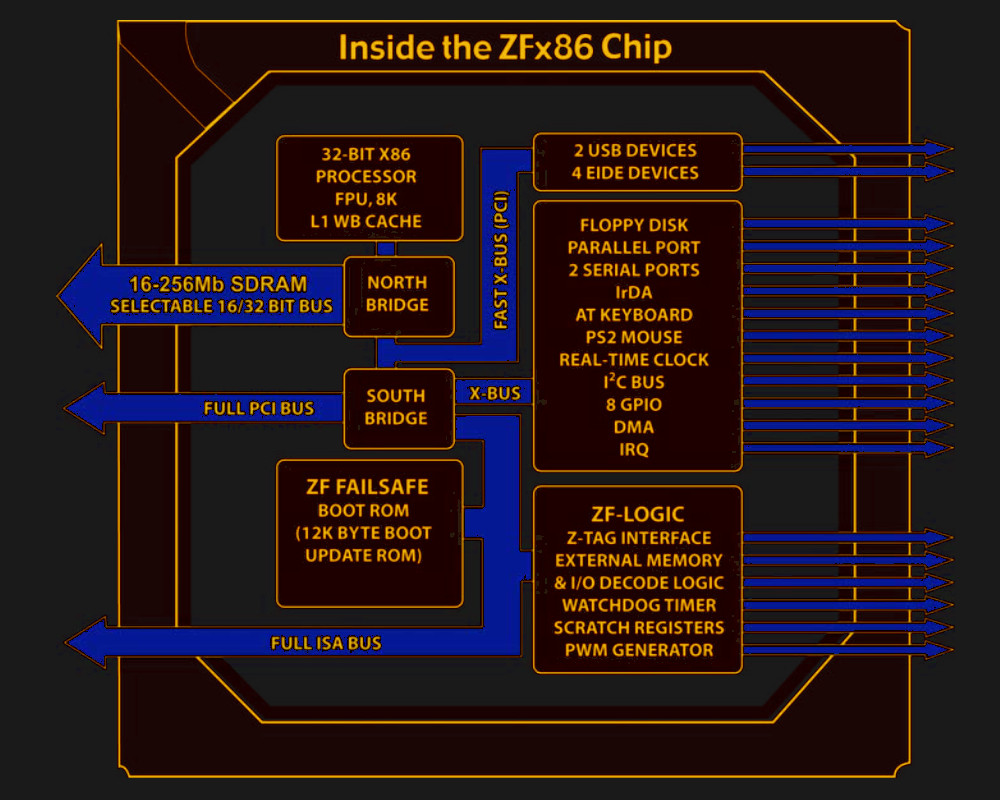
Block diagram of the ZFx86 SoC
An entire 486 PC in a chip that only uses 1W, that would have been amazing in 1994!

The Intel 80486 was released in 1989, and was substantially an improved version of their previous 80386 line of 32-bit microprocessors with an on-chip cache, more efficient pipelining, and a built-in mathematical co-processor. It had a 32-bit address space, though in practice the RAM and motherboard constraints of the 1990s meant that a typical 486 system would have RAM in megabyte quantities. There were a range of versions in clock speeds from 16 MHz to 100 MHz over its lifetime, and a low-end “SX” range with the co-processor disabled. It would have been the object of desire as a processor on which to run WIndows 3.1 and it remained a competent platform for Windows 95, but by the end of the ’90s its days on the desktop were over. Intel continued the line as an embedded processor range into the 2000s, finally pulling the plug in 2007. The 486 story was by no means over though, as a range of competitors had produced their own take on the 486 throughout its active lifetime. The non-Intel 486 chips have outlived the originals, and even today in 2022 there is more than one company making 486-compatible devices. RDC produce a range of RISC SoCs that run 486 code, and according to the ZF Micro Solutions website they still boast of an SoC that is a descendant of the Cyrix 486 range. There is some confusion online as to whether DM&P’s Vortex86 line are also 486 derivatives, however we understand them to be descendants of Rise Technology’s Pentium clone. Continue reading “Bye Bye Linux On The 486. Will We Miss You?”

Identify That Antenna By Sight

It’s a skill that radio amateurs pick up over years but which it sometimes comes as a surprise to find that is not shared by everyone, the ability to casually glance at an antenna on a mast or a rooftop and guess what it might be used for. By which of course I mean not some intuitive ability to mentally decode radio signals from thin air, but most of us can look at a given antenna and immediately glean a lot of information about its frequency and performance. Is this privileged knowledge handed down from the Elmers at the secret ceremony of conferring a radio amateur’s licence upon a baby ham? Not at all, in fact stick around, and I’ll share some of the tricks. Continue reading “Identify That Antenna By Sight”

Moving Big Stuff Without The Tears

It’s something that has probably happened to more than one of us over the years, there’s an unmissable opportunity at the machinery auction or on eBay, with the small snag that it weighs a ton and requires a flatbed truck to transport. A big lathe, a bandsaw, or the like.

The sensible option would be to hire a crane or a forklift to do the job, but cash is tight so at the appointed hour the truck turns up at the end of your driveway to meet you and as big a group of your friends as you could muster. You’re going to shift this thing with pure muscle power! If you grow up around any form of workshop-based small business it’s something you’ll no doubt be familiar with. Craftsmen seem to have a network for such moments, so just as the blacksmith might find himself helping the woodworker unload a huge saw bench, so might they both spend an unexpected afternoon at the engineering shop manhandling a lathe.

It came as a shock in a casual hackerspace conversation to realise how many times I’d been involved in such maneuvers at home, for friends, or at hackerspaces, and how that experience in doing so safely isn’t necessarily something that’s universal. Maybe it’s time to tell the story of moving big machines on limited resources. This is something that starts by thinking ahead and planning what you’ll need and where you’ll need it. Continue reading “Moving Big Stuff Without The Tears”

All Your Pixels Are (Probably Not) Belong To Pantone

There’s a piece of news floating around the open IP and allied communities at the moment which appears to have caused some consternation. It comes from Adobe, who have announced that due to an end of their licensing deal with Pantone LLC, PSD images loaded into Photoshop will have pixels containing unlicensed Pantone colours replaced with black. What, Pantone owns colours now? Are we expected to pay a royalty every time we take a picture of a blue sky? It’s natural to react with suspicion when hearing a piece of news like this, but for once we think this might not be the unreasonable intellectual property land grab it may first appear. To illustrate this, it’s necessary to explain what Pantone does, and what they don’t do. Continue reading “All Your Pixels Are (Probably Not) Belong To Pantone”

2022 Cyberdeck Contest: Prototype Cyberdeck Is Anything But Questionable

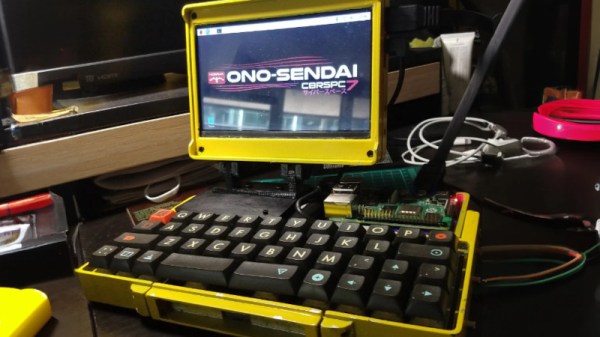
We see many projects here at Hackaday, about which their creators are unreasonably modest. We like a good cyberdeck, and we think [betaraybiff] is one of those creators from their project description for a Prototype Cyberdeck of Questionable Practical Use. It may be a prototype, but we think it could be quite a practical computer.

At its heart is the ubiquitous Raspberry Pi 4 paired with a PiSugar power supply and a minimalist mechanical keyboard. The case is the interesting part, because it’s well-designed to be 3D printed in sections with the HDMI display hinging up from above the keyboard. The Pi is open and visible on top of the deck, but this could easily be covered with another printed piece if desired.

So we disagree on the practicality, given a train journey and this cyberdeck we think we could easily crack out a Hackaday article or two. Never undersell your creations, like this one they’re almost certainly better than you think.

If you’d like to see more of the 2022 Cyberdeck Contest, take a look at the best of the best.

Fiber Laser Your Way To Flexible PCB Success!

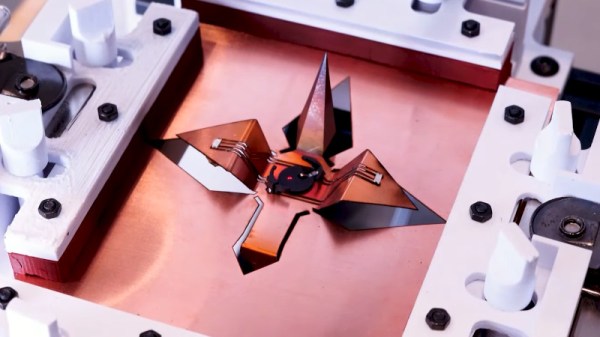
It’s not often we feel that something we’re featuring is a genuinely new and groundbreaking technique, but a team from the University of Maryland’s Small Artifacts Lab may have done just that with their foldable and flexible PCBs created using a fiber laser engraver.

Laser engraving a PCB is nothing new, but they’ve taken a custom PCB material made using Kapton tape and copper foil, and fine-tuned the engraver to not only selectively remove copper, but also to create in-place folds in the Kapton substrate. They have even used the laser to melt solder paste and solder components, though we’re not so convinced about the quality as seen in the video below the break. This means that they can not only create 3-dimensional PCB sculptures but also useful structures such as their example of an all-PCB micro switch. To make things easy they’ve even created a custom CAD package for designing in this medium.

Perhaps best of all, there appears to be nothing here that couldn’t be also performed outside the lab by anyone with enough Kapton and copper, and a fiber laser. We’re looking forward to where this technique will go. If you’re interested, you can read their paper here.

Continue reading “Fiber Laser Your Way To Flexible PCB Success!”