A No-Calibration Metal Detector

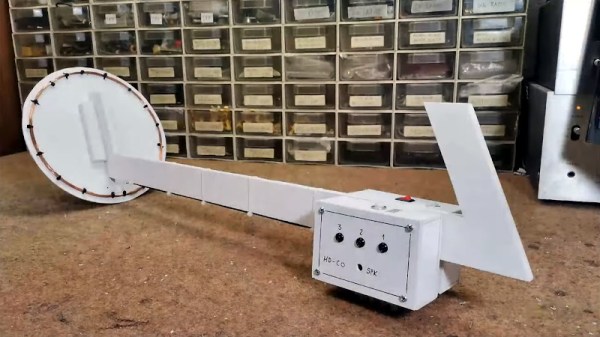
A traditional early project for someone discovering a love for electronics has been for many years a metal detector. This would mean a few transistors back in the day, but today it’s more likely to involve a microcontroller. [Mircemk] has an example that bends both worlds, with a single transistor oscillator and an Arduino.

This type of metal detector has a large search coil which forms part of the tuned circuit in an oscillator. As a piece of metal enters its range the frequency of oscillation changes. In the old days, this would have been detected as an audible beat frequency with another oscillator. This design would require a calibration step at the start of detecting, to tune the two oscillators to the same frequency.

This detector keeps the first oscillator but eschews the second one in favor of an Arduino. The microcontroller acts as a frequency counter, monitoring the frequency and issuing an alarm when it detects a change likely to be caused by a piece of metal. It may not have some of the finess a human ear could apply to a beat frequency in the all-analogue days, but it’s simple enough to build and it avoids the need for calibration. Seeing it in the video below the break we’re sure that just like those transistor models old, there will be plenty of fun to be had with it.

An Arduino may be one of the current go-to parts, but will it ever displace the 555? Perhaps not in the world of metal detectors!
Continue reading “A No-Calibration Metal Detector”

It’s Linux. On An ESP32

By today’s standards, the necessities for running a Linux-based operating system are surprisingly meagre in terms of RAM and processor power. Back in the day we ran earlier Linux versions on Intel 386 and 486 machines with tiny quantities of memory compared to the multi-gigabyte many-core powerhouses we do today.

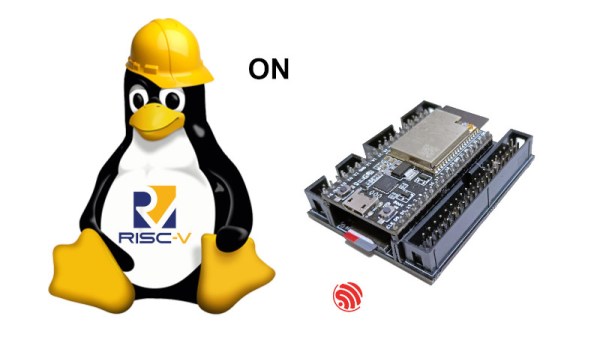
So it stands to reason that many of the more powerful microcontrollers should also run Linux, but of course they are often unable because the lack a memory management unit. The original ESP32 is just such a candidate, plenty of power but unable to run Linux. Not so fast, because [Dror Gluska] has managed to boot a Linux kernel on Espressif’s dual-core chip. How on earth? By emulating a RISC-V processor on it and booting a RISC-V version of the kernel.

The emulator in question is [Fabrice Belard]’s TinyEMU, a piece of software that brings both RISC-V and x86 to limited-spec platforms, and the write-up describes the extensive optimization and tracing of ESP32 bottlenecks which was finally able to get a Linux kernel booting in 1 minute and 35 seconds. Of course it’s simply an exercise to prove it can be done and we won’t be seeing Linux-based ESP projects any time soon, but it’s still an impressive piece of work.

This isn’t the lowest-spec microcontroller we’ve seen run Linux, back in 2012 we saw it on emulated ARM running on an 8-bit AVR.

CP/M Is Now Freer Than It Was

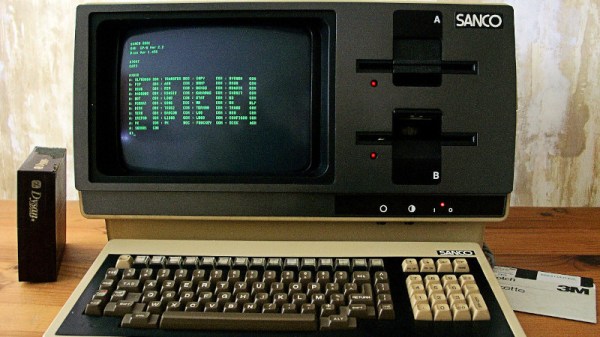
It’s easy to think of the earlier history of desktop computing operating systems in terms of DOS, Windows, and Mac OS with maybe a bit of AmigaOS, TOS, or RiscOS thrown in. But the daddy of desktop computing, the OS that put word-processors and spreadsheets in 1970s offices and had a huge influence on what followed, isn’t among that list. Digital Research’s CP/M ran initially on Intel 8080-based machines before losing out to MS-DOS as IBM’s choice for their PC, and then gradually faded away over the 1980s. Its source has been available in some form with a few strings for a long time now, but now we have confirmation from Digital Research’s successor company that it’s now available without restrictions on where it can be distributed.

For years it was something an operating system that had been bypassed by the hardware and hacker communities, as the allure of GNU/Linux was stronger and most available CP/M capable machines were also 1980s 8-bit gaming platforms. But with the more recent increased popularity of dedicated retrocomputing platforms such as the RC2014 it’s become a more common sight in our community. Brush up your command line skills, and give it a go!

Header: Michael Specht, CC BY-SA 3.0.

A Guitar From Scratch

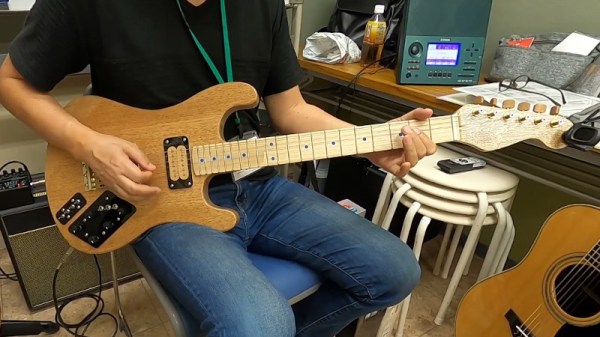
You can pursue your dreams of rock superstardom with any guitar, be it from an expensive luthier, a pawn shop, or a mail order catalog. But to join the ranks of rock greats there’s one way to have a truly special instrument, which is to build it yourself. [Bensoncraft] may not be [Bryan May]’s dad or indeed [Eddie van Halen], but he has at least joined the exclusive ranks of home made guitar builders with his video “Guitar from scratch: hard mode“.

It’s a fairly long video and we’ve placed it below the break, but a compelling one as we learn just how many operations go into making an electric guitar. When he says hard mode he’s not joking, there are no pre-made parts save for the strings and he’s not following a set of plans. Everything including the tuners and pickups are made from scratch, but for a non-guitar-player it’s she sheer number of different pieces of wood that go into making the solid body and neck of the instrument that’s so interesting. Even if you’ll never make a guitar you should watch it.

We’ve never seen a guitar build quite like this one before, but we have brought you a 3D printed guitar body, and neck.

Continue reading “A Guitar From Scratch”

Even DOOM Can Now Run DOOM!

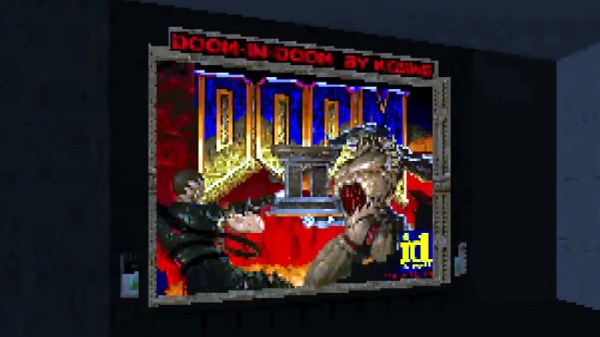
For years now, the standard test of any newly hacked piece of hardware has been this: can it run DOOM? id Software’s 1993 classic first-person shooter has appeared on everything, but here’s one from [kgsws] that’s a bit special. It’s DOOM, running inside DOOM itself.

So how has this feat been achieved? There’s a code execution exploit inside the original DOS DOOM II executable, and that has been used to run the more modern Chocolate Doom within the original. It appears as an in-game texture, giving an odd effect as if it’s being watched in a cinema.

The video below the break shows the game-in-game in action, but the real value lies in its in-depth description of the exploit, that takes us through some of the inner workings of the game and ably explains what’s going on. It finishes up with a specially made cinema WAD in which to play DOOM-in-DOOM, and even Hexen-in-DOOM. Pick up your trusty chainsaw, it’s going to be a long night.

Continue reading “Even DOOM Can Now Run DOOM!”

Burn Pictures On A CD-R, No Special Drive Needed

When we routinely carry devices holding tens or hundreds of gigabytes of data, it’s sometimes a shock to remember that there was once a time when 650 MB on a CD was a very big deal indeed. These now archaic storage media came first as silver pre-recorded CD-ROMs, then later as recordable CD-Rs. Most people eventually owned CD writer drives, and some fancy ones came with the feature of etching pictures in the unused portions of the disc.

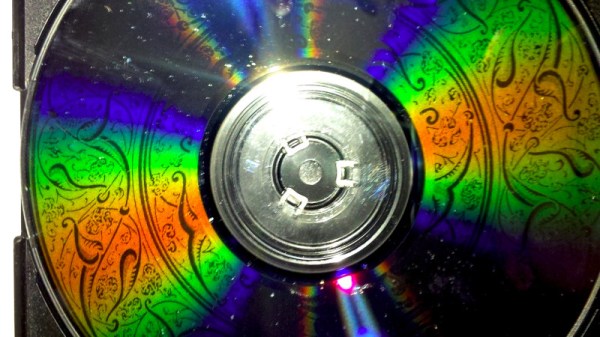
Haven’t got a fancy drive and desire an etched CD-R? No worries, [arduinocelentano] has a solution, in software which writes a disk image for a standard CD writer whose data makes the visible image on the disc.

CD-Rs have a thin layer of phthalate dye sandwiched between the polycarbonate disc and a silvered layer of lacquer. They’re often gold coloured, but the silvering is in fact just aluminium. The data is encoded as a series of pits and lands crested by the laser vapourising small portions of the dye to make holes.

The code creates a data structure of a standard CD-ROM session which doesn’t contain any usable data, instead whose pits and lands are arranged to form the image. You can find it all in a GitHub repository, and have a go at creating your own offerings. We would have made a Wrencher disc for our pictures, but sadly for some of us who were once in the thick of it we don’t have any CD-Rs any more.

Your Console, Your Cartridge, You Choose? Nintendo Faces A Challenge

If you read our articles, you’ll notice that we will usually feature images related to the subjects we talk about. If they came from another source and they’re not CC-licensed or similar then they are the property of someone else but we are using them under a doctrine known as fair use. Excerpts of copyrighted material may be used under fair use for the purposes of such things as journalistic reporting, so for example we can use a copyrighted picture of Captain America were we to write about Marvel superheroes. Some content owners still try to stop this, and it’s one of them that [Linus Tech Tips] has in their sights as they have published a guide to running Nintendo Switch games on a Steam Deck without they believe giving any justifiable cause for the notoriously litigious game giant to take action. It’s full of carefully blurred Nintendo IP, and there is no coverage of pirate software downloads.

On one hand it’s about a heavy-handed console developer taking down small online content producers, but there’s another angle which is far more relevant to the hardware community who read Hackaday. It also has application in the field of software emulation, because while the console manufacturer would prefer to stop all but their own unmodified hardware running a game there should be nothing to stop a legally owned piece of software or hardware being run in any way its owner chooses. This is the central thesis explored at the end of the video, and the gimmick of trying to draw Nintendo into the open on the matter is their way of bringing publicity to it.

Even though [Linus Tech Tips] is probably one of the most viewed technology YouTube channels, it’s clear that Nintendo will have the deeper pockets should they choose to rise to the bait. So we’re sure their lawyers are all over this as we write, but we’d be interested to see whether the claims made in the video are enough to see it stay up. It would be nice to think that it might cause Nintendo to reconsider some of their policies, but we’re not holding our breath. Continue reading “Your Console, Your Cartridge, You Choose? Nintendo Faces A Challenge”