Building A Digital Library Of Amateur Radio And Communications

For years the Internet Archive has provided the online community with a breathtaking collection of resources, out of print books, magazines, recordings, software, and any other imaginable digital asset in easily retrievable form. Now with the help of a grant from the Amateur Radio Digital Communications Foundation they are seeking to create a collection that documents amateur radio from its earliest days to the present.

The work will be multi-faceted, and include the print and digital materials we’d expect, as well as personal archives and oral histories from notable radio amateurs. For many of us this will provide a wealth of technical details and insights into taming the ionosphere, but for future historians it will be an invaluable reference on the first century of the hobby.

Amateur radio is perhaps the oldest hardware hacking pursuit of the electronic age, because certainly at the start, radio was electronics. Thus amateur radio’s long history has indirectly given us many of the things we take for granted today. Sure it has its moribund aspects, but we think if it continues to follow the growth of new technology as it has for so many years it will continue to be an exciting pursuit. We look forward to browsing this archive, and we hope to see it grow over the years.

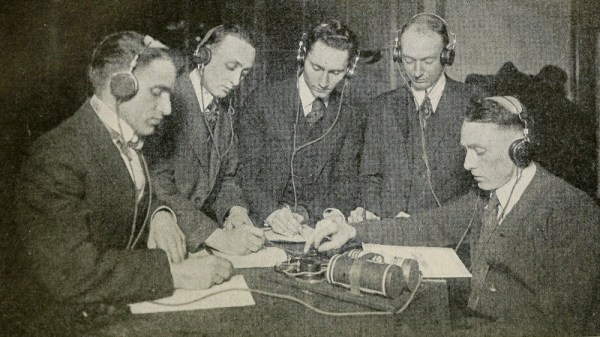
Header image: Lescarboura, Austin C. (Austin Celestin), 1891-, No restrictions.
Retro Speaker Becomes The Perfect Micro PC

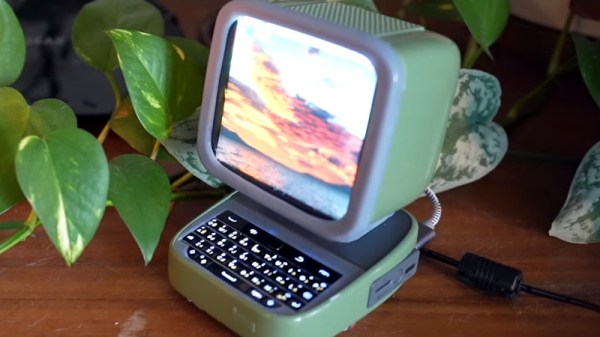
We’ve seen many cyberdecks and home built computers in our time here at Hackaday, but we’ve not seen many so tiny and so neatly built as this one from [Carter Hurd]. It takes the form of a tiny retro PC with a working display and keyboard, and we like it a lot.

The diminutive computer started life as a neat little retro themed Bluetooth speaker that a company bravely sent him for a project when he declined the chance to review it. Out came the speaker and electronics, and in went a USB Blackberry keyboard with a custom made bezel where the speaker’s keys had been.

The display is a 4″ LCD designed for a Raspberry Pi, and somewhat incredibly, he trimmed its corners to fit into the case. Making the curved CRT-style display front was achieved with vacuum form plastic, and a new display bezel was 3D printed.

A full-size Raspberry Pi fits in the base of the unit, and here he admits that it’s not the tidiest job. Perhaps a Pi Zero would have been more unobtrusive, but either way from the top and front it’s a really cute little machine. It may not be the only tiny cyberdeck we’ve seen, but it’s certainly a well-built one.

Continue reading “Retro Speaker Becomes The Perfect Micro PC”

The State Of The SBC Interface Ecosystem, Is It Time To Design A Standard?

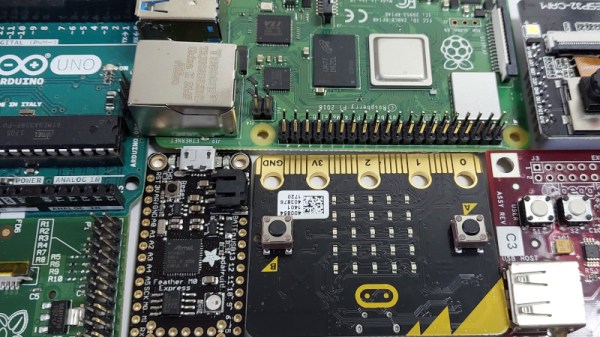
We are spoiled for choice when it comes to single board computers, whether they be based around a microcontroller or a more capable SoC capable of running an operating system such as GNU/Linux. They can be had from well-established brands such as Arduino, Adafruit, or Raspberry Pi, or from a Wild West of cheaper Far Eastern modules carrying a plethora of different architectures.

Everyone has their own favourite among them, and along with that comes an ecosystem of operating systems and software development environments. There’s another aspect to these boards which has evolved; certain among them have become de facto interface connector standards for hardware peripherals. Do these standards make any sense? Let’s talk about that.

Continue reading “The State Of The SBC Interface Ecosystem, Is It Time To Design A Standard?”

A Compressor Of Compressors Breaks The Noise Barrier

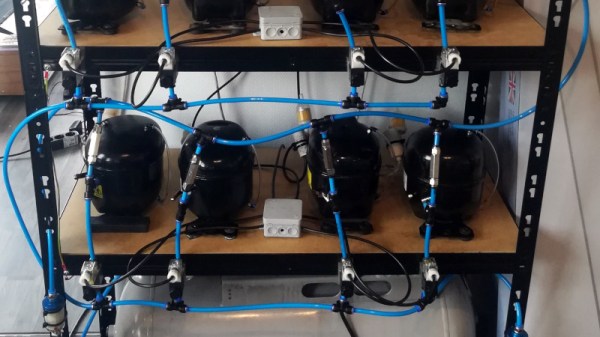
Having compressed air available in a workshop can be extremely useful. Having a compressor isn’t such a pleasure though, because unless it’s a very expensive model, it will be one of the noisier devices you own. Other than putting your compressor outside, is there a solution to the noisy side of having an air line? [Dominik Meffert] may have found one for his CNC plasma cutter in the shape of a rack of much quieter fridge compressors arranged in parallel with an air tank.

Of course, there’s nothing new about using a fridge compressor in the workshop. Indeed, such units are even commercially available as compressors for low-capacity tasks such as airbrushing. But we’ve never seen so many at once. It’s not entirely apparent how he’s handling the replacement of any lubricating oil that’s being caught in his filters, and we hope the refrigerant was disposed of safely, but we can see he’s on to something.

Fridge compressors have appeared here many times over the years, for more than compressing, we’ve even seen one as an engine. They aren’t always as strongly built as they should be though.

This Computer Is Definitely Not A Toy

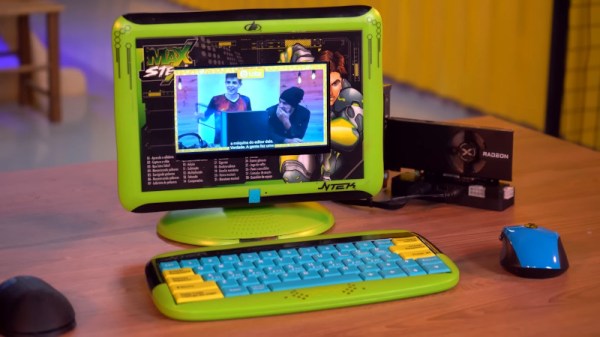
If you’ve ever eyed up a kids laptop and wondered whether it could take an upgrade with a single board computer, you’re not alone. [Labz] have taken a couple of Brazilian Max Steel toy computers from a decade or more ago, and made them into usable if unconventional portable computers (Brazilian Portuguese, but YouTube’s subtitle translation is your friend).

The computers are similar to the ones you may be familiar with from the likes of VTech, a QWERTY keyboard and fairly conventional form factor but with a tiny monochrome LCD and a few built-in games. In the video below the break we see both the laptop and desktop variants butchered with a rotary tool to receive new larger screens, with the laptop getting a Raspberry Pi and the desktop getting a small form factor PC. The laptop needed a 3D printed extension to make extra space, while the desktop received a PCI Express extension cable for a video card. Finally, an Arduino took care of the keyboard.

The cherry on the cake for this video comes at the end, when they find the now-grown-up kid from the original advert. Meanwhile, kids computers have featured here before a few times.

Continue reading “This Computer Is Definitely Not A Toy”

Hackaday Prize 2022: An Old (and Distinguished) Camera Learns New Tricks

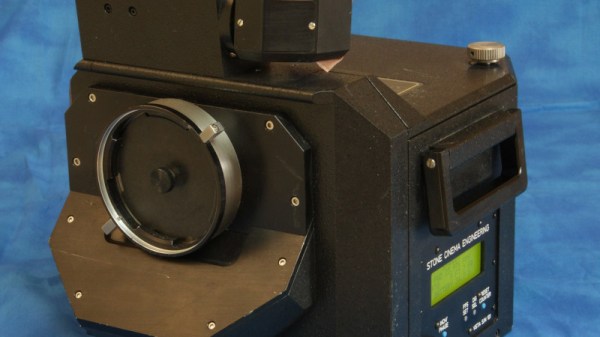
In the 1950s the major Hollywood studios needed impressive cinematic technologies for their epic movies, to both see off the threat from television, and to differentiate themselves from their competitors. For most of them this meant larger screens and thus larger frame film, and for Paramount, this meant VistaVision. [Steve Switaj] is working on one of the original VistaVision cameras made for the studio in the 1950s, and shares with us some of the history and the work required to update its electronics for the 2020s.

VistaVision itself had a relatively short life, but the cameras were retrieved from storage in the 1980s because their properties made them suitable for special effects work. This mostly analog upgrade hardware on this one had died, so he set to and designed a PIC based replacement. Unexpectedly it uses through-hole components for ease of replacement using sockets, and it replaces a mechanical brake fitted to the 1980s upgrade with an electronic pull back on the appropriate reel motor.

The whole thing makes for an interesting delve into some movie history, and also a chance to see some tech most of us will never encounter even if we have a thing for movie cameras.

IBM Made A MIPS Laptop. Will It Make You WinCE?

We’re used to our laptop computers here in 2022 being ultra-portable, super-powerful, and with impressively long battery lives. It’s easy to forget then that there was a time when from those three features the laptop user could usually expect only one of them in their device. Powerful laptops were the size of paving slabs and had battery lives measured in minutes, while anything small usually had disappointing performance or yet again a minuscule power budget.

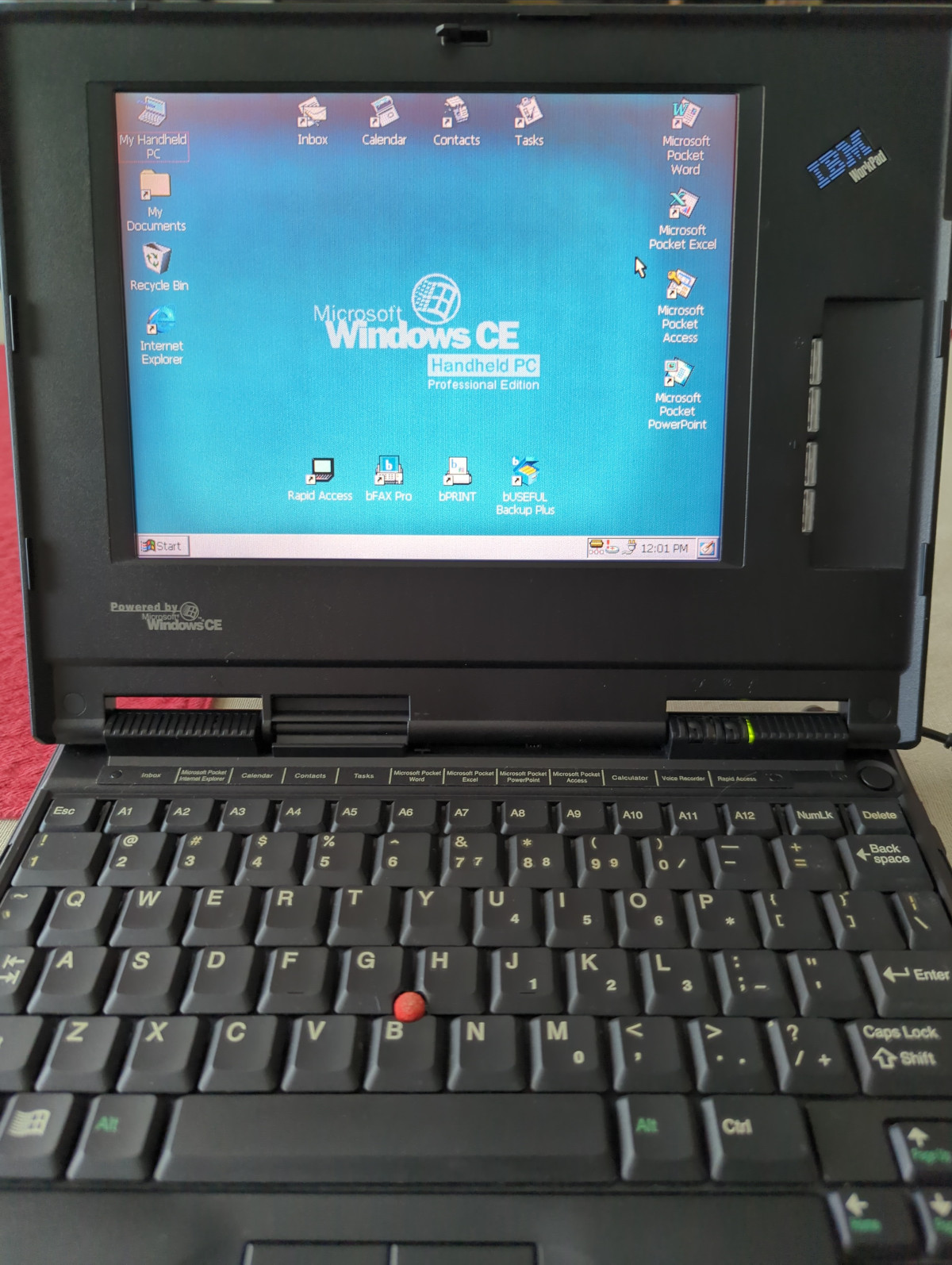
In the late 1990s manufacturers saw a way out of this in Microsoft’s Windows CE, which would run on modest hardware without drinking power. Several devices made it to market, among them one from IBM which [OldVCR] has taken a look at. It makes for an interesting trip down one of those dead-end side roads in computing history.

In the box bought through an online auction is a tiny laptop that screams IBM, we’d identify it as a ThinkPad immediately if it wasn’t for that brand being absent. This is an IBM WorkPad, a baby sibling of the ThinkPad line intended as a companion device. This one has a reduced spec screen and an NEC MIPS processor, with Windows CE on a ROM SODIMM accessible through a cover on the underside. For us in 2022 MIPS processors based on the open-sourced MIPS ISA are found in low-end webcams and routers, but back then it was a real contender. The article goes into some detail on the various families of chips from that time, which is worth a read in itself.

We remember these laptops, and while the IBM one was unaffordable there was a COMPAQ competitor which did seem tempting for on-the-road work. They failed to make an impact due to being marketed as a high-end executive’s toy rather than a mass-market computer, and they were seen off as “real” laptops became more affordable. A second-hand HP Omnibook 800 did the ultra-portable job on this bench instead.

The industry had various attempts at cracking this market, most notably with the netbooks which appeared a few years after the WorkPad was produced. It was left to Google to reinvent the ultra-portable non-Intel laptop as an internet appliance with their Chromebooks before they would become a mass-market device, but the WorkPad remains a tantalizing glimpse of what might have been.

Windows CE occasionally makes an appearance here, and yes, it runs DOOM.