A Rare Drone Common Sense Outbreak, In Denmark

Last September, Denmark was gripped by a spate of drone sightings near airports. It’s familiar territory for Hackaday, as we reported on a similar drone panic saga at British airports back in the last decade. Back then the British police dragged their feet and hid behind secrecy laws for years to avoid admitting they overreacted, but it seems in Denmark they do things differently (Danish language, Google Translate link.).

The Danish police in Jutland have rolled back their report, and noted that a reported observation alone is not enough to confirm a drone was present. It’s not confirmed why they’ve taken this step, but we’ve been told that there’s been an effort within the drone community to identify possible aircraft flight paths which could have resulted in a false drone sighting at the times in question.

We welcome this correction, and hope that its important message travels widely. Of course it is the right thing to do for a police force to take drone reports seriously, but overreacting as the British police did is of little help. We commend the Danish police for taking this step, and we’re likely to trust any drone reports from them a little bit more in the future. If you’d like to read our plea for a sensible response at the time, it’s here.

Thanks [UAVHive] for the tip.

Positioning Without Satellites Or Base Stations

We’re all used to satellite navigation systems such as GPS or GLONASS, sheer magic in which the combination of a set of reference transmitters and super-accurate timing information can be used to calculate a position to an astounding precision. They had land based predecessors such as LORAN and Decca Navigator which worked in a similar fashion but with fixed land-based reference transmitters. Terra is an attempt to do the same thing without a network of dedicated transmitters, instead using FM broadcast transmitters as its fixed points.

This might seem like an impossible task without access to the transmitters, but they have a workaround using the Internet as a backhaul. Instead of transmitting their timing information like the systems mentioned above, they rely on a set of reference receivers sharing it online to the client’s receiver software. So far they have a demo running in Denver.

The interesting thing about this system is that it’s open-source, and requires only a relatively inexpensive software defined radio receiver and a computer to operate. Now anyone with a group of internet-connected friends to set up reference receivers can have their own positioning system, it’s no longer the exclusive preserve of governments. We like this idea, and we look forward to seeing it being tested more widely.

If you’d like to know where we’ve come from, we’ve taken a look at LORAN before.

Review: The Tanmatsu, A Year On

About 18 months ago, we brought you a sneak peek at a handheld that started life in the Dutch conference badge scene. At the time it showed promise, but its software wasn’t ready for a fair review. Now it has both a stable operating system and a growing software library. It’s time to put it through its paces and see what it can do.

A Handheld Computer For Hackers

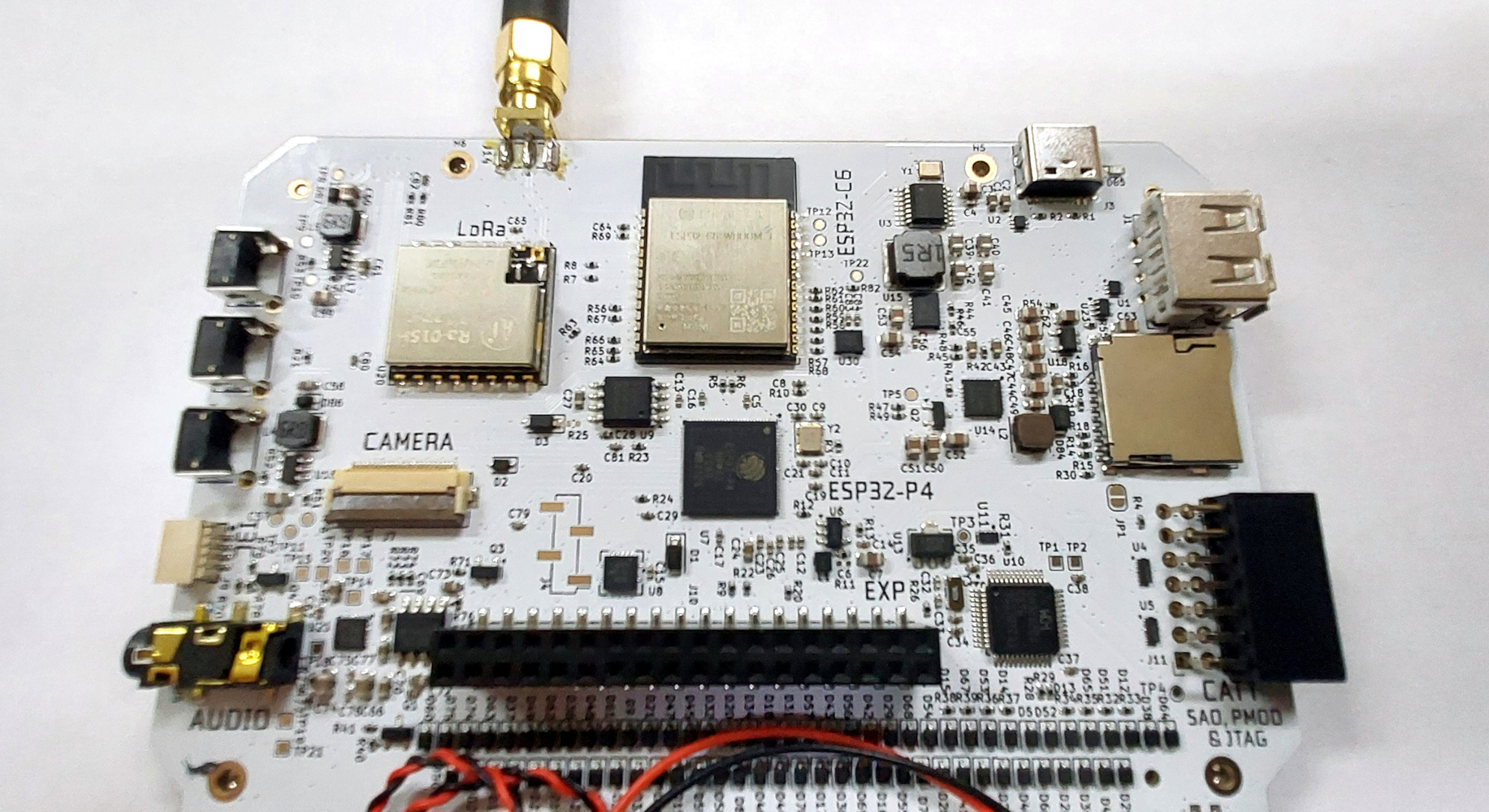
The Tanmatsu PCB, showing all the different parts.
The bare PCB, with the expansion connector bottom centre.

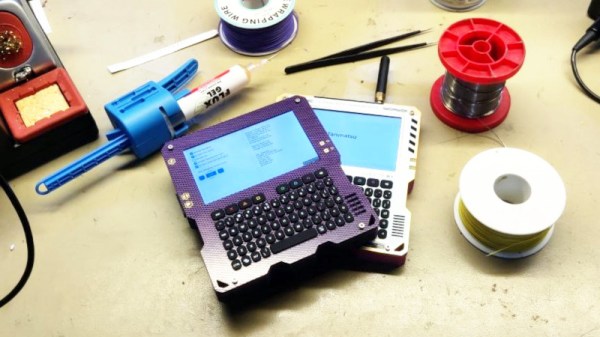
The Tanmatsu (Japanese for “Terminal”), is a general putpose palmtop computer based around an ESP32-P4 application processor from Espressif. It takes the form of a PCB and PETG 3D printed sandwich, with the front face PCB sporting a silicone QWERTY keyboard and an 800×480 MIPI DSI display. The keyboard should be familiar to many readers, being the same moulding as the Solder Party KeebDeck which has appeared on other devices.

Under the hood that P4 has two 400MHz RISC-V cores and 32MB of PSRAM with 16MB of Flash, and there’s an ESP32-C6 for WiFi, BLE and IEEE 802.15.4 mesh networking. There’s an Ebyte LoRa module with an SMA antenna too, which can be had in 868, or 915MHz versions depending on where in the world you live. Continue reading “Review: The Tanmatsu, A Year On”

Mechanical TV, Without The Benefit Of New Parts

There are many experimenters who have had a go at a mechanical television, and though there are a few challenges, it’s a relatively straightforward project in 2026. A hundred years ago though it was still beyond the cutting edge of technology, and that’s where [Paul Kocyla] is placing his build. It’s a mechanical TV system, using only parts that would have been available in the 1920s. The project isn’t finished yet, but we suggest following along for some fascinating insights into developments in early electronics.

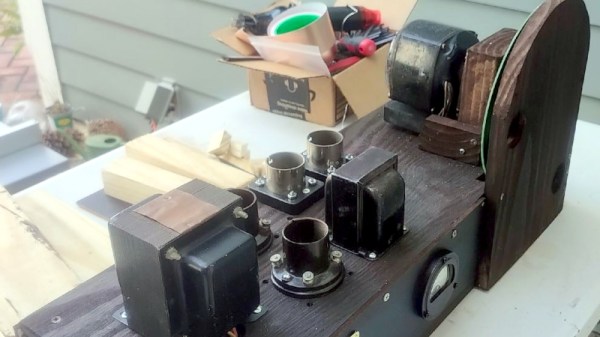
As it stands he has a wooden chassis, a period power supply and amplifier, a synchronous motor, and of course the Nipkow disk that makes it all possible. The electronics aren’t quite finished, and he’s yet to source a neon lamp. This last part may be particularly tricky, as there were specific flat-plate neon lamps made for this application. It’s interesting to find that the motor would synchronize to the grid frequency and would need to be restarted a few times for the frame to be in the right place.

His last posting contains a particularly interesting nugget of information for anyone using tubes. The amplifier carries a 120 Hz hum, something difficult to trace. The culprit is the early tubes with directly heated cathodes formed from the heaters themselves; they had such a low thermal mass that they would “blink” at 120 Hz if fed with AC. A set of period copper oxide rectifiers solve this by feeding DC to the heaters. There’s a YouTube series to follow, and we’ve placed the most recent one in which he fixes the power supply, below the break.

Back in January, we marked the hundredth anniversary of mechanical TV’s invention. Meanwhile, some of us have been known to experiment in this direction too.

Continue reading “Mechanical TV, Without The Benefit Of New Parts”

It’s Linux, On A Sega Megadrive

If you were in the market for a games console in 1990, the chances are that the object of your desire was either a Super Nintendo with its 16-bit 6502 derivative, or the Sega Megadrive, sold as the Genesis in North America, with its Motorola 68000. Both machines featured impressive graphics and sound for their time, but they remain firmly in the 16-bit era. Which makes it a surprise to see LinuxMD. It’s Linux, for the Sega Megadrive, with the latest mainline kernel.

The Motorola 68000 series of chips was the first porting target for Linux, and is still maintained in 2026. This build runs from an SD card  in a modern Megadrive storage peripheral, and is reported to run on the original hardware. The lowly 68000 in the Sega doesn’t have a memory management unit required for the full Linux experience, so what’s really running here is a kernel compiled with the -nommu option. That in itself is a feat, on this architecture. On it you get smolutils, a cut down coreutils, and that seems to be it.

We like this project, for pushing both console and kernel to the limit, even though we see that maybe it’s not the most practical Linux machine. Meanwhile though, this isn’t the only UNIX-like OS for this console.


Image: Evan-Amos, Public domain.

Make Your Own Loudspeaker From Scratch

A loudspeaker is a vital component of every device that plays sound, but while its operation is simple, it’s a surprisingly difficult device to build. [Rvanderouderaa] has made an Instructables post showing a speaker design that it’s claimed, had an impedance that varies by volume (Dutch language, Google Translate link).

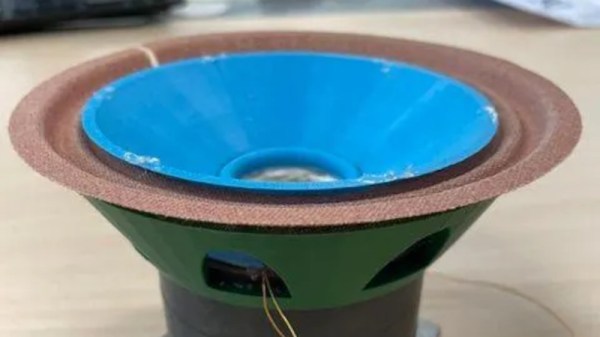
In all moving-coil speakers, a coil of wire is held in a radial magnetic field. To this is attached a cone, and when a current is passed through the coil the whole thing moves to create the sound. The tricky part of making one comes in making the cone itself, and in particular the suspension system that holds it in place while allowing it to move backwards and forwards. It’s normal for these components to be moulded from thick paper.

This design uses a 3D printed frame and cone, with the 3D printing providing excellent rigidity. The suspension system is a circular corrugated sheet, and it’s made in this case using papier-maché made from wet toilet paper, and a 3D printed mould. We particularly like this technique.

This is an impressive build, simply for having made a recognizable and working speaker in the first place. There’s no demo video so we have no idea how it sounds, but for us the point is more in the construction than the reproduction.

If speakers interest you, we’ve taken an in-depth look at them in the past.

A Standalone YouTube Streaming Rig

YouTube streaming typically involves a camera with an HDMI output, a USB3 HDMI digitiser, and a suitably beefy PC to run it all. It’s quite a process, and for [Coreymillia], more complex than it needs to be. He’s come up with something simpler, a dedicated self-contained streaming rig using a Raspberry Pi 4.

As you might expect it uses the Raspberry Pi HQ camera at the optical end, but it’s the software surrounding it that transforms it from a mere camera into a streaming rig. There’s a web based user interface, but perhaps more interesting are the companion dashboard peripherals. A Raspberry Pi or an ESP32 Cheap Yellow Display can both serve as a small in-view dashboard and controller.

We know from experience that a stream can be a difficult thing to get right even with high-end hardware, and we’re interested to see this standalone device allowing , we hope, an easier way to do it. If you’re a streamer we’re guessing you’ll be taking a closer look. Even so, this is surprisingly, not the simplest Raspberry Pi based streaming device we’ve seen.