Automated Pancake Making For Devotees Of Fluffy Pancakes

We have a weakness for automated pancake machines here at Hackaday, but in terms of complete pancake machines rather than CNC batter printers we’re surprised to see more from the rest of the world than we do from the USA. Perhaps this has something to do with differences in opinion on what constitutes a pancake, whether the moniker should be applied to a large and thin disk of cooked batter, or to a smaller, thicker, and fluffier variety. For Europeans only the former will do, while for Americans anything but the latter is simply crêpe. To restore American honour in the world of automated pancakes then, a team of students from Kennesaw State University in Georgia, USA, have built a pancake vending machine for fluffy American-style pancakes as part of their coursework.

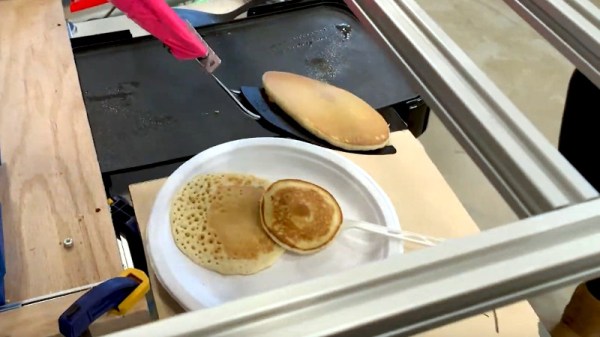
Sadly for the team the COVID-19 pandemic put a stop to their lab work and stopped them making a fully functional vending machine, but the important part of robotic pancake making is something they’ve completely nailed. In the video below the break we see them testing various batter mixes before developing their mixer and batter delivery system, and finally a robotic flipper that cooks the pancakes on a griddle and delivers them to a plate.  It also has the unexpected benefit of stacking pancakes.

We’re sure that without the pandemic they would have made a fully-functional vending machine for lucky Georgia students to sate their appetites upon. Meanwhile for pancake-crazy readers, here are complete pancake making machines from South Africa, and from France.

Continue reading “Automated Pancake Making For Devotees Of Fluffy Pancakes”
A Microcontroller Display With A Classic Twist

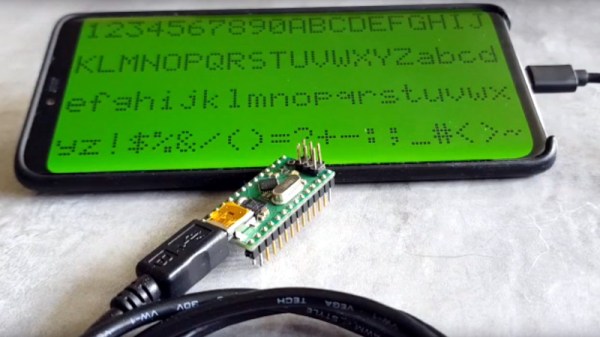
In a fit of lock-down-induced boredom, [Peter Z] has turned his smartphone into an LCD screen (simulation) via an Android app (German language, Google Translate link), so that a mobile device can be plugged into your favourite microcontroller and the classic HD44780 LCD look can be replicated on its screen.

It doesn’t speak standard HD44780, but rather a custom UART serial protocol, so if you’re looking for something to replace a busted LCD, this isn’t your bag. But if you are looking for a large UART terminal for debugging, with a nice aesthetic, you win.

We’d guess that a serial-to-Bluetooth converter could also be made to function, with a bit of work. The protocol is trivial too, meaning that almost any microcontroller could make use of it. All the code as well as the APK is available from the forum linked above, and there is a YouTube video of it in operation below.

The number one complaint in the comments is going to be that this doesn’t emulate a HD44780, so if that’s really what you want, read this deep-dive into the HD44780 and get hacking.

Continue reading “A Microcontroller Display With A Classic Twist”

Wooden Sheet Metal Press Tools Make Steel Toecaps

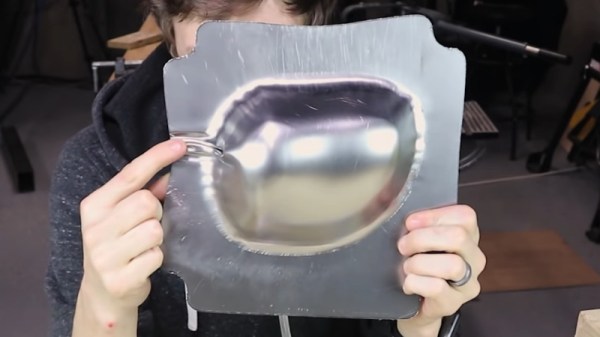
If you have ever looked closely at a typical mass-produced automobile, you will be familiar with pressed-steel panels. Complex curves can be repeated thousands of times over, by putting a sheet of steel between shaped tooling in a press and applying huge force. The same work that would take a skilled panel beater weeks to do by hand, in a second. It’s something [Stuff Made Here] tackled when he wanted to wear a set of Crocs in the workshop, and needed to make the tooling to produce them in his hydraulic press. The resulting video which we’ve posted below the break shows his learning curve, and along the way is a handy primer in sheet metal pressing.

We watch as he discovers the properties of sheet metal under the stress of pressing, how it wrinkles and folds, and how the tool needs careful design and the sheet needs to be securely clamped in place to prevent this. The big surprise is that his tooling is made from CNC-machined wood, while we’re sure that it would wear given repeated use it seems that the forces on the tool are not such as to destroy this material. In the end he’s produced a multi-part tool including both halves of the press tool, a machined guide for the moving part, and a set of substantial sheet metal plates to constrain the material. The steel toecap application may not be everyone’s first idea when it comes to sheet metal forming, but we’re sure this technique could find application in many other projects. It’s a territory into which we’ve edged in the past, but never with pressings this complex.

Continue reading “Wooden Sheet Metal Press Tools Make Steel Toecaps”

Scopetrex Is A Game Console… For Your Oscilloscope!

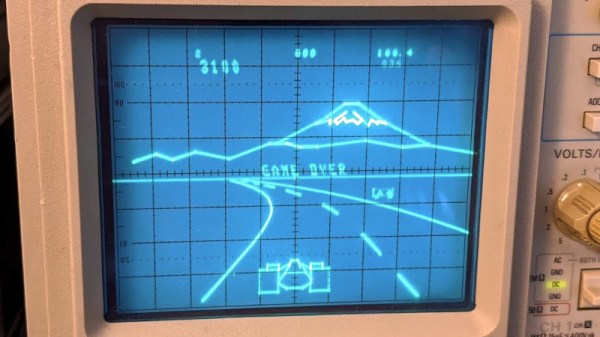
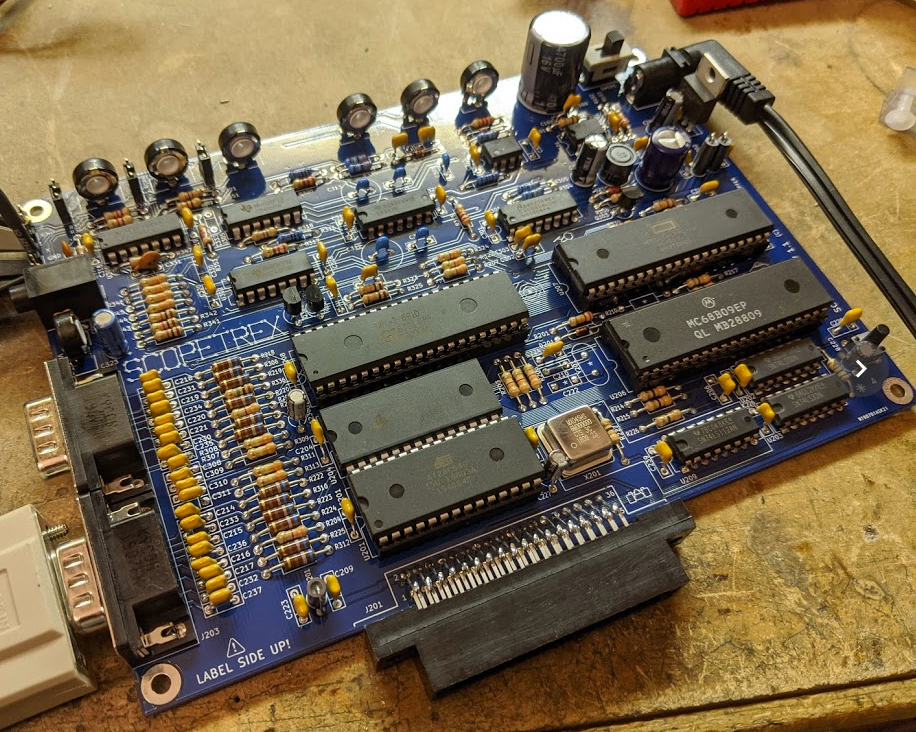
You’ve always wanted a game console at your bench, but maybe you haven’t had space for a monitor or TV set? Wouldn’t it be useful if the screen you do have on your bench could also play games? [Tube Time] has fixed this problem, with Scopetrex, a vector graphic console for your oscilloscope. In fact, it’s better than just a console, because it’s a clone of the legendary Vectrex, the vector-based console with built-in CRT screen from the 1980s.

The board itself is a slightly enhanced version of the original, offering not extra functionality but the ability to substitute some of the parts for more easily found equivalents. It gives full control over display size and brightness, can use the cheaper 6809E processor and AY-3-9810 sound chip if necessary, and only needs a single 5 volt supply. There’s also a custom controller board, which is handly Vectrex-compatible. All you will need to play Vectrex games on your ‘scope once you’ve built this board, are a copy of the Vectrex ROM, and some games.

The Vectrex holds an enduring fascination for our community, and has appeared here many times. Particularly memorable is a CRT replacement, and then of course there’s the never-released mini Vectrex prototype.

Thanks [Justin List] for the tip.

What Will You Do With An Extra 1.2 Gigahertz?

While our collective minds have been turned towards the global pandemic it’s refreshing to hear that in some quarters life has continued, and events that would have made the news in more normal times have continued to take place while they have been replaced in coverage by more urgent considerations.

In the last few weeks there has been a piece of routine American bureaucracy that flew under the radar but which will have a significant effect on global technology; the United States’ Federal Communication Commission first proposed, then ratified, the allocation of an extra 1200 MHz of spectrum in the 6 GHz band to ISM usage. This allocation process is likely to be repeated by other regions worldwide, freeing up another significant piece of spectrum for unlicensed usage.

In practice this means that there will be a whole new set of WiFi channels created, and we’ll all have a little more spectrum to play around with, so it’s worth examining in a little more detail. Continue reading “What Will You Do With An Extra 1.2 Gigahertz?”

Start Printing From Film For Around £100

For the vast majority of readers, the act of taking a photograph will mean reaching for a mobile phone, or for a subset of you picking up a digital camera. A very small number of you will still use chemical film for its versatility and resolution, and we’re guessing that more would join those ranks if some of the cost barriers to doing so could be reduced.

It would be near-impossible to reduce the cost of a chemical photograph to the infinitely repeatable click of a digital camera shutter, but at least if the cost of a darkroom is intimidating then [Sroyon Mukherjee] has an interesting post over at 35mmc about how a darkroom for black-and-white printing from negatives can be equipped for less than £100 ($123). It’s a fascinating read even if your photography remains firmly in the digital, because along the way it explains some of the mysteries of the process. Few people had this type of equipment at home even in the days when most of us took our films to the drugstore, so as time passes this knowledge is concentrated among an ever narrower group.

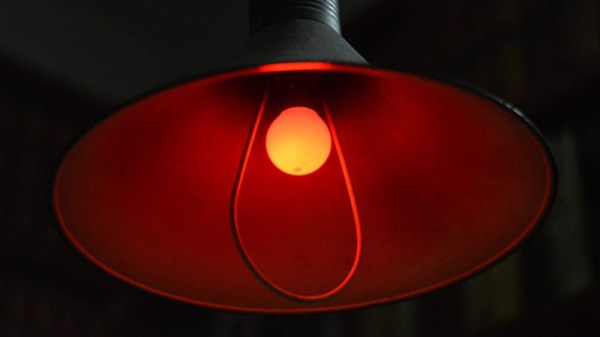
The guide is full of useful hacks. Finding a second-hand enlarger takes an element of patience, but once it has been secured there are a variety of other essential items. The red safe light can be as simple as a mobile phone flashlight with a red filter, but we learn the trick of exposing a sheet of photographic paper with a coin laid on it to check that no white light is sneaking in. One of the main points of the piece is that there is no need for a special room to make a darkroom, and we take a tour of a few photographers’ set-ups in hallways, bathrooms, and basements.

So if you spot an unloved enlarger just waiting for a hacker to pass by, this might inspire you to do something with it. He doesn’t cover the development process, but if you throw caution to the winds you could always try coffee and vitamin C.

[via Hacker News]

The Lost Art Of Component Scavenging

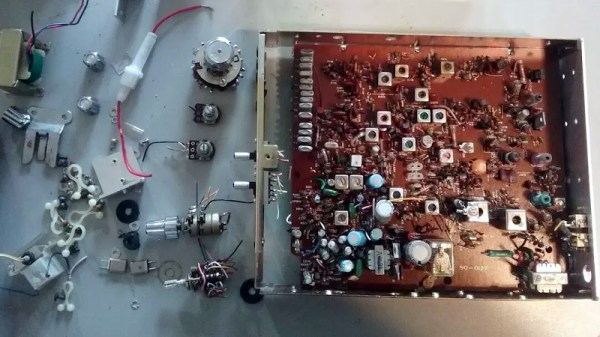
With the easy and cheap availability of parts by Internet mail order, it’s easy to forget that acquiring electronic components was once a more tedious process, and it was common to use salvaged parts because they were what you had. Scouring a panel from a dumpster-find TV for the right resistor may now be a thing of the past, but it’s not entirely dead. [Ryan Flowers] was lucky enough to score a box of old CB radios at a garage sale, and takes us through a teardown in search of parts he can use to make a QRP amateur radio rig. Delving into aged electronics is right up our street!

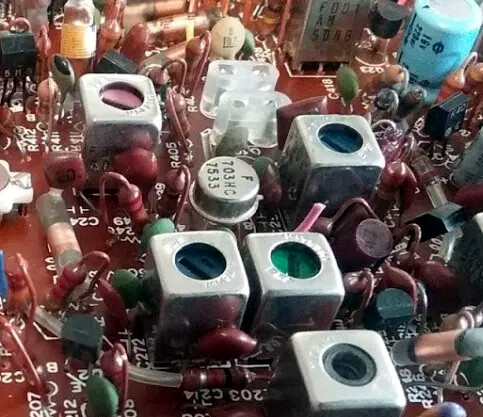
An IF amplifier was high-tech back in '75.
An IF amplifier was high-tech back in ’75.

A possibility for a 27 MHz CB rig is to convert it to the neighbouring 10 m amateur band, but since these were all AM rigs, a mode that sees very little amateur use, it was better to part them out. It’s an interesting study in the evolution of radio design, as an entirely analogue design of mostly discrete components is revealed.

Careful inspection of the photographs reveals a Fairchild uA703 5-transistor IF amplifier chip in a metal can, but that’s about as high-tech as it gets. Unexpectedly there is a huge bank of crystals rather than the frequency synthesiser that would have been standard only a few years later.

He comes away with the chassis, switches and pots, and the RF inductors and crystals from the PCB. Those miniature Toko inductors used to be a common sight, but are now something of a rarity. If you fancy a wallow in semiconductors from this era we’ve previously taken a look at the vintage Fairchild catalogue, in which the uA703 is on page 398.