Just How Can You Lose Something The Size Of A Cargo Ship?

I’m writing from a cozy farmhouse just outside of Oxford, UK where we are slowly emerging from a particularly intense Atlantic storm. Some areas have widespread flooding, while fallen tree branches and damaged roofs are countrywide. Our neighbours in the Irish Republic are first in the path of these storms, and receive an especially strong pasting.

In the news following the storm is a merchant ship that was washed up by this storm on the coast of County Cork. The MV Alta  is a nearly 2300t and 77m (just over 253 ft) freighter that had been abandoned in 2018 south of Bermuda after a mechanical failure had rendered it incapable of navigation. Its crew had been rescued by the US Coast Guard, and since then — apart from a brief sighting in mid-Atlantic by a Royal Navy polar research vessel — it had passed unseen as a drifting ghost ship before appearing on the Irish coast.

In a very literal sense it had dropped off the radar, but the question for us is how? With the huge array of technological advances in both navigation aids and global sensing available at the end of the 21st century’s second decade, should that even be possible? It’s worth taking a while as land-lubbers to look at how ships are tracked, to try to make sense of the seeming invisibility of something that is after all pretty large and difficult to hide.

Continue reading “Just How Can You Lose Something The Size Of A Cargo Ship?”

Now You Can Be Big Brother Too, With A Raspberry Pi License Plate Reader

If you are wowed by some of the abilities of a Tesla but can’t quite afford one, perhaps you can enhance your current ride with a few upgrades. This was what [Robert Lucian Chiriac] did with his Land Rover, to gain some insight into automotive machine vision he fitted it with a Raspberry Pi and camera with an automatic number plate recognition system.

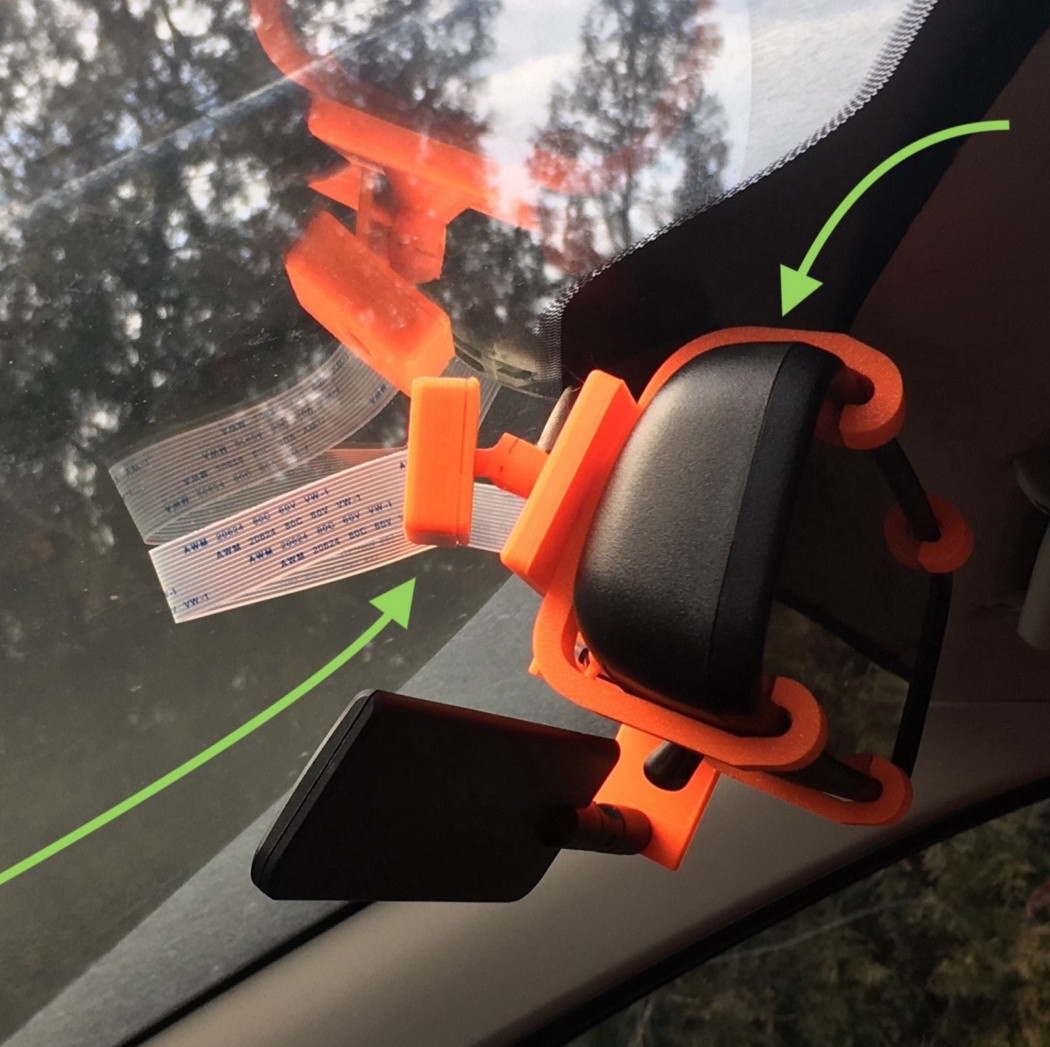
This bracket should find a use in a few projects.

His exceptionally comprehensive write-up takes us through the entire process, from creating a rather useful set of 3D-printed brackets for a Pi and camera through deciding the combination of artificial intelligence software components required, to making the eventual decision to offload part of the processing to a cloud service through a 4G mobile phone link. In this he used Cortex, a system designed for easy deployment of machine learning models, which he is very impressed with.

The result is a camera in his car that identifies and reads the plates on the vehicles around it. Which in a way has something of the Big Brother about it, but in another way points to a future in which ever more accessible AI applications self-contained without a cloud service become possible that aren’t quite so sinister.  It’s an inevitable progression whose privacy questions may go beyond a Hackaday piece, but it’s also a fascinating area of our remit that should be available at our level.

You can see the system in action in the video below the break, as well as find the code in his GitHub repository.

Continue reading “Now You Can Be Big Brother Too, With A Raspberry Pi License Plate Reader”

Review: Unnamed Chinese DDS Function Generator

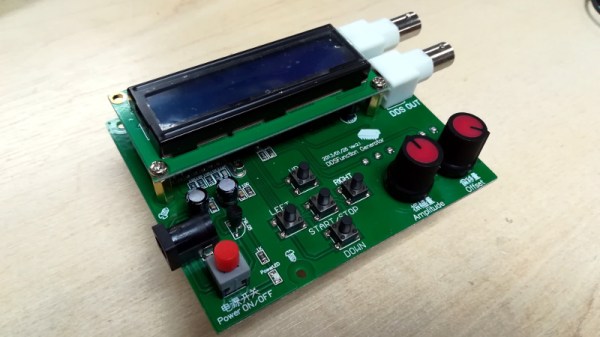
Best forgotten: my awful 2018 function generator.

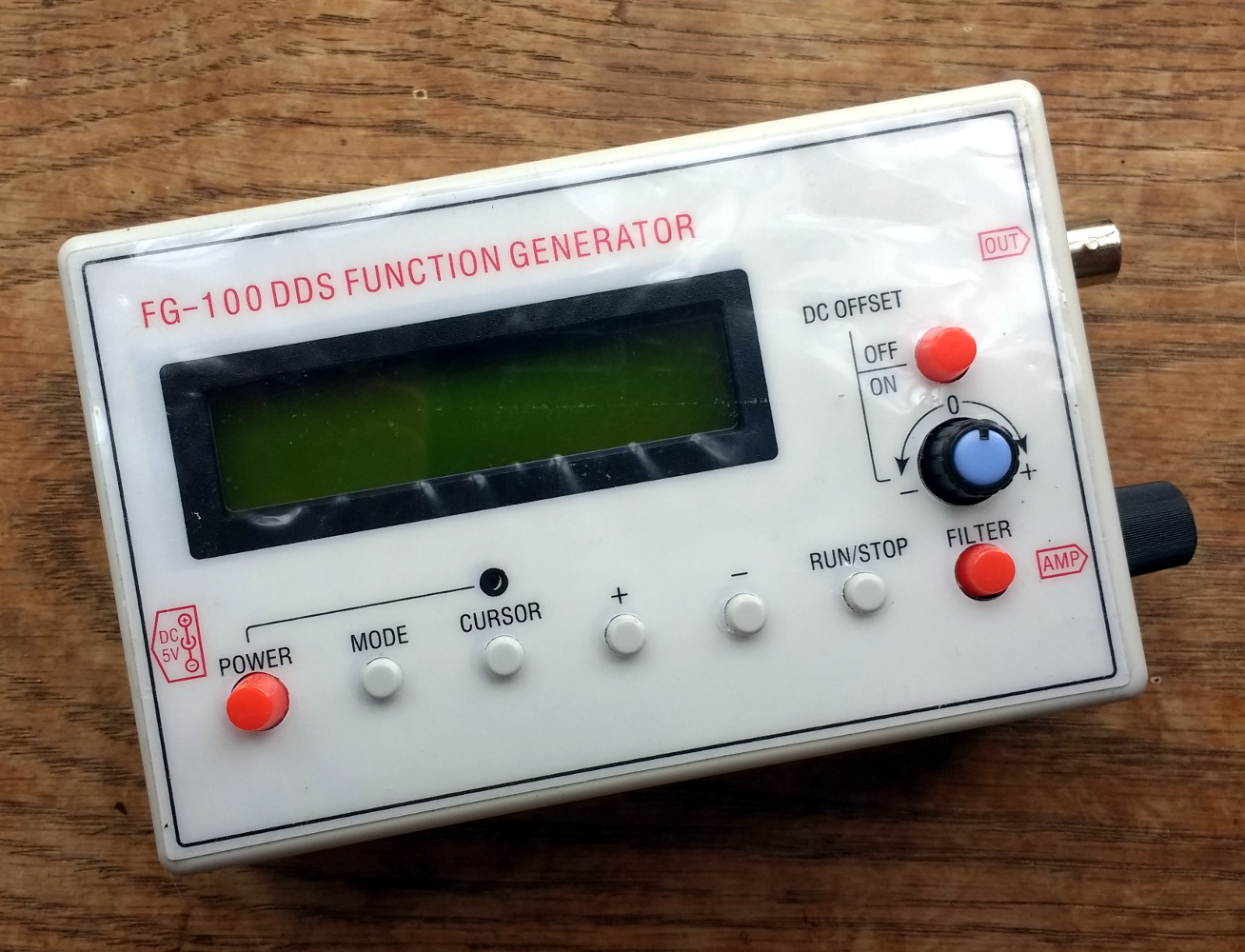
A lifetime of amassing random pieces of test equipment has left me with a gap in my armoury, namely that I don’t possess a low frequency function generator. This could easily be addressed, but for two things. I have a love for exploring the cheaper end of exported electronics and my need for a function generator is less than my desire to spend significant cash. I’ve tried to balance these competing forces in the past by picking up an astoundingly cheap instrument; that time I ended up with a lemon, but will lightning strike twice in the same spot? I spent £10 ($13) on a different cheap function generator and set off to find out. Continue reading “Review: Unnamed Chinese DDS Function Generator”

A Z80 Computer At The Next Level

At the close of the 8-bit home computer era there were some machines produced that attempted to bridge the gap between the 8- and 16-bit worlds, either by providing a 16-bit device with a backwards compatibility mode, or an 8-bit one with enhanced capabilities to compete with its newer rivals. These products largely fell by the wayside in the face of new 16-bit only platforms, but they and the various enhanced versions of 8-bit processors that appeared over subsequent decades present a fascinating glimpse of what might have been. It’s a theme [Konstantin Dimitrov] explores with his Z20X computer project, a machine using the Zilog eZ80 processor running at 20 MHz, with 512 kB of external memory, and an interface for a 7″ TFT screen module.

The eZ80 is a more recent development, a pipelined processor capable of much higher clock speeds and addressing up to 16 MB of memory while maintaining software compatibility with the Z80. Had it come to market in the late 1980s it would have been a sensation, but instead it has appeared in embedded computers and perhaps of most interest to Hackaday readers, in TI’s line of programmable calculators.

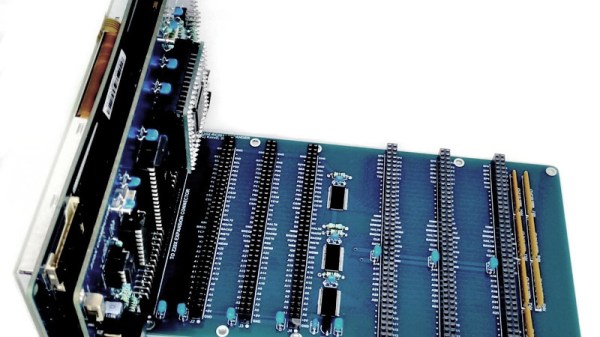
The Z20X is designed to be a through-hole board, with the only SMD component the eZ80 itself. We can understand the motivation behind this, but at the same time wonder whether its likely builders in 2020 will be people unfazed by SMD assembly. It has a system of processor modules in case of future upgrades, and an expansion backplane with an option of an RC2014-compatible bus. There are also PS/2 keyboard and mouse connectors, a serial bus, and an on-board sound chip. The website is short on details of any software, but we’d expect it to work with the typical Z80 retrocomputer offerings such as a BASIC interpreter and the CP/M operating system.

This machine is likely to appeal to retrocomputing enthusiasts, but had it appeared even without the display in a previous decade it would no doubt have become an object of desire. It does however serve as a reminder that the Z80 line has been updated, and though most of us will have moved on it still offers a few chips that could be of interest. Meanwhile for a comparison, take a look at last year’s review of the latest in the range of RC2014 retrocomputer boards.

Thanks [yNos] for the tip.

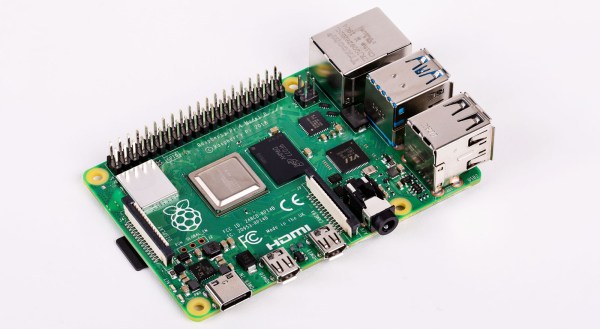
Raspberry Pi Slips Out New PCB Version With USB C Power Fix

When the Raspberry Pi people release a fresh model in their line of fruity single board computers, it’s always an event of great interest. The Raspberry Pi 4 brought some significant changes to the formula: they moved to mini micro HDMI and USB-C power sockets, for instance. The early adopters who scored one of those Pi 4s were in for a shock though, if they had all but the most basic USB C power cables the device wouldn’t power up. Now the Register has news that they have slipped out with little fanfare an updated version of the board containing a fix for this problem.

Our colleague Maya Posch delved deeply into the USB C specification and delivered a pithy analysis at the time which demonstrated that the fault lay with the configuration of the sense resistors used by intelligent USB C power sources to determine what power to supply. For the addition of a single surface mount resistor the problem need never have existed, and we’re guessing that’s how they fixed it.

There’s no need to despair should you have one of the older boards, though. They will still work as they always have done with the so-called “dumb” power supplies and cables, and meanwhile we’re sure that future Pi boards will have had a lot of attention paid to their USB power circuitry.

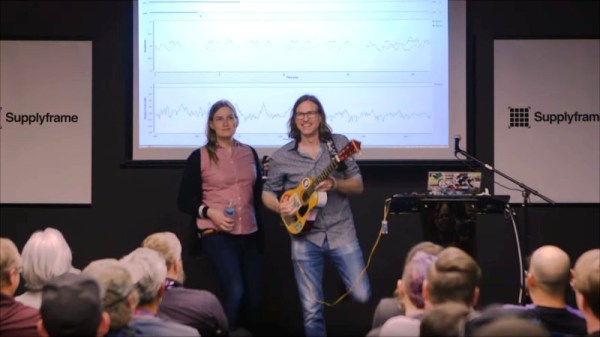
Software Defined Everything With Mike Ossmann And Kate Temkin

Software defined radio has become a staple of the RF tinkerer, but it’s likely that very few of us have ever taken their software defined toolchain outside the bounds of radio. It’s an area explored by Mike Ossmann and Kate Temkin in their newly published Supercon talk as they use GNU Radio to do some things that you might find unexpected.

For most people, a software defined radio is a device. An RTL-SDR dongle perhaps, or the HackRF that a popular multi-tool for working in the radio frequency realm. But as they explain, the SDR hardware can be considered merely as the analogue front end, being just the minimal analogue circuitry coupled with a digitiser. The real software-defined part comes — as you might expect — in the software

Kate and Mike introduce GNU Radio Companion — the graphical UI for GNU Radio — as their tool of choice and praise it’s use as a general purpose digital signal processing system whether or not that includes radio. Taking their own Great Scott Gadgets GreatFET One USB hackers toolkit peripheral as an input device they demonstrate this by analysing the output from a light sensor. Instantly they can analyse the mains frequency in a frequency-domain plot, and the pulse frequency of the LEDs. But their bag of tricks goes much deeper, exploring multiple “atypical use cases” that unlock a whole new world through creative digital signal processing (DSP).

Continue reading “Software Defined Everything With Mike Ossmann And Kate Temkin”

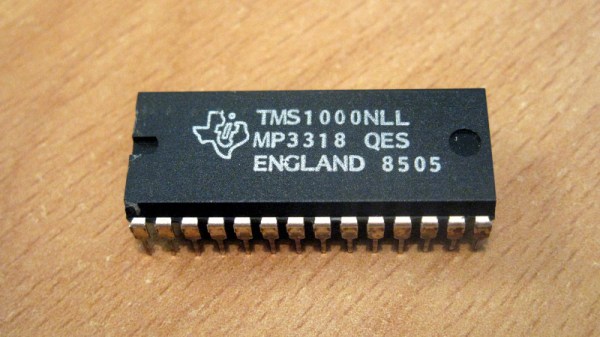
The TMS1000: The First Commercially Available Microcontroller

We use a microcontroller without a second thought, in applications where once we might have resorted to a brace of 74 logic chips. But how many of us have spared a thought for how the microcontroller evolved? It’s time to go back a few decades to look at the first commercially available microcontroller, the Texas Instruments TMS1000.

Imagine A World Without Microcontrollers

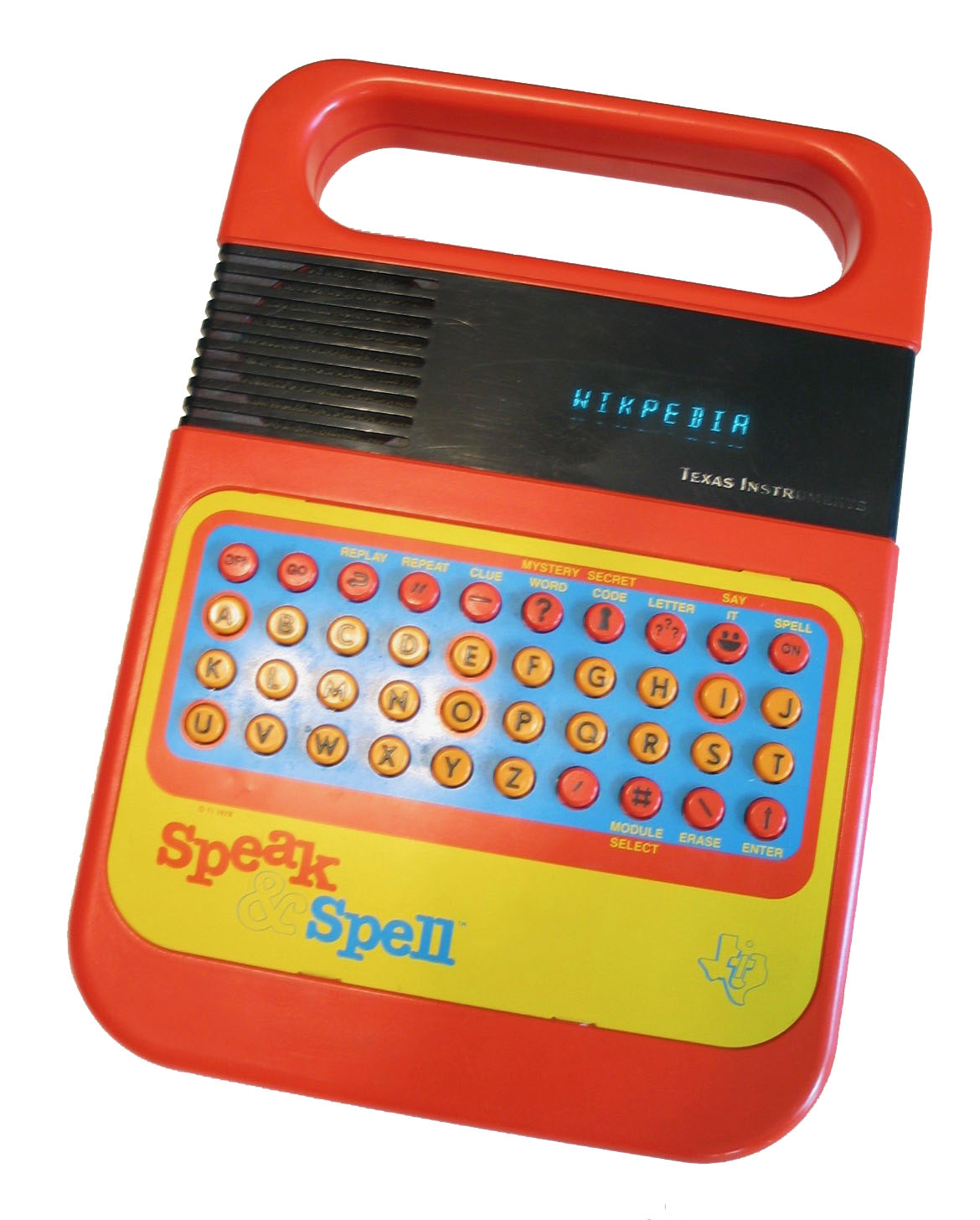
The Texas Instruments Speak And Spell from 1978 was a typical use for the TMS1000.
The Texas Instruments Speak & Spell from 1978 was a typical use for the TMS1000. FozzTexx (CC-SA 4.0)

It’s fair to say that without microcontrollers, many of the projects we feature on Hackaday would never be made. Those of us who remember the days before widely available and easy-to-program microcontrollers will tell you that computer control of a small hardware project was certainly possible, but instead of dropping in a single chip it would have involved constructing an entire computer system. I remember Z80 systems on stripboard, with the Z80 itself alongside an EPROM, RAM chips, 74-series decoder logic, and peripheral chips such as the 6402 UART or the 8255 I/O port. Flashing an LED or keeping an eye on a microswitch or two became a major undertaking in both construction and cost, so we’d only go to those lengths if the application really demanded it. This changed for me in the early 1990s when the first affordable microcontrollers with on-board EEPROM came to market, but by then these chips had already been with us for a couple of decades.

It seems strange to modern ears, but for an engineer around 1970 a desktop calculator was a more exciting prospect than a desktop computer. Yet many of the first microcomputers were designed with calculators in mind, as was for example the Intel 4004. Calculator manufacturers each drove advances in processor silicon, and at Texas Instruments this led to the first all-in-one single-chip microcontrollers being developed in 1971 as pre-programmed CPUs designed to provide a calculator on a chip. It would take a few more years until 1974 before they produced the TMS1000, a single-chip microcontroller intended for general purpose use, and the first such part to go on sale. Continue reading “The TMS1000: The First Commercially Available Microcontroller”