Your TS80 – Music Player

By now most readers will be familiar with the Miniware TS100 and TS80 soldering irons, compact and lightweight temperature controlled soldering tools that have set a new standard at the lower-priced end of the decent soldering iron market. We know they have an STM32 processor, a USB interface, and an OLED display, and that there have been a variety of alternative firmwares produced for them.

Take a close look at the TS80, and you’ll find the element connector is rather familiar. It’s a 3.5 mm jack plug, something we’re more used to as an audio connector. Surely audio from a soldering iron would be crazy? Not if you are [Joric], who has created a music player firmware for the little USB-C iron. It’s hardly a tour de force of musical entertainment and it won’t pull away the audiophiles from their reference DACs, but it does at least produce a recognisable We Wish You A Merry Christmas as you’ll see from the video below the break.

Since the TS100 arrived a couple of years ago we’ve seen a variety of inventive firmware for it. You may remember [Joric]’s previous triumph of a Tetris game for the iron, but our favourite is probably the TS100 oscilloscope.

Continue reading “Your TS80 – Music Player”

At Three Grand A Tail Light, There’s An Opportunity For A Hacker

It can be amusing sometimes, to read an incredulous reaction from outside our community to something that would be bread-and-butter in most hackerspaces. Take the sorry saga of the Cadillac XLR tail light, as reported by Jalopnik. This car was a more-expensive Corvette with a bit of lard around its midriff, and could appear a tempting pick for a bit of inexpensive luxury rubber-burning were it not for the revelation that a replacement second-hand tail light for one of these roadsters can set you back as much as three grand. The trusty auto on the drive outside where this is being written cost around a tenth that sum, so what on earth is up? Is it because a Caddy carries some cachet, or is something else at play?

It appears that the problem lies in the light’s design. It’s an LED unit, with surface mount parts and a set of fragile internal PCBs that are coated in something that makes reworking them a challenge. On top of that, the unit is bonded together, and instead of being a traditional on-off tail light it’s a microprocessor-controlled device that gets its orders digitally. This is all too much for XLR owners and for the Jalopnik hacks, who castigate General Motors for woefully inadequate design and bemoan the lack of alternatives to the crazy-expensive lights, but can’t offer an alternative.

Reading about the problem from a hardware hacker perspective they are right to censure the motor manufacturer for an appalling product, but is there really nothing that can be done? Making off-the-shelf microcontroller boards light up LEDs is an elementary introduction project for our community, and having the same boards talk to a car’s computer via CAN is something of a done deal. Add in LED strips and 3D printing to create a new backing for the tail light lens, and instead of something impossibly futuristic, you’re doing nothing that couldn’t be found in hackerspaces five years ago.

So what’s to be learned from the Cadillac XLR tail light? First of all, there’s scope for an enterprising hacker to make a killing on a repair kit for owners faced with a three grand bill. Then, there’s another opportunity for us to be acquainted with the reality that the rest of the world hasn’t quite caught up with repair culture as we might imagine. And finally there’s the hope that a badly designed automotive component might just be the hook by which the issue of designed-in obsolescence moves up the agenda in the public consciousness. After all, there will be other similar stories to come, and only bad publicity is likely to produce a change in behavior.

Of course, to get it really right you need a car that’s hackable in the first place. Or better still, one designed by and for hackers.

Thanks [str-alorman] for the tip.

Cadillac XLR header image:Rudolf Stricker [CC BY-SA 3.0].

Open-Source Analytical Balance Pits Gravity Against Electromagnetism

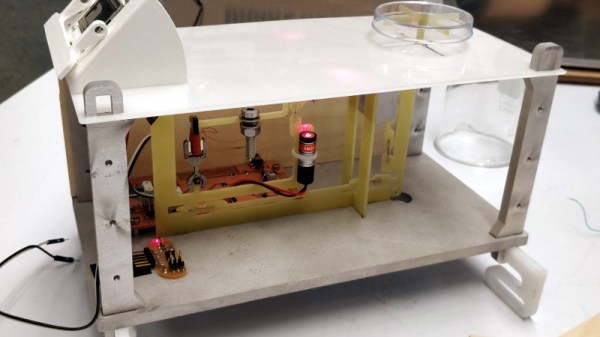
As the open-source movement has brought its influence to more and more fields, we’ve seen an astonishing variety of things once only available at significant expense become accessible to anyone with access to the tools required to create them. One such arena is that of scientific instrumentation, and though we have seen many interesting developments there has been one which has so far evaded us. An analytical balance, a very specialised weighing machine designed to measure the tiniest of masses, remains available only as a new unit costing a fortune, or as a second-hand one with uncertain history and possible contamination. Fortunately, friend of Hackaday [Zach Fredin] is on the case, and as part of one of his MIT courses he chose to create an open-source analytical balance.

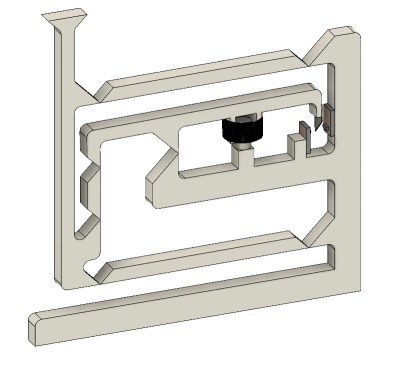
The write-up is interspersed with his course notes as he learns a series of fabrication techniques, but in addition to the milled Delrin finished model he treats us to his prototype and gives us an explanation of how these instruments work. It’s a technique that’s rather different to a traditional weighing machine: instead of measuring deformation of a spring in some way it produces a force from an electromagnet to oppose that exerted by gravity on the mass to be measured, and quantifies how much electrical energy is required to do that. The mechanism incorporates feedback through a vane and an optical sensor, which he admits he’s not yet had time to set up properly.

It’s an interesting project not least because it exposes some of the inner workings of an analytical balance, and we look forward to his completing it. If this whet your appetite for the topic it’s worth also looking at [Ben Krasnow’s] video of a balance made using a moving coil meter for an explanation of the technique.

194 LED Ball Is Free-Form Soldering On Another Level

We’ve all seen plenty of impressive free-form soldering in these pages, maybe some of us have even had a go ourselves. Using nothing but bare conductors, electronic components, and solder, complex and beautiful electronic sculptures can be created. But the latest free-form project from [Jiří Praus] takes the medium to a new level, as he’s taken no less than 194 bare surface-mount addressable LEDs and formed them into a perfect sphere supported by nothing more than soldered copper wire.

This feat was achieved with the aid of a 3D printed hemispherical jig with spaces for each LED, and each half was assembled in a marathon soldering session. Some significant fault-finding was required due to a few dry joints, and an ESP32 board and Li-Po cell were fitted in between the two halves as they were joined. The result is a triumph, a Christmas bauble like no other, and one which we aren’t sure we could manage to solder so well even on a good day.

If you recognise [Jiří ]’s work, it’s probably because we’ve featured several of his creations previously. It’s always difficult to pick a favorite, but the one which caught our eye the most was his fully functional freeform Arduino Uno.

Continue reading “194 LED Ball Is Free-Form Soldering On Another Level”

Optical Communication Using LEDs Alone

We’re all used to the humble LED as a ubiquitous source of light, but how many of us are aware that these components can also be used as photodiodes? It’s something [Giovanni Blu Mitolo] takes us through as he demonstrates a simple data link using just a pair of LEDs and a couple of Arduinos. It’s a showing off his PJON networking layer, and while you’d need a bit more than a couple of LEDs on breadboards for a real-world application, we still think it’s a neat demonstration.

PJON itself is very much worth a look, being an implementation of a robust and error-tolerant network for Arduinos and other small microcontroller platforms. It has a variety of communication strategies for various different media, and as this LED demonstration shows, its strength is that it’s capable of working through media that other networks would balk at. Whether it’s controlling home automation through metal heating ducts or providing an alternative to LoRa at 433 MHz, it’s definitely worth a second look. We’ve mentioned it before, but remain surprised that we haven’t seen it more often since. Take a look, the video is below the break.

Continue reading “Optical Communication Using LEDs Alone”

Eight Motors Speed This Boat Along

Messing about in boats has always held a curious appeal for the hardware hacker. Perhaps that’s because it remains an approachable way to make something that moves under its own power with a bit of speed, and barring calamities, the worst that can happen to the unwary boater is a soaking. [NASAT Channel] is a Vietnamese hacker who is a serial producer of small motorised boats, and one of his latest is a particularly impressive example.

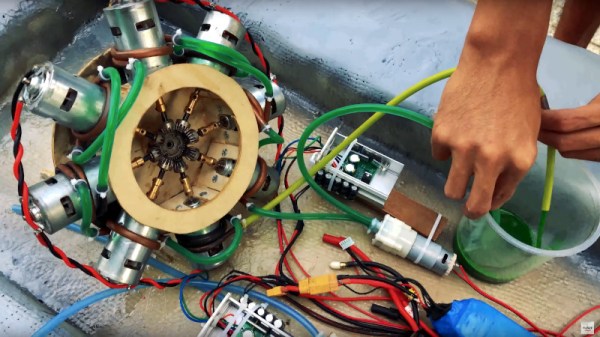
The boat itself is a relatively conventional expanded polystyrene hull covered with fiberglass, but the motive power is something a little special. He’s taken eight of the ubiquitous 775 DC brushed motors and used them in a star configuration with beveled gears, which in turn drives a flexible shaft which goes straight to a propeller under the craft. Each motor shares a water cooling pipe serviced by a small pump, and the drive comes from a pair of cheap PWM motor controllers. We see him zipping up and down a stretch of river next to some moored boats, and if we’re honest, we wouldn’t mind a go ourselves.

We’re not entirely convinced such a rough-and-ready eight-way gearbox will be reliable for long-term use, and we’d be interested to know just how equally so many motors are actually sharing the load. But we like it for its sheer audacity, and we think you will too. Take a look at the video below the break, and if you’re inspired then grab a hammock, some friends, and have a go.

Continue reading “Eight Motors Speed This Boat Along”

Amazon Ring: Neighbors Leaking Data On Neighbors

For a while now a series of stories have been circulating about Amazon’s Ring doorbell, an Internet-connected camera and entry system that lets users monitor and even interact with visitors and delivery people at their doors. The adverts feature improbable encounters with would-be crooks foiled by the IoT-equipped homeowner, but the stories reveal a much darker side. From reports of unhindered access by law enforcement to privately-held devices through mass releases of compromised Ring account details to attackers gaining access to children via compromised cameras, it’s fair to say that there’s much to be concerned about.

One cause for concern has been the location data exposed by the associated Amazon Neighbors crowd-sourced local crime paranoia app, and for those of us who don’t live and breathe information security there is an easy-to-understand Twitter breakdown of its vulnerabilities from [Elliot Alderson] that starts with the app itself and proceeds from there into compromising Ring accounts by finding their passwords. We find that supposedly anonymized information in the app sits atop an API response with full details, that there’s no defense against brute-forcing a Ring password, and that a tasty list of API and staging URLs is there for all to see embedded within the app. Given all that information, there’s little wonder that the system has proven to be so vulnerable.

As traditional appliance makers have struggled with bringing Internet connectivity into their products there have been a few stories of woeful security baked into millions of homes. A defense could be made that a company with roots outside the Internet can be forgiven for such a gaffe, but in the case of Amazon whose history has followed that of mass Web adoption and whose infrastructure lies behind so much of the services we trust, this level of lax security is unforgivable. Hackaday readers will be aware of the security issues behind so-called “smart” devices, but to the vast majority of customers they are simply technological wonders that are finally delivering a Jetsons-style future. If some good comes of these Ring stories it might be that those consumers finally begin to wake up to IoT security, and use their new-found knowledge to demand better.

Header image: Ring [CC BY-SA 4.0]