This Is The Bike You Wanted Your Dad To Make You When You Were Eight Years Old!

The ever-resourceful [Turbo Conquering Mega Eagle] has an excellent excuse for starting on projects, he’s building them for his kids and making videos. We’re not so sure his little motorcycle wasn’t built because Dad also wants to have a go though, because it seems he had quite a lot of fun testing it.

The build starts with a Chinese petrol conversion kit for a bicycle. There’s a little twofour-stroke motor and a basic chain drive to a large sprocket intended to fit on the opposite side of a bicycle wheel to the pedal sprocket. He uses a pair of pneumatic wheelbarrow wheels for which he makes a new bush and to which he welds the sprocket. These go into a fairly simple hardtail frame for which he makes a padded motorcycle seat, and from then on he’s ready to go.

The result is a rather cool little non-road-legal motorcycle that we suspect most readers will have a hankering to own. We’re not so sure about its seeming lack of brakes though. Judge for yourself, the video is below the break.

This isn’t the first home made small bike we’ve brought you, though it’s a lot safer than the first one.

Continue reading “This Is The Bike You Wanted Your Dad To Make You When You Were Eight Years Old!”
Ethernet, Over DC Power

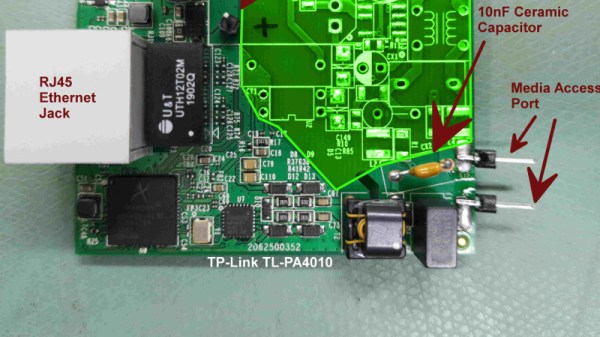
We’re used to extending our network connections and being no longer constrained in our use of Ethernet by proximity to a switch or hub. Our houses routinely contain wireless networks, and of course powerline-Ethernet units passing data over our mains wiring. [Peter Franck] had a similar problem but without the mains power, for a distributed sprinkler system he needed to send Ethernet over DC cables.

The solution is a surprisingly simple one, taking one of those powerline Ethernet units and converting it by removing its mains power section. These devices contain the Ethernet and powerline modem chip with its associated circuitry, and a small switch-mode power supply. He’s removed the power supply and put in a capacitive coupling to the DC cabling, resulting in a relatively inexpensive DC powerline network device.

Powerline Ethernet devices are not without their own issues, for instance they are not popular with radio amateurs due to their effect on the RF noise floor. We’d therefore be curious to see what the RF emissions are like for this hack, but we still think it’s a useful weapon in the armoury as well as something to do with all those surplus powerline Ethernet bricks.

Review: Ear Wax Cleaning Cameras As Cheap Microscopes, We Take A Closer Look

Those of us who trawl the world of cheap imported goods will most often stay in our own comfortable zones as we search for new items to amaze and entertain us. We’ll have listings of electronic goods or tools, and so perhaps miss out on the scores of other wonders that can be ours for only a few dollars and a week or two’s wait for postage.

Who knew sticky ears were such big business!

Just occasionally though something will burst out of another of those zones and unexpectedly catch our eye, and we are sent down an entirely new avenue in the global online supermarket.

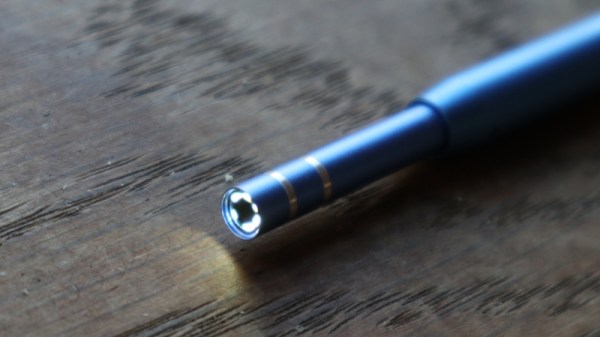
Thus it was that when a few weeks ago I was looking for an inspection camera I had a listing appear from the world of personal grooming products. It seems that aural hygiene is a big market, and among the many other products devoted to it is an entire category of ear wax removal tools equipped with cameras. These can get you up close and personal with your ear canal, presumably so you can have a satisfying scoop at any accumulated bodily goop. I have a ton of electronics-related uses for a cheap USB close-up camera so I bought one of these so I could — if you’ll excuse the expression — get a closer look.

Continue reading “Review: Ear Wax Cleaning Cameras As Cheap Microscopes, We Take A Closer Look”

LCD Panel Lamp Shade Makes For Eye-Catching Lighting

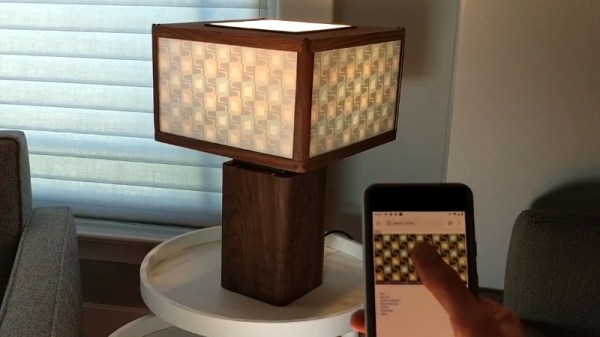
At first sight, [Kyle]’s Elroy lamp is simply an attractive piece of modern-styled interior furnishing; its clean lines, wood grain, and contemporary patterning being an asset to the room. But when he pulls out his phone, things change. Because this lamp hides a secret: at its heart may be a standard LED bulb, but the shade conceals four LCD screens driven by an Nvidia Jetson. These can be controlled through a web app to display a variety of textures, completing the effect.

This is not however simply a set of laptop screens bolted to a lampshade. The screens started life in laptops sure enough, but have since had their reflective backing removed to create a transparent LCD panel. Then an appropriate diffuser had to be found, which after much experimentation became a composite including more than one textured paper. Finally the whole was enclosed in an attractive wooden lamp frame and became part of the furniture. We like it, both as an aesthetically pleasing lamp and as a genuine departure from the norm.

This isn’t the first eye-catching lampshade we’ve brought you, but it’s certainly raised the bar. You can see it in action in the video below the break.

Continue reading “LCD Panel Lamp Shade Makes For Eye-Catching Lighting”

Time Sync Through Your VGA Connector

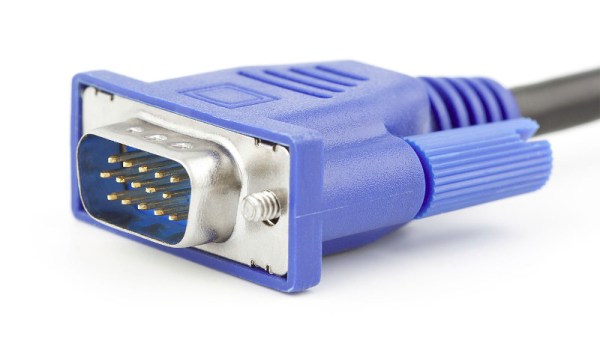
While it might be in its twilight years, the venerable VGA video connector conceals a versatile interface that  can still provide the experimenter with the opportunity for a variety of hacks. We’ve not seen anything quite like [flok]’s one, in which he uses the VGA interface to insert timing information from which an NTPd instance gets its reference.

If this seems counter-intuitive because a VGA interface is an analogue output rather than a digital input, then you are correct to smell a rat. And he comes clean in his first sentence, as he’s not using the VGA lines themselves but the I2C interface that is a feature of all but the most basic of VGA cards. This is the means by which a plug-and-play operating system can identify a monitor’s capabilities, but there’s little to stop it being used for other purposes. In this case an Arduino fed by a 1-pulse-per-second timing signal from a temperature compensated crystal oscillator provides the I2C peripheral which is polled by NTPd.

This project should be of interest to any tinkerer because of its invaluable information on identifying and using the I2C interface on a VGA socket. So if you’ve used your VGA card as an SDR you might find it interesting, but hurry or you could have missed the boat entirely.

VGA plug image: Swift.Hg [CC BY-SA 3.0]

An Atari Graphics Chip, Ready For You To Build

The most notable of the home computer and console hardware from the 8-bit golden era didn’t get their impressive sound and graphics from off-the-shelf silicon, instead they relied on secretive custom chipsets to get the edge over their competitors. Unfortunately for vintage gaming aficionados, those chips are now long out of production and in many cases there’s little information to be had about their operation.

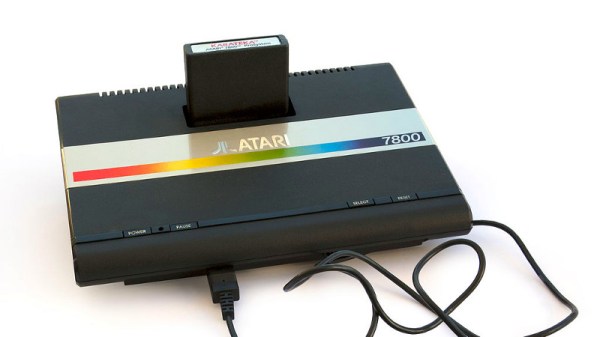
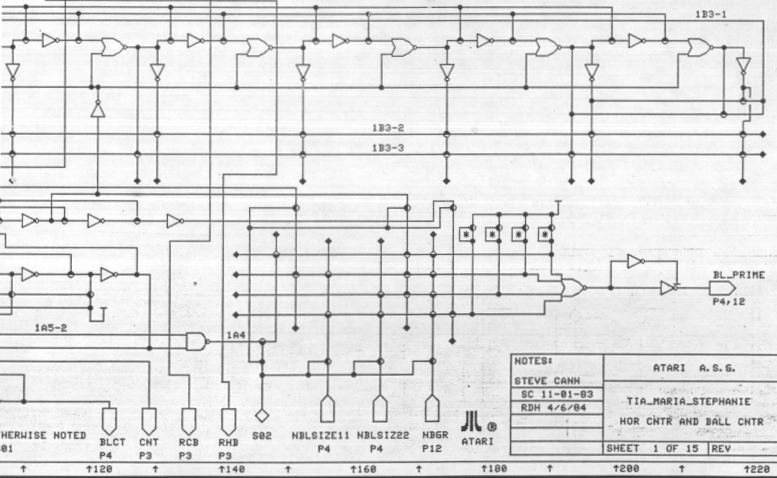
Which makes discovery of the schematics (PDF link) for the “Tia Maria” graphics chip found in the Atari 7800 console an unusual occurrence, and one which should be of special interest to the emulation community. They can be found alongside the rest of the Atari Museum’s 7800 information.

That such a useful document is available at all is due to a lucky find in a dumpster following the demise of Atari, when a treasure trove of documents was discarded. It seems that the existence of these schematics has been known within the Atari community for some time, and we expect before long this information will find its way into FPGA implementations of the 7800; especially since the system features nearly complete backwards compatibility with the massively successful Atari 2600.

When that happens we hope we’ll be able to bring it to you, but it’s not the first time someone’s made an Atari on an FPGA.

Via RetroRGB

Header image: Bilby [CC BY 3.0]

Finally, A Usable Rotary Phone From A Conference Badge

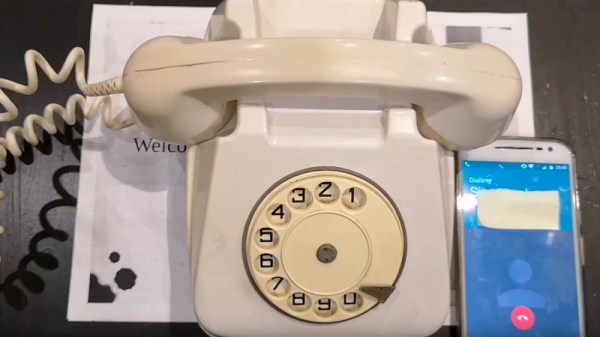
A few weeks ago we featured a project from [Dan], a work-in-progress in which he was attaching an EMF 2018 electronic conference badge to a rotary phone. At the time we looked forward to his progress, expecting maybe to see it in our travels round the field at EMF 2021. We have to say we did him a disservice then, because he’s made excellent progress and has now turned it into a fully functional cellular rotary phone.

When we left him he’d interfaced the dial to the badge and not a lot else, but it was enough to spark our interest because we think there should be more re-use of old electronic conference badges. Since then he’s reverse engineered the original bell with the help of a motor driver and a cheap DC-to-DC converter, and the handset with the guts of a Bluetooth headset because in experimenting he managed to kill the badge’s audio circuitry.

The result can be seen in the video below the break, and we have to admit it looks pretty good. Depending where you are in the world you’ll either love or hate the ringing sound, but that is of little consequence to the utility of the device. If you have a drawer full of conference badges gathering dust, perhaps it’s time to give them a second look.

Continue reading “Finally, A Usable Rotary Phone From A Conference Badge”