Antenna Tuning For GHz Frequencies

Antenna tuning at HF frequencies is something that radio amateurs learn as part of their licence exam, and then hone over their time operating. A few basic instruments and an LC network antenna tuner in a box are all that is required, and everything from a bit of wet string to ten thousand dollars worth of commercial antenna can be loaded up and used to work the world. When a move is made into the gigahertz range though it becomes a little more difficult. The same principles apply, but the variables of antenna design are much harder to get right and a par of wire snippers and an antenna tuner is no longer enough. With a plethora of GHz-range electronic devices surrounding us there has been more than one engineer sucked into a well of doom by imagining that their antenna design would be an easy task.

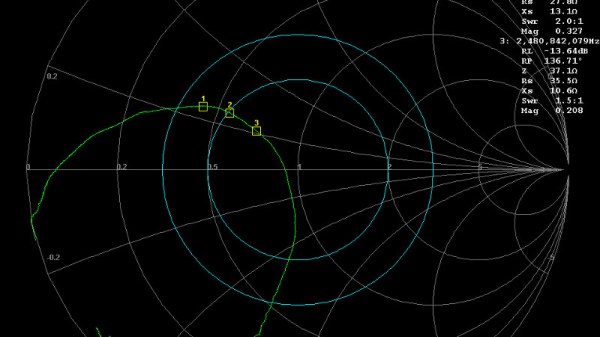
An article from Baseapp then makes for very interesting reading. Titled “Antenna tuning for beginners“, it approaches the subject from the perspective of miniature GHz antennas for IoT devices and the like. We’re taken through the basics and have a look at different types of antennas and connectors, before being introduced to a Vector Network Analyser, or VNA. Here is where some of the Black Art of high frequency RF design is laid bare, with everything explained through a series of use cases.

Though many of you will at some time or other work with these frequencies it’s very likely that few of you will do this kind of design exercise. It’s hard work, and there are so many ready-made RF modules upon which an engineer has already done the difficult part for you. But it does no harm to know something about it, so it’s very much worth taking a look at this piece.

It’s an area we’ve ventured into before, at a Superconference a few years ago [Michael Ossmann] gave us a fundamental introduction to RF design.

An Exoskeleton Arm For A Hacker On A Budget

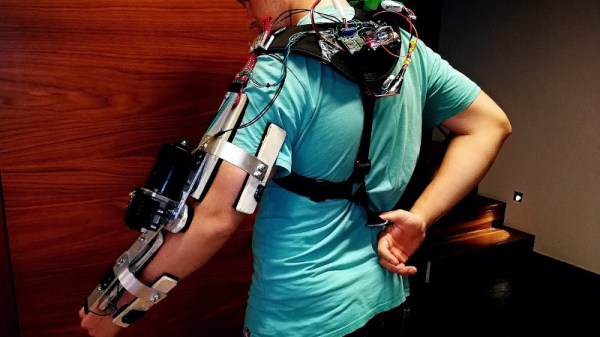
Whether it is motivated by a dream of superhuman strength courtesy of a mech suit or of mobility for those with impaired muscle function, the powered exoskeleton exerts a curious fascination among engineers. The idea of a machine-augmented human body achieving great things is thwarted though by the difficulty of the task, actuators and power sources small enough to be worn comfortably represent a significant challenge that is not easily overcome. It’s a subject that has captivated [Kristjan Berce] since at a young age seeing his grandmother struggling with lifting, and he presents a working powered exoskeleton arm as a proof of his ideas.

It’s a wonderful exercise in low-tech construction with hand tools and a drill press on pieces of aluminium and wood. Motive power comes from an automotive windscreen wiper motor, and electrical power comes from a hefty LiPo attached to the device’s harness. There is a feedback potentiometer incorporated into the elbow joint, and an Arduino oversees the operation under the direction of a pair of glove-mounted buttons. It’s certainly impressive to see it in the video below lifting a bicycle, though we wonder how its weight might affect someone with less muscle function than average.

Projects like this one are very good to see, because there’s a chance that somebody out there may be helped by building one of these. However there is always a note of caution to be struck, as the best solutions come from those who need them and not those who merely think they have the solution. We have written about the Engineer Saviour Trap here in years past.

This isn’t the first prosthetic arm we’ve seen though, we covered a hackerspace in England printing one for a local youngster.

Continue reading “An Exoskeleton Arm For A Hacker On A Budget”

Retrotechtacular: The OSCAR 7 Satellite Died And Was Reborn 20 Years Later

If I were to ask you what is the oldest man-made orbiting satellite still in use, I’d expect to hear a variety of answers. Space geeks might mention the passive radar calibration spheres, or possibly one of the early weather satellites. But what about the oldest communication satellite still in use?

The answer is a complicated one. Oscar 7 is an amateur radio satellite launched on November 5th 1974, carrying two transponders and four beacons, all of which operate on bands available to amateur radio operators. Nearly 45 years later it still provides radio amateurs with contacts just as it did in the 1970s. But this bird’s history is anything but ordinary. It’s the satellite that came back from the dead after being thought lost forever. And just as it was fading from view it played an unexpected role in the resistance to the communist government in Poland.

Continue reading “Retrotechtacular: The OSCAR 7 Satellite Died And Was Reborn 20 Years Later”

Apple Lightning Video Adaptors Run IOS, Dynamically Loaded

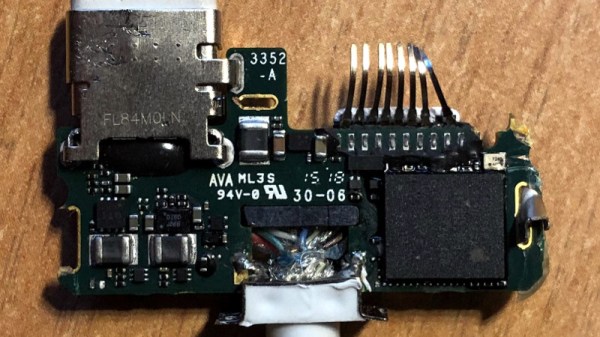
Apple has for a very long time been a company that ploughs its own furrow when it comes to peripherals, with expensive proprietary hardware being the order of the day over successive generations of its products. One of its current line of proprietary interfaces is the Lightning connector, best thought of as an Apple-only take on the same ideas that the rest of the world knows as USB-C. There are a whole host of white dangly peripherals that can be hung from your iDevice’s Lightning port, including a pair of display adaptors that allow them to drive an HDMI or VGA monitor.  [Lisa Braun] has subjected one that had failed to a teardown, and her analysis gives some insight into the way Apple creates its peripherals.

Where you might expect these to contain mostly the equivalent of a graphics card, in fact they have a fully-fledged SoC of their own that runs its own OS with the same Darwin kernel as its host. Unexpectedly this is not held upon the adapter itself, instead it is shipped with iOS and loaded dynamically. Thus the file containing it can be retrieved from iOS and unpacked, leading to some interesting analysis. In a fascinating twist for those of us unused to Lightning’s internals, it’s revealed that the device can be driven from a USB port with the appropriate cobbled-together adapter, allowing a full-size MacOS device to interrogate it. This many not be news to readers with a long memory though, we’ve told you in the past about reverse engineering the Lightning connector.

A 3D-Printable Mecanum Wheeled Robot Platform

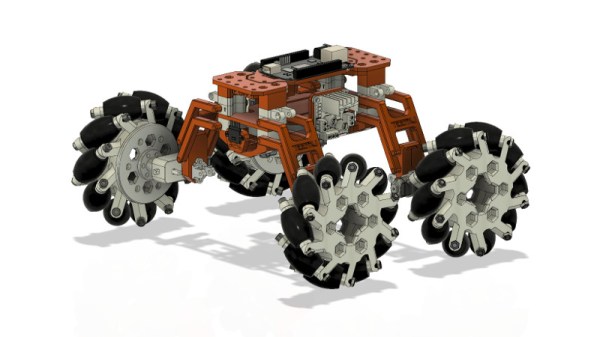
If your interest lies with robotics there are a multitude of different platforms for you to build. [Teemu Laurila] was frustrated with what was on offer, so designed his own with four-wheel double wishbone suspension and mecanum wheels for maximum flexibility.

It’s a design that has been through multiple revisions since its first iteration in 2015, and along the way it’s clear some thought has gone into it. That double wishbone suspension features an angle for a high ground clearance, and is fully sprung. Drive comes from small motor/gearboxes at each axle. The chassis meanwhile has plenty of space for a single-board computer, and has been specifically designed with the BeagleBone Black in mind.

This build isn’t fully DIY, as the mecanum wheels appear to be off-the-shelf items, but the rest of the project makes up for this. If you need to make your own, it’s hardly as though there aren’t any projects from which you can borrow components.

Continue reading “A 3D-Printable Mecanum Wheeled Robot Platform”

Lack Of Space Is No Longer An Excuse For Not Having A Pen Plotter

Pen plotters, those mechanical X-Y drawing machines that have in many cases been superseded by inkjet and other printer technologies, exert a fascination from a section of our community. Both analogue and digital machines are brought out of retirement for some impressive graphical effects, and we suspect that more than one of you wishes you had the space for one in your lives.

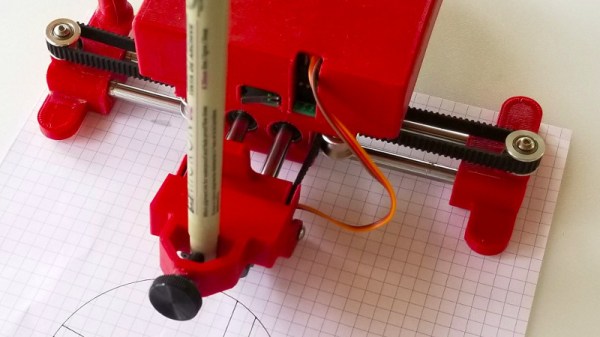
The good news is that you now no longer need room for a hefty piece of 1970s instrumentation, because the ever-inventive [Bart Dring] has produced a tiny 3D-printed plotter with an ESP32 at its heart. The ESP runs his ESP32 port of the Grbl firmware, and can handle a G-code file placed wirelessly upon the controller’s SD card.

The mechanism is particularly clever, using a single belt for both X and Y axes. The pen lift Z axis is a hinged design rather than a linear one, with a hobby servo doing the lifting. The hinge bearings are placed as close as possible to the paper surface to achieve an approximation to a vertical lift. You can see the machine in action in the video below the break, drawing its own self-portrait.

If you are a long-time reader you will recognise [Bart]’s work, he has appeared here quite a few times. His coaster-cutting machine and his CNC plotter badge are particularly memorable.

Continue reading “Lack Of Space Is No Longer An Excuse For Not Having A Pen Plotter”

This Wristwatch Is A Free Form Work Of Art

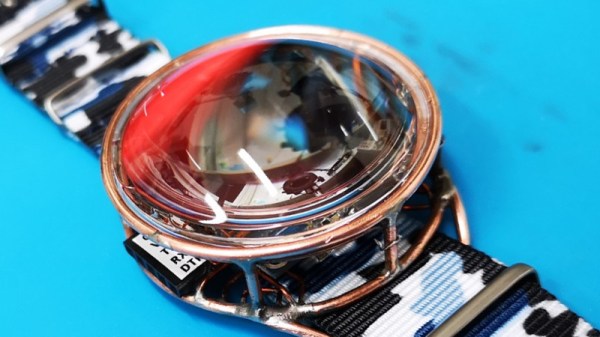
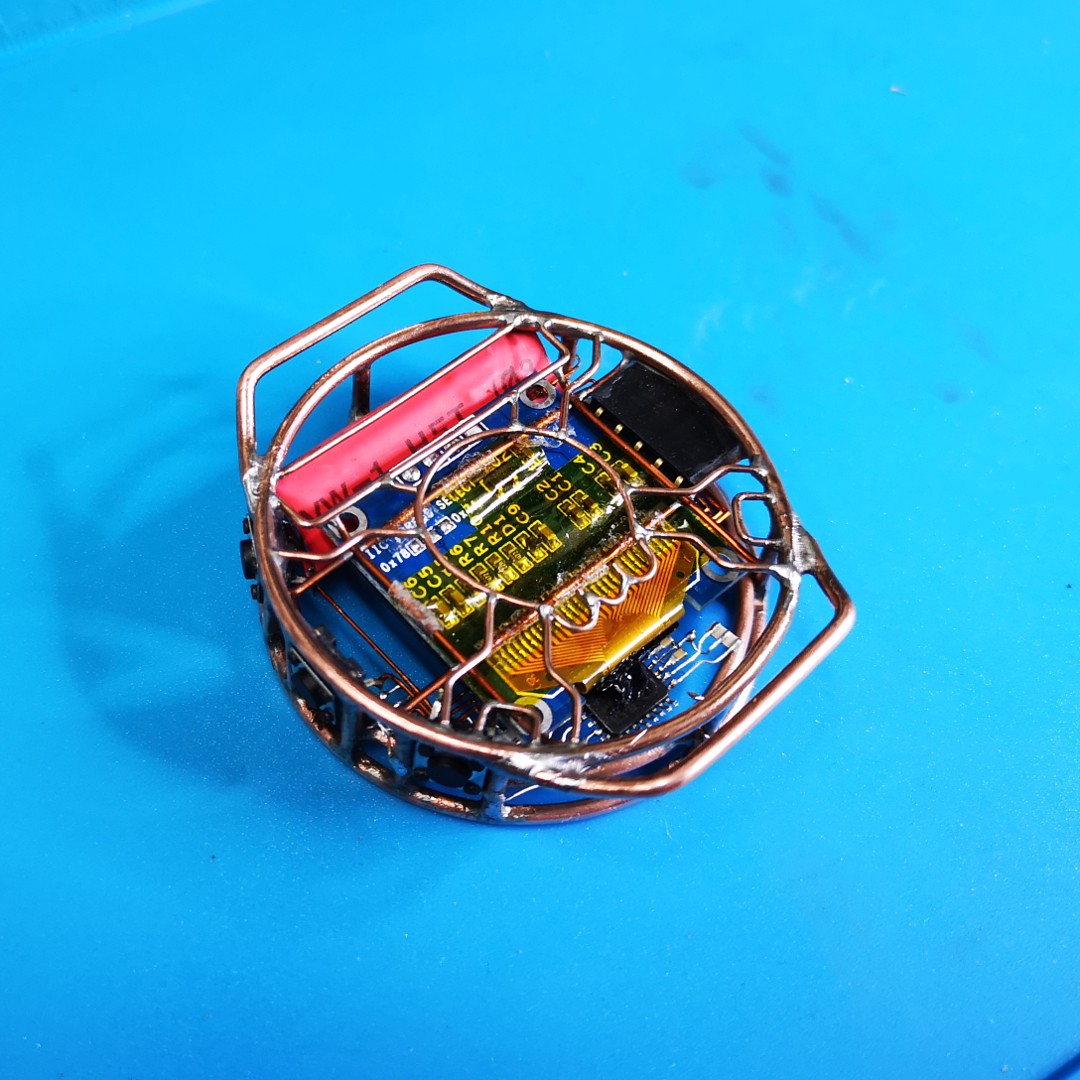
Free-form circuitry built as open wire sculpture can produce beautiful pieces of electronics, but it does not always lend itself to situations in which it might be placed under physical stress. Thus the sight of [Mile]’s free-form wristwatch is something of a surprise, as a wristwatch cam be exposed to significant mechanical stress in its everyday use.

A wire Wrencher graces thewe underside.
A wire Wrencher graces the underside.

The electronic side of this watch is hardly unusual, the familiar ATmega328-AU low-power microcontroller drives a tiny OLED display. Mechanically though it is a different story, as the outline of a wristwatch shell is traced in copper wire with a very neat rendition of a Wrencher in its base, and a glass lens is installed over the screen to take the place of a watch glass. A strap completes the wristwatch, which can then be worn like any other. Power comes from a small 110 mAh lithium-polymer cell, which it is claimed gives between 6 and 7 hours of on time and over a month of standby with moderate use.

Unfortunately there does not seem to be much detail about the software in this project, but since ATmega328 clocks and watches are ten a penny we don’t think that’s a problem. The key feature is that free-form construction, and for that we like it a lot.