Come To The Hackaday Cambridge Mini Unconference!

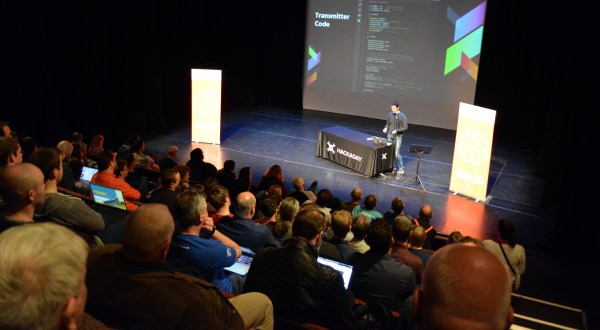
Hackaday would like to invite you to a Mini Unconference on Saturday 16th of March, hosted by our friends at Cambridge Makespace, UK.

One of our most successful engagements with our community over the years here at Hackaday has been the Unconference. A group of you our readers join us for a while and deliver a series of 8-minute lightning talks about what is on their mind. This could be a project, a trend, a technological discovery, or whatever, and they combine to form a fascinating cross-section of the state of our world at any given time. Delivering a talk isn’t essential so don’t worry if you’re shy, but we hope that many of you will have something to share.

This is a mini unconference since we have room for only about fifty or so people in a more intimate venue. Cambridge Makespace is a successful hackerspace in the British university city, and they have been so kind as to host the event for us in their classroom. We’ll convene after lunch and have two afternoon sessions with a break for coffee and snacks, and finish up by getting some pizzas in before heading out to enjoy what Cambridge has to offer. Places are limited, so if you know you are going to be able to make it to Cambridge, sign up without delay.

Look Ma, No Glue! Electrostatic Adhesion As If By Magic

One of the projects at the recent Hacker Hotel hacker camp in the Netherlands appeared to have achieved the impossible. A vertical PCB surface was holding pieces of paper as though they were pinned to it as on a notice board, yet there was no adhesive or fixings in sight. Was Harry Potter among the attendees, ready with a crafty bit of magic at a waggle of a wizard’s wand, or was a clever hack at work?

Of course, it was the latter, as [Jana Marie Hemsing], had created an electrostatic adhesion plate because she was curious about the phenomenon. A PCB with extra insulation has an array of conductors on one side that carry a very high voltage. High enough for electrostatic attraction to secure a piece of paper to the PCB.

The voltage is generated from an AC source by a Cockroft-Walton multiplier on the back of the PCB, and the front is coated with Plasti-Dip for insulation. It seems that soldermask is not a reliable insulator at such high voltages.

Using the board, [Jana] was able to attach a piece of paper to it with a shearing force of 5 mN at 3 kV applied voltage, which may not sound like much but appeared to be just enough to carefully pick the contraption up by the piece of paper. The boards are designed for tessellation, so larger arrays could easily be assembled.

We’ve never had a project quite like this one, but we have brought you an electrostatic ping-pong ball accelerator.

Blacksmithing For The Uninitiated: What Is A Forge?

Blacksmiths were the high technologists of fabrication up until the industrial revolution gained momentum. At its core, this is the art and science of making any needed tool or mechanism out of metal. Are you using the correct metal? Is the tool strong where it needs to be? And how can you finish a project quickly, efficiently, and beautifully? These are lessons Blacksmiths feel in their bones and it’s well worth exploring the field yourself to appreciate the knowledge base that exists at any well-used forge.

I had an unexpected experience a few days ago at the Hacker Hotel weekend hacker camp in the Netherlands. At the side of the hotel our friends at RevSpace in The Hague had set up a portable forge. There was the evocative coal fire smell of burning coke from the hearth, an anvil, and the sound of hammering. This is intensely familiar to me, because I grew up around it. He may be retired now, but my dad is a blacksmith whose work lay mostly in high-end architectural ironwork.

Working the RevSpace forge at Hacker Hotel, in not the most appropriate clothing for the job.

The trouble is, despite all that upbringing, I don’t consider myself to be a blacksmith. Sure, I am very familiar with forge work and can bash metal with the best of them, but I know blacksmiths. I can’t do everything my dad could, and there are people we’d encounter who are artists with metal. They can bend and shape it to their will in the way I can mould words or casually solder a tiny surface-mount component, and produce beautiful things in doing so. My enthusiastic metal-bashing may bear the mark of some experience at the anvil but I am not one of them.

It was a bit of a surprise then to see the RevSpace forge, and I found myself borrowing a blacksmith’s apron to protect my smart officewear and grabbing a bit of rebar. I set to and made a pretty simple standard of the dilletante blacksmith, a poker with a ring on one end. Hammer one end of the rebar down to a point, square off the other end for just over 3 times the diameter of the ring, then bend a right angle and form the ring on the pointy end of the anvil. Ten minutes or so of fun in the Dutch sunshine. Working a forge unexpectedly brought with it a bit of a revelation. I may not be a smith of a high standard, but I have a set of skills by virtue of my upbringing that I had to some extent ignored.

Where others might have put effort into learning them, they’re things I just know. It had perhaps never occurred to me that maybe all my friends in this community didn’t learn how to do this by hanging round the forge next to the house they grew up in. If I have this knowledge merely by virtue of my upbringing, perhaps I should share some of it in a series of articles for those in our community who’ve always fancied a go at a forge but have no idea where to start.

Continue reading “Blacksmithing For The Uninitiated: What Is A Forge?”

Ask Hackaday: Earth’s Magnetic Field Shifting Rapidly, But Who Will Notice?

Just when you though it was safe to venture out, the National Oceanic and Atmospheric Administration released an unexpected update. Magnetic North is on the move — faster than expected. That’s right, we know magnetic north moves around, but now it’s happened at a surprising rate. Instead of waiting for the normal five year interval before an update on its position, NOAA have given us a fresh one a bit earlier.

There are some things that we can safely consider immutable, reliable, they’ll always be the same. You might think that direction would be one of them. North, south, east, and west, the points of the compass. But while the True North of the Earth’s rotation has remained unchanged, the same can not be said of our customary method of measuring direction.

Earth’s magnetic field is generated by a 2,000 km thick outer core of liquid iron and nickel that surrounds the planet’s solid inner core. The axis of the earth’s internal magnet shifts around the rotational axis at the whim of the currents within that liquid interior, and with it changes the readings returned by magnetic compasses worldwide.

The question that emerged at Hackaday as we digested news of the early update was this: as navigation moves inexorably towards the use of GPS and other systems that do not depend upon the Earth’s magnetic field, where is this still relevant beyond the realm of science?

Continue reading “Ask Hackaday: Earth’s Magnetic Field Shifting Rapidly, But Who Will Notice?”

The Primordial Sinclair ZX Spectrum Emerges From The Cupboard

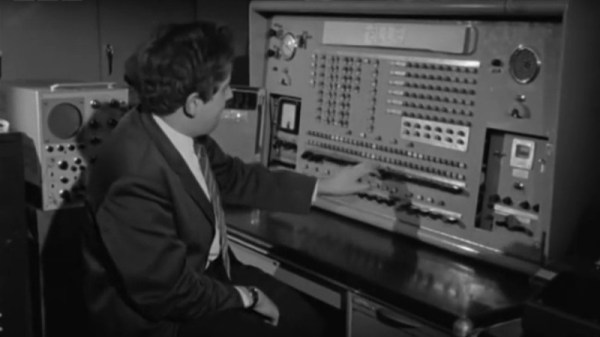
The Centre for Computing History in Cambridge, UK, receive many donations from which they can enrich their collection and museum displays. Many are interesting but mundane, but the subject of their latest video is far from that. The wire-wrapped prototype board they reveal with a flourish from beneath a folded antistatic mat is no ordinary computer, because it is the prototype Sinclair ZX Spectrum.

It came to the museum from Nine Tiles, a local consultancy firm that had been contracted by Sinclair Research in the early 1980s to produce the BASIC ROM that would run on the replacement for their popular ZX81 home microcomputer. The write-up and the video we’ve placed below the break give some detail on the history of the ROM project, the pressures from Sinclair’s legendary cost-cutting, and the decision to ship with an unfinished ROM version meaning that later peripherals had to carry shadow ROMs with updated routines.

The board itself is a standard wire-wrap protoboard with all the major Spectrum components there in some form.  This is a 16k model, there is no expansion connector, and the layout is back-to-front to that of the final machine. The ULA chip is a pre-production item in a ceramic package, and the keyboard is attached through a D connector. Decent quality key switches make a stark contrast to the rubber keys and membrane that Spectrum owners would later mash to pieces playing Daley Thompson’s Decathlon.

This machine is a remarkable artifact, and we should all be indebted to Nine Tiles for ensuring that it is preserved for those with an interest in computing to study and enjoy. It may not look like much, but that protoboard had a hand in launching a huge number of people’s careers in technology, and we suspect that some of those people will be Hackaday readers. We’ll certainly be dropping in to see it next time we’re in Cambridge.

If you haven’t been to the Centre for Computing History yet, we suggest you take a look at our review from a couple of years ago. And if prototype home computers are your thing, this certainly isn’t the first to grace these pages.

Continue reading “The Primordial Sinclair ZX Spectrum Emerges From The Cupboard”

The Cat, The Aircraft, And The Tiny Computer

Sharing your life with a cat is a wonderful and fulfilling experience. Sharing your life with an awake, alert, and bored cat in the early hours when you are trying to sleep, is not. [Simon Aubury] has just this problem, as his cat [Snowy] is woken each morning by a jet passing over. In an attempt to identify the offending aircraft, he’s taken a Raspberry Pi and a software-defined radio, and attempted to isolate it by spotting its ADS-B beacon.

The SDR was the ubiquitous RTL chipset model, and it provided a continuous stream of aircraft data. To process this data he used an Apache Kafka stream processing server into which he also retrieved aircraft identifying data from an online service. Kafka’s SQL interface for interrogating multiple streams allowed him to untangle the mess of ADS-B returns and generate a meaningful feed of aircraft. This in turn was piped into an elasticsearch search engine database, upon which he built a Kibana visualisation.

The result was that any aircraft could be identified at a glance, and potential noise hotspots forecast. Whether all this heavy lifting was worth the end result is for you to decide, however it does provide an interesting introduction to the technologies and software involved. It is however possible to monitor ADS-B traffic considerably more simply.

Thanks [Oleg Anashkin] for the tip.

Talk To Your ‘Scope, And It Will Obey

An oscilloscope is a device that many of us use, and which we often have to use while our hands are occupied with test probes or other tools. [James Wilson] has solved the problem of how to control his ‘scope no-handed, by connecting it to a Raspberry Pi 3 running the snips.ai voice assistant. This is an interesting piece of software that runs natively upon the device in contrast to the cloud service provided by the likes of Alexa or Google Assistant.

The ‘scope in question is a Keysight 1000-X that can be seen in the video below the break, but looking at the Python code we could imagine the same technique being brought to other instruments such as the Rigol 1054z we looked at controlling via USB a year or two ago. The use of the snips.ai software provides a pointer to how voice-controlled projects in our community might evolve beyond the cloud services, interestingly though they do not make a big thing of it their software appears to be open-source.

Oscilloscopes do not have to be remotely controlled by voice alone. It seems to be a common desire to take measurements no-handed — one project we’ve featured in the past did the job with a foot switch.

Continue reading “Talk To Your ‘Scope, And It Will Obey”