Mine Bitcoin With An ESP8266

With all the hype surrounding cryptocurrencies and the current high not quite so high but still pretty eye-watering price of Bitcoin, there are some things which might once have been pure folly that could now be deemed worthy of pursuit. There is an excavation mission being considered to unearth a hard drive containing an early Bitcoin wallet in a Welsh landfill, for instance. But a more approachable task for you may be the possibility of mining using minimal hardware.

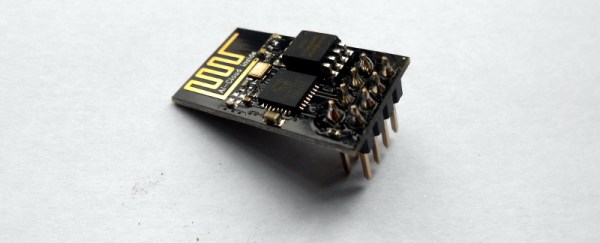
Take [Merlot Machina]’s project for example, implementing a Bitcoin miner on an ESP8266. Part of this is the timeless pursuit of answering the joke question: “Will it mine Bitcoin”, and the other part is looking at this like a lottery ticket. Is it a worthwhile punt at a prize for a minimal investment?

He gives us a rundown of some of the statistics involved, and comes away with the conclusion that it is something like a not-very-good lottery ticket. The ESP performs 1200 hashes per second while the entire Bitcoin community manages about 1.2 exahashes per second. This he calculates gives him a 1 in 1016 chance of mining a block every ten minutes, which for the tiny cost of an ESP and its relatively frugal power budget is a chance he sees as worth taking.

So far he has implemented the hashing algorithm and verified it against a known hash on an already-mined block. At this point though he’s hit a roadblock in the need to run Bitcoin core on a server to keep the ESP supplied with new block headers, so the ESP miner remains a proof of concept. The write-up is still an interesting read though, and given that many readers will have a few spare ESP boards it’s possible that one of you may take it to the next level and Win It Big. If that’s you, you’ll be able to sit on your private island sipping a cool drink, and laugh at the commenters who said it would never happen. Meanwhile here at Hackaday we’ll stick to tried-and-trusted revenue generation strategies, such as bringing you the latest hardware hacks.

This might seem a peculiarly slow miner, but it’s not the slowest we’ve seen by any means. The ever-prolific [Ken Shirriff] has tried it on an IBM 1401 mainframe and a Xerox Alto, and you can of course do it the old-fashioned way.

Have Your Own 200 Water Street Digital Clock

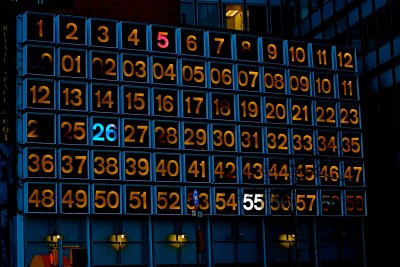
On the front of a building in New York City, above a branch of the ubiquitous Starbucks coffee chain, there is a clock. It is no ordinary clock, the 200 Water Street clock is an art installation created by the artist [Rudolph de Harak], and consists of 72 lighted numbers which are illuminated in sequence to show hours, minutes, and seconds. It is a landmark of sufficient fame that [Jason Ben Nathan] and [Eldar Slobodyan], Cornell University students of [Bruce Land], decided to make their own tribute to it as their course project.

Water Street clock at night
Water Street clock at night [via NYC ♥ NYC]
It’s a fairly straightforward build, thanks to the use of Adafruit Dotstar multicolour LED strips which are populated with APA102 pixels. Behind the scenes is a PIC32 microcontroller, and the time information comes from an off-the-shelf 60kHz WWVB time signal receiver. There is also a temperature sensor, for a handy second function.

The front panel is a piece of ply with the required numbers nicely laser-cut. All the schematics and code are available, should you fancy your hand at building your own version of the clock.

If you are curious about the real-life clock here’s an image. But you get a much more interesting perspective if you stand in front of it. If you just can’t go there, get an approximation through the wonders of Google Street View.

Making A Classic Chip From Discretes

A hackspace discussion of voltage regulators within our earshot touched on the famous μA723, then moved on to its competitors. Kits-of-parts for linear regulators were ten-a-penny in the 1970s, it seems. A rambling tale ensued, involving a Lambda power supply with a blown-up chip, and ended up with a Google search for the unit in question. What it turned up was a hack from 2014 that somehow Hackaday missed at the time, the replication by [Eric Schlaepfer] of an out-of-production regulator chip using surface-mount semiconductors when his Lambda PSU expired.

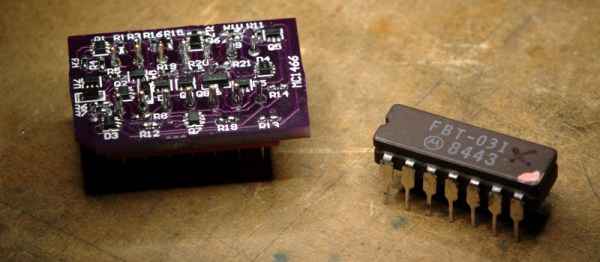
Lambda were one of those annoying electronics companies with a habit of applying their own part numbers to commonly available chips in an effort to preserve their spares sales. Thus the FBT-031 in this Lambda PSU was in fact a Motorola MC1466, a dirt-cheap common part in the 1970s. Unfortunately though unlike the 723 the MC1466 has long passed out of production, and is rarer than the proverbial hen’s tooth.

Happily, these chips from the early 1970s were often surprisingly simple inside. The MC1466 schematic can be found on its data sheet, and is straightforward enough to replicate with surface-mount discrete components. He thus created a PCB that replicated the original pin layout even though it overlapped the original footprint. A few parts were slightly unusual, dual transistor arrays and a matched triple diode, but the result proved to be a perfect replacement for a real MC1466. Of course a project like this is almost too simple for [Eric], who went on to build the incredible Monster 6502.

If the data sheet lacks a schematic, never fear. You can always try reverse engineering the chip directly.

Hackaday Superconference Talk: Cory Grosser

When we look at a product or project here at Hackaday it is likely that our interest has been caught by its internal technology, or perhaps by its functionality. It is easy to forget that there is another angle to each and every item that graces these pages, and it is every bit as important as those we have already mentioned. Aesthetic design, the look and feel of a product, is something that is so often overlooked.

One of the speakers at the Hackaday Superconference was [Cory Grosser], one of America’s leading independent product designers, and the designer of the Supplyframe Design Lab in which the Superconference was being held. In his talk he covered some of the principles of design, touching on its psychology and its purpose in creating a successful product. In doing so he delivered a fascinating talk full of insights into the design of products both famous and somewhat obscure.

Continue reading “Hackaday Superconference Talk: Cory Grosser”

The Bedside Light App That Phones Home

Desiring a bedside lamp with a remote control, [Peadar]’s wife bought a Xiaomi Yeelight, an LED model with an accompanying Android app. And since he’s a security researcher by trade, he subjected the app to a close examination and found it to be demanding permissions phoning home to a far greater extent than you’d expect from a bedside light.

His write-up is worth a read for its fascinating run-through of the process for investigating any Android app, as it reveals the level to which the software crosses the line from simple light-controller into creepy data-slurper. The abilities to create accounts on your device, download without notification, take your WiFi details and location, and record audio are not what you’d expect to be necessary in this application. He also looks into the Xiaomi web services the app uses to phone home, revealing some interesting quirks along the way.

This story has received some interest across the Internet, quite rightly so since it represents a worrying over-reach of corporate electronic intrusion. It is interesting though to see commentary whose main concern is that the servers doing the data-slurping are in China, as though somehow in this context the location is the issue rather than the practice itself. We’ve written before about how some mildly sinister IoT technologies seem to bridge the suspicion gap while others don’t, it would be healthy to see all such services subjected to the same appraisal.

As a postscript, [Peadar] couldn’t get the app to find his wife’s Yeelight, let alone control it. That the spy part of the app works while the on-the-surface part doesn’t speaks volumes about the development priorities of its originator.

Image: Xiaomi Yeelight website.

An Automated Ice Cream Topper For The Ultimate In Zero Effort Desserts

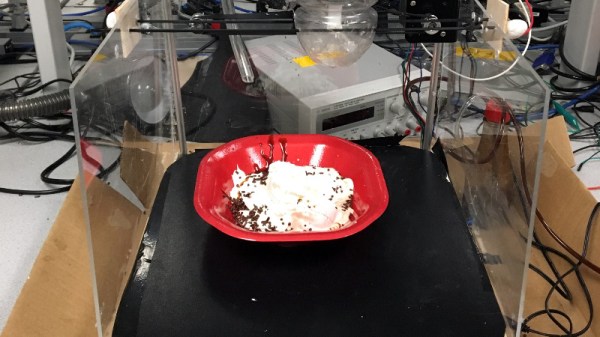
It’s a highly personal facet of the eating experience, the choice of topping applied to your frozen dessert. Everybody has their own preferences when it comes to whipped cream, sprinkles, and chocolate syrup. Should the maintenance of those preferences become a chore, there is a machine for that, and it comes courtesy of [Kristen Vilcans] and [Ramita Pinsuwannakub] in the form of their Cornell University project as students of [Bruce Land]. Their Automated Ice Cream Topper holds profiles for each registered user, and dispenses whipped cream, chocolate sauce, and candy sprinkles onto ice cream at the simple push of a button.

The hardware seems simple enough until you appreciate the many iterations used to ensure that it works smoothly. The bowl of ice cream sits on a motorised turntable, and a can of whipped cream is suspended above it upon rails made from kebab skewers. A servo and lever operates the can to release the cream.  Meanwhile the sprinkles come from an inverted spice jar with a motorised disc to momentary align a hole with the jar’s spout, and the chocolate syrup comes courtesy of an air pump and some plastic tubing. The whole is controlled from a PIC32 microcontroller.

It is refreshing to see that such projects do not have to tackle especially high-tech problems to be extremely successful. We could all dispense our own toppings, but now we know there’s s machine for the task, who wouldn’t want to give it a try!

If ice cream student projects are your thing, perhaps you’d like a 3D printer?

How Much Of A Battery Pack Does Your Electric Car Need?

[Elon Musk] recently staged one of his characteristic high-profile product launches, at which he unveiled a new Tesla electric semi-truck. It was long on promise and short on battery pack weight figures, so of course [Real Engineering] smelled a rat. His video investigating the issue is below the break, but it’s not the link that caught our eye for this article. As part of the investigation he also created an online calculator to estimate the battery size required for a given performance on any electric vehicle.

It’s not perfectly intuitive, for example it uses SI units rather than real-world ones so for comparison with usual automotive figures a little mental conversion is needed from kilometres and hours to metres and seconds if you’re a metric user, and miles if you use Imperial-derived units. But still it’s a fascinating tool to play with if you have an interest in designing electric cars or conversions, as you can tweak the figures for your chosen vehicle indefinitely to find the bad news for your battery pack cost.

It’s very interesting from a technical standpoint to see a credible attempt at an electric truck, and we hope that the existing truck manufacturers will show us more realistic prototypes of their own. But we can’t help thinking that the overall efficiency of electric long-distance trucking could be improved hugely were they to make a truck capable of hauling more than one trailer at once. Any safety issues could be offset by giving these super-trucks their own highways, and with such dedicated infrastructure the power could be supplied from roadside cables rather than heavy batteries. In such circumstances these long trains of electrically hauled containers could be rather successful, perhaps we might call them railroads.

Continue reading “How Much Of A Battery Pack Does Your Electric Car Need?”