New Life For An Obscure Apple Plotter

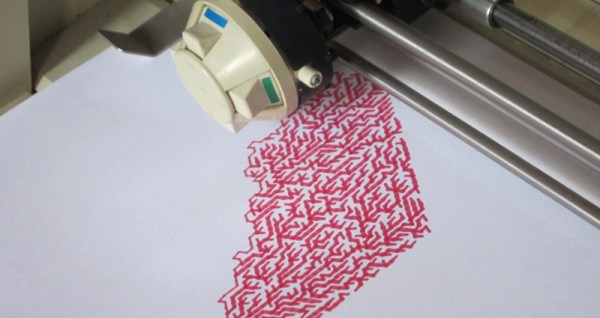
We’ve all at some point or other seen something done online by somebody else, and thought “I’d like to have a go at that!”. When [Phooky] saw the artwork on the #PlotterTwitter hashtag, he remembered a past donation of a plotter to the NYC Resistor hackerspace. Some searching through the loft revealed a dusty cardboard box containing not the lovely Hewlett-Packard he’d hoped for, but instead an Apple 410 Color Plotter. This proved to be such an obscure part of the legacy Apple product line that almost no information was available for it save for a few diagrams showing DIP switch settings for the serial port.

Undeterred, he took a look inside and found a straightforward enough control board featuring a Z80 processor and support chips with 1983 date codes. The ROMs were conveniently socketed, so after dumping their contents, he was able to identify the routine for the plotter’s test program, and thus work from there to deduce its command set.  A small matter of the plotter using hardware handshaking lines to signal a full buffer later, and he was able to use it to produce beautiful plots. Should you be one of the lucky few remaining Apple 410 owners, you may find his software library for it to be of some use.

If you’d like to see some more aged plotter action on these pages, we’ve had an analog Hewlett Packard here in the past, as well as a vintage drum plotter.

Thanks [Sophi] for the tip.
Rickroll The Masses With A Coin Cell Throwie

If there is one educational institution that features on these pages more than any other, it may be Cornell University. Every year we receive a pile of tips showing us the engineering term projects from [Bruce Land]’s students, and among them are some amazing pieces of work. Outside the walls of those technical departments though, we suspect that cool hacks may have been thin on the ground. English Literature majors for example contain among their ranks some astoundingly clever people, but they are not known for their handiness with a soldering iron or a lathe.

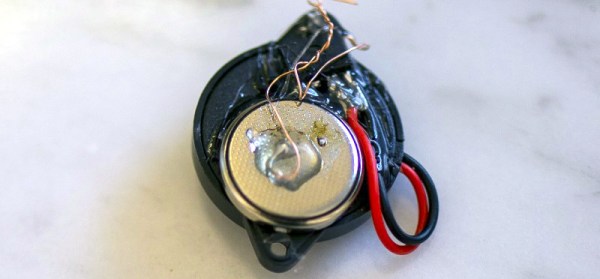
We’re happy to note then that someone at Cornell who is handy with a soldering iron has been spreading the love. In the form of coin cell powered throwies that intermittently Rickroll the inhabitants of the institution’s halls of residence. We have few technical details, but they seem to be a simple affair of a small microcontroller dead-bug soldered to a coin cell and a piezoelectric speaker. If we were embarking on such a project we’d reach for an ATtiny of some description, but similar work could be done with a PIC or any number of other families.

The Cornell Daily Sun write-up is more a work of investigative journalism detailing the perplexed residents searching for the devices than it is one of technical reference. We’re pleased to note that the university authorities have a relaxed attitude to the prank, and that no action will be taken against the perpetrator should they be found.

Thus we’d like to take a moment to reach out to the Cornell prankster, and draw their attention to our Coin Cell Challenge competition. There is still time to enter, and a Rickrolling throwie would definitely qualify. This isn’t the first tiny Rickrolling prank we’ve shown you on these pages.

Thanks [Simon Yorkston] for the tip.

Art, Craft, Make, Hack, Whatever

Anyone who has spent much time reading Hackaday, or in the real world in or around a few hackspaces, will know that ours is a community of diverse interests. In the same place you will find a breathtaking range of skills and interests, people working with software, electronics, textiles, and all conceivable materials and media. And oftentimes in the same person: a bare-metal kernel guru might spend their time in a hackspace making tables from freight pallets rather than coding.

Through it all run a variety of threads, identities if you will, through which the differing flavours of our wider community define themselves. Words like “Hacker” and “Maker” you may identify with, but when I mention words like “Crafter” or “Artist”, perhaps they might meet with some resistance. After all, artists paint things, don’t they, and crafters? They make wooly hats and corn dollies! Continue reading “Art, Craft, Make, Hack, Whatever”

Prepping For Power Outages

When the mains power goes, we are abruptly brought face-to-face with how many of the devices and services we take for granted rely upon it. Telephones for instance, where once they were attached to the wall by a cable, now they are a cordless device with a mains-powered base station. Your cellphone can fill that gap, but a modern smartphone with a battery life of under a day is hardly a reliable long-term solution. Meanwhile modern heating systems may still burn gas or fuel oil, but rely on an electric pump for circulation. Your kitchen is full of electrically-powered white goods, your food is preserved by an electric refrigerator, even your gas cooker if you have one will probably expect a mains supply.

When the power goes out we might say that we instantaneously travel back a couple of centuries, but the reality is that our ancestors in 1817 wouldn’t have been in the same mess we are, they had appropriate solutions to surviving a wickedly cold winter when electricity was still something of a gleam in [Michael Faraday]’s eye. In short, they were prepared in a way most of us are not. That’s a shame, so let’s take a closer look sensible modern preparedness.

Continue reading “Prepping For Power Outages”

A Dynamometer For Measuring Motor Power

If you have ever ventured into the world of motor vehicles you may be familiar with a dynamometer, possibly as a machine to which your vehicle is taken for that all-important printout that gives you bragging rights (or not) when it comes to its ability to lay down rubber. A dynamometer is essentially a variable load for a rotating shaft, something that converts the kinetic energy from the shaft into heat while measuring the power being transferred.

Most of us will never have the chance to peer inside our local dyno, so a term project from a group of Cornell students might be something of interest. They’ve built a dynamometer for characterising small electric motors, and since their work is part of their degree courses, their documentation of it goes into great detail.

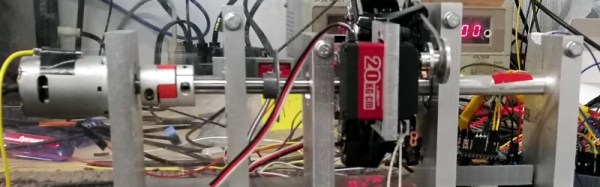
Their dynamometer takes the form of a shaft driving a stainless steel disc brake upon which sit a pair of calibers mounted on a fixed shaft that forms a torsion bar. The whole is mounted in a sturdy stainless steel chassis, and is studded with sensors, a brace of strain gauges and a slotted disc rotation sensor. It’s not the largest of dynamometers, but you can learn about these devices from their work just as they have.

This is a project sent to us by [Bruce Land], one of many from his students that have found their way to these pages. His lectures on microcontrollers are very much worth a look.

An Mbed In Your Browser

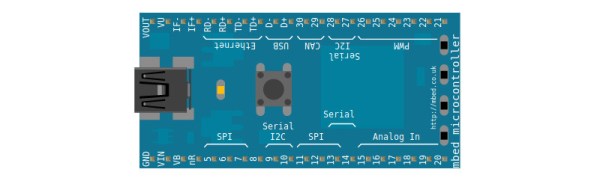
If you have dabbled in the world of ARM microcontrollers, you might be familiar with the Mbed platform, a software abstraction layer for a range of ARM-based small dev boards. If you don’t have an Mbed board but fancy giving it a go, you might imagine that you’d be out of luck, but [Jan Jongboom] could have an answer to your problem in the form of an Mbed simulation in your browser.

We’re not high-end ARM microcontroller developers here at Hackaday so beyond observing that it brings the Mbed abstraction layer binaries to the browser through the magic of Emscripten it’s best to point the curious at its GitHub repository. But we can see its attraction as a means to take a look at Mbed, and given that [Jan] describes himself as “a developer and evangelist currently working on the Internet of Things for ARM“, it’s safe to say this one comes as they say, from the horse’s mouth.

The Mbed board that is probably most famous is the education-focused micro:bit, but there are plenty of others on the market. Back in 2015 we published a getting started guide, if you are new to the Mbed.

Via Hacker News.

Don’t Get Caught Up In Blockchain Hype

It’s the story of the moment, isn’t it. As the price of Bitcoin continues on its wild and crazy rollercoaster ride, everyone’s talking about cryptocurrencies, and in almost mystical terms, about blockchains. Perhaps to be a little more accurate, we should report that they are talking about The Blockchain, a single entity which it seems is now the answer to all ills.

Of course, there is no single blockchain, instead blockchain technologies form the underpinnings of the cryptocurrency boom. Since little dollar signs seem to be buzzing around in front of everyone talking about that subject, it has attracted the attention of hordes of people with little understanding of it. APNIC have a good article aimed at those people: Don’t Get Caught Up In Blockchain Hype, which is worth a read even if you do understand blockchain technologies.

It makes the point that many large enterprises are considering investments in blockchain technologies, and lists some of the potential pitfalls that they may encounter. There may be a slight element of schadenfreude for some of the technically literate in seeing this in action, but given that such things can have consequences for those among us it’s too important to ignore.

As an analogy of a relatively clueless executive jumping on a tech-driven bandwagon, a software company of our acquaintance had a boss who decided in the heady days before the dotcom crash that the organisation would fully embrace open-source. Something to be welcomed, you might think, but given that the software in question was a commercially sensitive asset upon which all company salaries depended, it was fortunate that he listened to his developers when they explained to him exactly what open source entails.

Whether you are a blockchain savant or an uninterested bystander, it’s worth a read as you may sometime need its arguments to save someone from their own folly. If you fancy a simple example to help understand something of how blockchains work, we’ve got that covered for you.

Bitcoin coins image: Mike Cauldwell [Public domain].