Stealth Cell Tower Inside This Office Printer Calls To Say I Love You

If you look around the street furniture of your city, you may notice some ingenious attempts to disguise cell towers. There are fake trees, lamp posts with bulges, and plenty you won’t even be aware of concealed within commercial signage. The same people who are often the first to complain when they have no signal it seems do not want to be reminded how that signal reaches them. On a more sinister note, government agencies have been known to make use of fake cell towers of a different kind, those which impersonate legitimate towers in order to track and intercept communications.

In investigating the phenomenon of fake cells, [Julian Oliver] has brought together both strands by creating a fake cell tower hidden within an innocuous office printer. It catches the phones it finds within its range, and sends them a series of text messages that appear to be from someone the phone’s owner might know. It then prints out a transcript of the resulting text conversation along with all the identifying information it can harvest from the phone. As a prank it also periodically calls phones connected to it and plays them the Stevie Wonder classic I Just Called To Say I Love You.

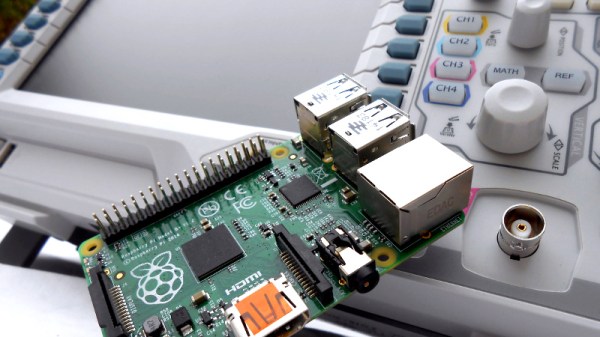
In hardware terms the printer has been fitted with a Raspberry Pi 3, a BladeRF software-defined transceiver, and a pair of omnidirectional antennas which are concealed behind the toner cartridge hatch. Software comes via  YateBTS, and [Julian] provides a significant amount of information about its configuration as well as a set of compiled binaries.

In one sense this project is a fun prank, yet on the other hand it demonstrates how accessible the technology now is to impersonate a cell tower and hijack passing phones. We’re afraid to speculate though as to the length of custodial sentence you might receive were you to be caught using one as a private individual.

We’ve considered the Stingray cell phone trackers before here at Hackaday, as well as looking at a couple of possible counter-measures. An app that uses a database of known towers to spot fakes, as well as a solution that relies on an SDR receiver to gather cell tower data from a neighbourhood.

[via Hacker News]

Sort Your Candy With A Raspberry Pi And Google Cloud Vision

If you have been off trick-or-treating and returned home with an embarassment of candy, what on earth can you do to mange the problem and sort it by brand?

Yes, it’s an issue that so many of us have had to face at this time of year. So much a challenge, that the folks at [Dexter Industries] have made a robotic candy-sorter to automate the task.

OK, there’s something of the tongue-in-cheek about the application. But the technology they’ve used is interesting, and worth a second look. Hardware wise it’s a Lego Mindstorms conveyor and hopper controlled by a Raspberry Pi through the BrickPi interface. All very well, but it’s in the software that the interest lies. They use the Raspberry Pi’s camera to take a picture to send off to Google Cloud Vision, which they then query to return a guess at the brand of the candy in question. The value returned is then compared to a list of brands to keep or donate to another family member, and the hopper tips the bar into the respective pile.  They provide full build details and code, as well as the video we’ve put below the break. So simple a child can explain it, sort of.

Continue reading “Sort Your Candy With A Raspberry Pi And Google Cloud Vision”

The Lotus Sevens: The Real Most-Hackable Cars

In the late 1940s and early 1950s, Europe was still struggling to recover from the crippling after-effects of war. In Britain it is referred to as the “austerity period”, with food still rationed and in which “make do and mend” was very much the order of the day. The consumer boom of the late 1950s and 1960s was very far in the future, and if you were a hardware hacker your source materials were limited to whatever you could find from war surplus or whatever prewar junk might come your way. This was a time in which the majority of adults had recently returned from war service, during which they had acquired practical skills through the necessities of battle that they sought an outlet for in peacetime.

One field that benefited from this unexpected flowering of creativity was that of motor racing. Before the war it had been an exclusive pursuit, with bespoke cars at famous circuits like the banked track at Brooklands, in Surrey. In a reflection of the wider social changes that followed the war the motor racers of the post-war years came from humbler backgrounds, they raced homemade specials made from tired-out prewar motors on wartime airfield perimeter tracks like the one at Silverstone which still hosts Formula One racing today.

Continue reading “The Lotus Sevens: The Real Most-Hackable Cars”

Robotic Farming, Aussie Style

Australian roboticists from the Queensland University of Technology have developed a prototype agricultural robot that uses machine vision to identify both weed and crop plants before either uprooting or poisoning the weeds or applying fertiliser to the crop.

The machine is a wide platform designed to straddle a strip of the field upon which it is working, with electric wheel motors for propulsion. It is solar-powered, and it is envisaged that a farm could have several of them continuously at work.

At a superficial level there is nothing new in the robot, its propulsion, or even the plant husbandry and weeding equipment. The really clever technology lies in the identification and classification of the plants it will encounter. It is on the success or failure of this in real farm environments that the robot’s future will hinge. The university’s next step will be to take it on-farm, and the ABC report linked above has a wonderfully pithy quote from a farmer on the subject. You can see the machine in action in the video below the break.

Farming robots have a significant following among the hardware hacker community, but it is possible that the machine-vision and plant-identifying abilities of this one would be beyond most hackers. However it is still an interesting project to watch, marking as it does a determined attempt to take the robot out of the lab and into real farm settings.

Continue reading “Robotic Farming, Aussie Style”

Not Quite 101 Uses For An ATX Power Supply

The PC power supply has been a standard of the junk box for the last couple of decades, and will probably continue to be for the foreseeable future. A product that is often built to a very high standard and which will give years of faithful service, yet which has a life of only a few years as the PC of which it is a part becomes obsolete. Over the decades it has evolved from the original PC and AT into ATX, supplying an ever-expanding range of voltage rails at increasing power levels. There have been multiple different revisions of the ATX power supply standard over the years, but they all share the same basic form factor.

So a pile of ATX supplies will probably feature in the lives of quite a few readers. Most of them will probably be old and obsolete versions of little use with today’s motherboards, so there they sit. Not small enough to ignore, yet Too Good To Throw Away. We’re going to take a look at them, try to work out what useful parts they contain, and see a few projects using them. Maybe this will provide some inspiration if you’re one of those readers with a pile of them seeking a purpose.

Continue reading “Not Quite 101 Uses For An ATX Power Supply”

The Pumpkin Noti-Fire

Everyone has an episode somewhere in their youth involving the use of an aerosol spray as an impromptu flamethrower. Take some mildly inebriated teenagers, given them a deodorant can and a box of matches, and sooner or later one or two of them are going to lose their eyebrows.

For most of us an amusing teenage episode is how the aerosol flamethrower remains. Not for [Mike Waddick] though, when last week’s DDoS attack on DNS infrastructure took away his ability to work his, attention turned to a Halloween project. He created a carved pumpkin that spits fire as a notification signal when a text or an email is received.

flame-testKey to the project is the Glade Automatic Spray Air Freshener. This is a battery-powered device with an aerosol can that is operated by either an electronic timer or a push-button switch. Remove the switch, and its line is revealed as an active low trigger for the spray. [Mike] replaced the switch with a line from a microcontroller and put a lit tea-light candle in front of the nozzle for fully controllable (if not entirely safe) flamethrower fun. Early tests proved the concept, so it only remained for the pumpkin to be carved and the system installed.

The microcontroller used in this case was the Lightblue Bean, though almost any similar board could have been put in its place. Notifications were processed via Bluetooth from an iPhone via ANCS (Apple Notification Center Service), which the Bean could query to trigger its fiery alerts. There is a brief video showing the device in action singeing [Mike]’s hand, which we’ve placed below the break.

Continue reading “The Pumpkin Noti-Fire”

One Home Made NES To Rule Them All

The Nintendo Entertainment System, or Famicom depending on where in the world you live, is a console that occupies a special place in the hearts of people of a certain age. If you lived in a country that Nintendo didn’t ship its consoles to in the late ’80s and early ’90s though, you might think that it would be an experience that would have passed you by. Eastern Europeans for instance didn’t officially meet Mario for years.

A Pegasus NES clone. Ktoso the Ryba [Public domain], via Wikimedia Commons.

Fortunately for them there was an industry of Chinese and Taiwanese clone makers whose products were readily available in those markets. For the countries without official Nintendo products it is these consoles and their brand names that have achieved cult gaming status rather than the real thing.

In Poland, [phanick] wanted to recreate his youth by building his own clone console (Polish Language, English translation via Google Translate). His chosen target was the Pegasus, the Taiwanese NES clone that was the must-have console for early ’90s Poles.

But he wasn’t just satisfied with building a Pegasus clone. Along the way the project expanded to include support for 72-pin NES cartridges as well as the 60-pin Pegasus ones, and the ability to play both PAL and NTSC games. For this dual-system support he had to include both sets of processor and graphics chip variants, along with logic to switch between them. He goes into some detail on the tribulations of achieving this switch.

The result is a very impressive and well-executed piece of work. The PAL games have a letterbox effect with black bars at top and bottom of the screen, while the NTSC games have slightly washed-out colours. But if you were a gamer of the day you’ll see these as simply part of the genuine experience.

He’s posted a descriptive video which we’ve embedded below the break, but with non-English commentary. It is however still worth watching even without understanding the audio, for its view of the completed board and gameplay.

Continue reading “One Home Made NES To Rule Them All”