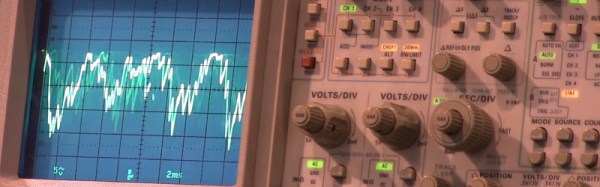
[Alan Wolke]’s How To Use An Oscilloscope

If you were to create a Venn diagram of Hackaday readers and oscilloscope owners the chances are the there would be a very significant intersection of the two sets. Whether the instrument in question is a decades-old CRT workhorse or a shiny modern digital ‘scope, it’s probably something you’ll use pretty often and you’ll be very familiar with its operation.

An oscilloscope is a very complex instrument containing a huge number of features. Modern ‘scopes in particular bring capabilities through software unimaginable only a few years ago. So when you look at your ‘scope, do you really know how to use its every feature? Are you getting the best from it, or are you only scratching the surface of what it can do?

[Alan Wolke, W2AEW] is an application engineer at Tektronix, so as you might expect when it comes to oscilloscopes he knows a thing or two about them. He’s spoken on the subject in the past with his “Scopes for Dopes” lecture, and his latest video is a presentation to the NJ Antique Radio Club which is a very thorough exploration of using an oscilloscope. The video is below the break and at an hour and twenty minutes it’s a long one. We make no apologies for that, for it should be fascinating in its entirety for any oscilloscope owner. Even if you find yourself nodding along to most of what he’s saying there are sure to be pearls of ‘scope wisdom in there you weren’t aware of.

Continue reading “[Alan Wolke]’s How To Use An Oscilloscope” →

Drinkro The Synchro Bartender

There is a significant constituency among hackers and makers for whom it is not the surroundings in which the drink is served or the character of the person serving it that is important, but the quality of its preparation. Not for them the distilled wit and wisdom of a bartender who has seen it all, instead the computer-controlled accuracy of a precisely prepared drink. They are the creators of bartending robots, and maybe some day all dank taverns will be replaced with their creations.

Drinkro is a bartending robot built by the team at [Synchro Labs]. It uses a Raspberry Pi 3 and a custom motor controller board driving a brace of DC peristaltic liquid pumps. that lift a variety of constituent beverages into the user’s glass. There is a multi-platform app through which multiple thirsty drinkers can place their orders, and all the source code and hardware files can be found in GitHub repositories. The robot possesses a fairly meagre repertoire of vodka and only three mixers, but perhaps it will be expanded with more motor driver and pump combinations.

There is a video of the machine in action, shown below the break. We can’t help noticing it’s not the fastest of bartenders, but maybe speed isn’t everything.

Continue reading “Drinkro The Synchro Bartender” →

Retrotechtacular: The Modern Telephone

We take recorded telephone messages for granted in these days of smartphones and VOIP. Our voicemail lives on an anonymous server in a data centre in the cloud somewhere, in a flash memory chip on our DECT base station, or if we’re of a retro persuasion, on a micro-cassette. Wherever we go, we now know our calls will not go unanswered.

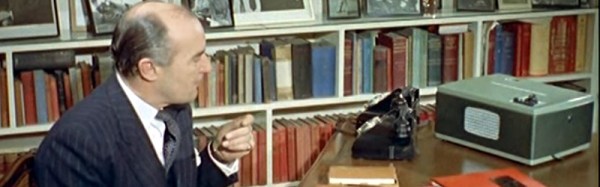
Today’s subject takes us back to a time when automatically recording a phone call was the last word in high technology, with a British Pathé newsreel piece from 1959 entitled “Modern Telephone”. Its subject is the Ansafone J10, one of the first telephone answering machines available on the British market. After featuring a fantastic home-made Meccano answering machine with turntable recording created by a doctor, it takes us to the Ansafone factory where the twin tape mechanisms of the commercial model are assembled and tested. Finally we get to see it in use on the desk of a bona fide Captain of Industry, probably about the only sort of person who could afford an Ansafone in 1959.

Part of the film’s charm comes not from the technology but from the glimpse it gives us of 1950s Britain sanitised for the newsreel. The clipped tones, leather armchairs and bookshelves, the coal fire and the engineer in a three-piece suit. The past is a foreign country; they do things differently there.

Take a look at the film below after the break, and never take your recorded calls for granted again.

Continue reading “Retrotechtacular: The Modern Telephone” →

Liddiard Omnidirectional Wheels

Omnidirectional wheels are one of the hardy perennials of the world of invention. There seems to be something about the prospect of effortless parallel parking that sets the creative juices of backyard inventors flowing, and the result over the years have been a succession of impressively engineered ways to move a car sideways.

The latest one to come our way is courtesy of Canadian inventor [William Liddiard], and it is worthy of a second look because it does not come with some of the mechanical complexity associated with other omnidirectional wheel designs. [Liddiard]’s design uses a one-piece tyre in the form of a flexible torus with a set of rollers inside it which sits on a wheel fitted with a set of motorised rollers around its circumference. The entire tyre can be rotated round its toroidal axis, resulting in a tread which can move sideways with respect to the wheel.

The entire process is demonstrated in a video which is shown below the break, and the small Toyota used as a demonstration vehicle  can move sideways and spin with ease. We would be wary of using these wheels on a road car until they can be demonstrated to match a traditional tyre in terms of sideways stability when they are not in their omnidirectional mode, but we can instantly see that they would be a significant help to operators of industrial machines such as forklifts in confined spaces.

Continue reading “Liddiard Omnidirectional Wheels” →

Binary Keyboard Is The Purest Form Of Input Device

You may be a hardcore keyboard aficionado whose buckled-spring switches will be pried from your cold dead hands, but there is a new model on the street that relegates your blank-key Das Keyboard or your trusty IBM Model M to the toy chest.

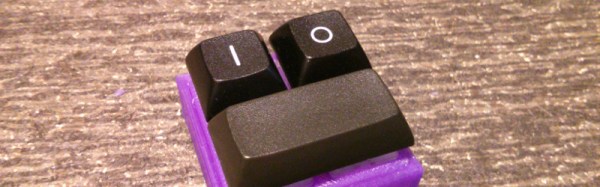
The new challenger comes from Reddit user [duckythescientist], who has created a minimalist three-key binary keyboard. It features a 0 key, a 1 key, a return key, and nothing else. Characters are entered as ASCII or Unicode, and the device emulates either a QWERTY or Dvorak keyboard layout to the host computer’s USB interface. It couldn’t be a simpler layout to learn, though we’d concede that not everyone has the entire binary Unicode table memorised.

The keys are mounted in a custom 3D printed case, and the electronics come from the creator’s own “tinydev” board based on an ATtiny85. All the code is available in a GitHub repository, and there is a very short video of its Unicode ability below the break.

Continue reading “Binary Keyboard Is The Purest Form Of Input Device” →

Motorcycling Like It’s 1905 With A Home Made Engine

The modern motorcycle represents the pinnacle of over a century of refinement in design and manufacture of its every component. A modest outlay will secure you a machine capable of three figure speeds with impeccable handling, breathtaking acceleration and stopping power, that somehow seems also to possess bulletproof reliability that will take it to a hundred thousand miles of faithful transport.

At the dawn of the internal combustion engine age it was a different matter. Machines were little more than bicycles with rudimentary engines attached, brakes and tyres were barely capable of doing the job demanded of them, and the early motorcyclists were a hardy and daring breed.

You might think that this article would now head into retrotechtacular territory with a nostalgic look at an early motorcycle, but instead its subject has a much more recent origin. We happened upon [Buddfab]’s contemporary build of a 1905-era motorcycle, and we think it’s a bike you’d all like to see.

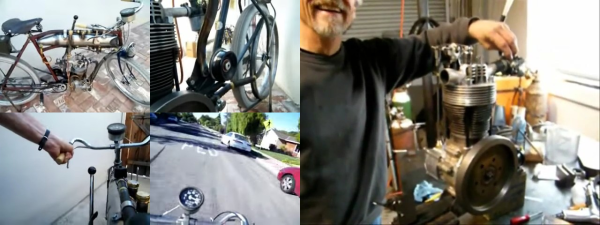
The bike itself is a faithful reproduction of a typical Edwardian machine. It has a modified bicycle frame with a belt drive and springer front forks. That’s all very impressive, but the engine is a masterpiece, crafting a more modern parts bin into something resembling a 1905 original. He’s taken the cylinder, piston, and half a cylinder head from an aircooled VW flat four and mated it with the crankshaft of a 125cc Honda, welding the two connecting rods together to join German and Japanese parts. With a custom-made crankcase, Lucas points, and the carburetor from a British Seagull outboard motor it both looks and sounds like an original, though we’d expect it to be significantly more reliable.

You can see videos of both bike and engine below the break, as he takes it for a spin through American suburbia. Sadly we’ll never see it passed to the definitive writer on early motorcycles for an expert view, but it would fool us completely.

Continue reading “Motorcycling Like It’s 1905 With A Home Made Engine” →

3D Printed Diffuser Lights Up This Magnifier

If you are working with surface mount electronics and don’t have the handy heritage of a pulp-comic superhero to give you super-high-resolution eyesight, then you will quickly find yourself needing a magnifying glass. And since you’ll be using both hands doing the soldering, you’ll need some way to hold it.

There are multiple solutions to this problem on the market, from headband magnifiers and inspection magnifiers on arms to cheap “Helping hands”. They all have their strengths and weaknesses, but none of them appealed to our reader [Anil], who wanted an illuminated magnifier to fit the Hobby Creek arm on his Pana-Vise.

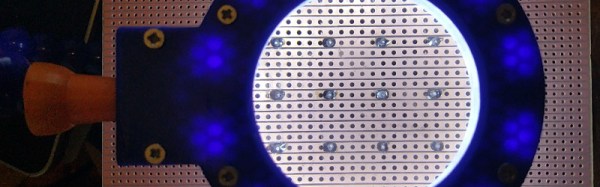
His solution was to 3D print a surround for a lens from a set of helping hands. This is no simple print though, it’s made of three layers. There is a translucent diffuser, a layer that holds a set of LEDs and attaches to the arm, and a cover to hold the lens in place. Power for the LEDs comes via USB.

The print itself was a bit tricky, his diffuser used T-glase translucent filament, and was fused to the PLA LED ring in a single print from his dual-extruder printer. He takes us through the various steps he needed to get it right, and shows us a few of his failed prototypes. The resulting magnifier looks to be a useful addition to his bench, he’s made the STL files available towards the bottom of his post so you can have a go at making one for yourself.

This is the kind of simple hack that can make life so much easier for the SMD constructor. We’ve had  another set of augmented helping hands featured here in the past, and of course there’s the ultimate portable SMT station. If SMD soldering is new to you, please also read our SMD guide for the nervous.