A Simple 3D Printed Rover Design

There are plenty of RC cars and robot platforms out there that you can buy. However, there’s an understanding that’s gained from building your own rover from the ground up. Which is precisely what [Alex] got from developing this compact 3D printed rover design.

The design is by no means fast; it’s intended more for crawling around “at a slow deliberate pace” as [Alex] puts it. Off-the-shelf 12 V gear motors are used to provide plenty of torque to get around. The modular design means that it can be built with just wheels, or set up with tracks fitted for additional performance in softer terrain. Skid steering is used to turn the platform.

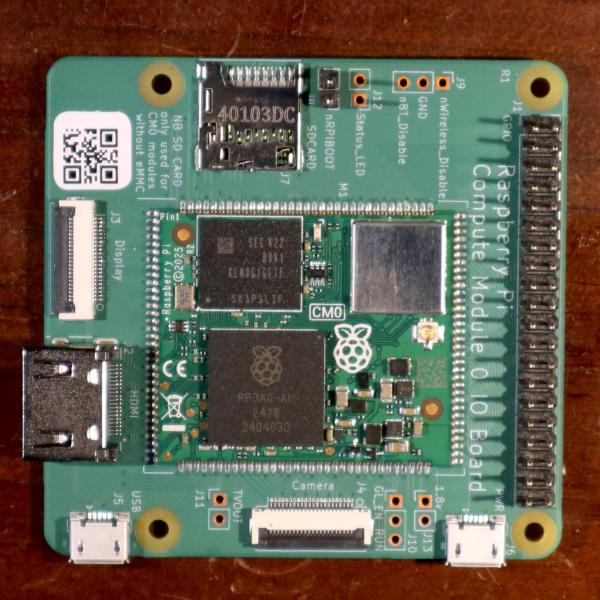
Fitted with a Raspberry Pi Zero 2W, the rover can be controlled remotely over WiFi. A separate FPV camera and transmitter is then used to stream video remotely to pilot the bot. However, if you’re so inclined, you can probably use the Raspberry Pi to stream the video, too.

It’s a fun build and a great way to learn about building rovers and robots that move. We’ve seen some other interesting tracked rovers before, too. Video after the break.


Continue reading “A Simple 3D Printed Rover Design”

Breakbeats Courtesy Of The RP2040

While one often listens to songs or albums in full, sometimes you just want to lay down a simple beat. [todbot]’s latest project promises to do just that.

The build relies on a Raspberry Pi Pico or any other RP2040-based microcontroller board, and is programmed in CircuitPython. The PWM feature is used for audio output, and it’s loaded with different WAV samples of the classic “Amen” break.

Each measure, a random new sample is chosen and played, changing the beat. Even better, all the samples can loop, and they come in varying lengths, allowing them to overlap and lay over each other to add further depth to the mix. It’s a cinch to setup, as CircuitPython has an AudioMixer object built in.

Those wishing to tinker for themselves can find all the code and samples on Github. A build like this one is a great way to start learning about working with audio and music, after all. We’ve seen [todbot]’s work here before, too. Video after the break.
Continue reading “Breakbeats Courtesy Of The RP2040”

3-Wheeled Electric Skateboard Does Things Differently

Typically, electric skateboards drive one or more wheels with brushless motors, while keeping everything mounted on otherwise fairly-standard trucks to maintain maneuverability. However, [swedishFeetballs] decided to go a different route, building a 3-wheeled design using some interesting parts.

The build relies on a large combined hub motor and wheel, similar to those you would find on a hoverboard or some electric scooters; this one is a Xiaomi part sourced from eBay. It’s controlled via an off-the-shelf electric skateboard speed controller that comes complete with its own remote.

The hardware is all bolted up to a custom skateboard deck built from scratch to accept the large single rear wheel. Up front, a regular skateboard truck is used. Batteries are mounted under the deck. Reportedly, the board has a top speed of 15 mph, which unsurprisingly matches that of the Xiaomi M365 the hub motor is sourced from.

It’s a neat way to build an electric skateboard, and to be honest we couldn’t be more curious as to how it rides. Unfortunately, only a few seconds of footage is available, but we’ve embedded it below for your watching pleasure!

Meanwhile, you might also be curious as to the benefits of a half-track skateboard. Video after the break.

Continue reading “3-Wheeled Electric Skateboard Does Things Differently”

China Loves Battery Swapping EVs, But Will They Ever Make It Here?

Electric vehicles promise efficiency gains over their gas-fuelled predecessors, but the issue of recharging remains a hurdle for many eager to jump on board with the technology. The problem is only magnified for those that regularly street park their vehicles or live in apartments, without provision to charge a vehicle overnight at home.

Battery swapping promises to solve that issue, letting drivers of EVs change out their empty battery for a freshly charged one in a matter of minutes. The technology has been widely panned and failed to gain traction in the US.

However, as it turns out, battery swapping for EVs is actually thing in China, and it’s catching on at a rapid rate.

Continue reading “China Loves Battery Swapping EVs, But Will They Ever Make It Here?”

Mystery Effect Causing LEDs To Glow During Reflow

Sometimes you notice something small that nevertheless you can’t explain. [Greg Davill] found himself in just such a situation this week when he noticed some green LEDs glowing dimly when reflowing some boards. Naturally, [Greg] set out to investigate.

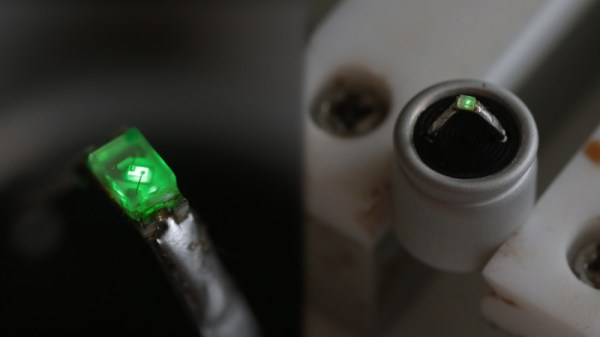
The green LEDs were wired up as power indicators, and [Greg] suspected that the polymer caps on the board might be generating a small current somehow that was causing the LEDs to light up ever so slightly. A simple test hooked a polymer cap directly up to a multimeter. When warmed with a heat gun, the meter showed a small current “in the 5-10 uA range.”

Going further, [Greg] soldered an LED to the cap and once again heated it up, this time to 100° C. The LED  glowed, continuing to do so for around 60 seconds with heat removed. The mystery also grew deeper – [Greg] noticed that this only happened with “fresh” capacitors. Once they’d been through one heat cycle, the caps would no longer light an LED when warmed up.

It’s a curious case, and has many speculating as to the causative mechanism on Twitter. Explanations from thermoelectric effects to chemical reactions inside the capacitor. If you’ve got the inside scoop on what’s going on here, don’t hesitate to let us know in the comments. Meanwhile, check out some of [Greg]’s best work – a glowing D20 dice featuring a whopping 2400 LEDs.

[Thanks to J Peterson for the tip!]

Keep Track Of Your Google Calendar With This Custom Build

Keeping track of your appointments on Google Calendar is easy enough if you’re holding a phone or sitting at a computer, but sometimes you just want to know what’s going on at a glance. This desktop calendar build from [andrei.erdei] does just that with plenty of helpful LEDs.

The attract mode is very cool, even if it doesn’t display any actual information.

The design is simple, using WS2812 LEDs to backlight numbers to indicate whether they are weekdays, weekends, anniversaries, holidays, or any other dates of importance. The numerical layout is a nifty perpetual design allowing the display to easily accommodate the structure of any month, even those neat and tidy ones that start on Monday.

The design relies on an ESP-01 to communicate with Google Calendar and display the relevant data. It’s all wrapped up in a 3D printed case, with the printed paper template backlit from behind some smoked acrylic giving a surprisingly professional-looking finish.

If you’re tired of picking up your phone for every last thing, this design could be just what you’re after for keeping track of your appointments. Alternatively, you could always go the hard copy route. Video after the break.

Continue reading “Keep Track Of Your Google Calendar With This Custom Build”

Underwater Tanks Turn Energy Storage Upside-Down

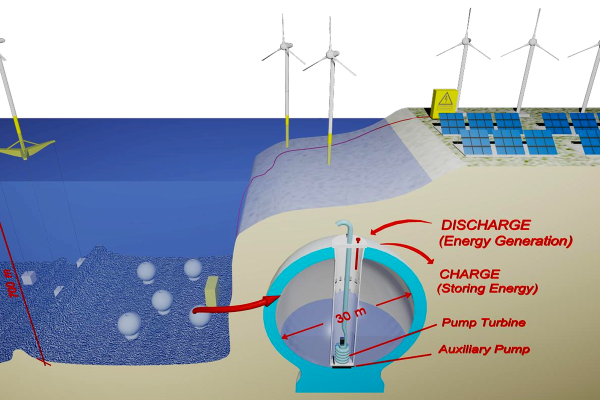
Pumped hydro storage is one of the oldest grid storage technologies, and one of the most widely deployed, too. The concept is simple – use excess energy to pump a lot of water up high, then run it back through a turbine when you want to get the energy back later.

With the rise in renewable energy deployments around the world, there is much interest in finding ways to store energy from these often-intermittent sources. Traditional pumped hydro can help, but there is only so much suitable land to work with.

However, there could be a solution, and it lurks deep under the waves. Yes, we’re talking about underwater pumped hydro storage!

Continue reading “Underwater Tanks Turn Energy Storage Upside-Down”