Build Your Own In-Fridge Soda Fountain

Who doesn’t love an ice cold soda? Lots of people, probably. This one’s not for them. It’s for those of us that are tired of having to go through the arduous process of manually opening a bottle and pouring a drink. Wouldn’t it be cool if you could have your own soda fountain at home? [Kedar Nimbalkar] thought so, and built a soda fountain that you can install right inside a fridge.

The system is based around using small pumps marketed as “6V DC air pumps” on Amazon. [Kedar] uses an indirect method of pumping the soda in this project. It’s a sad fact that it’s hard to find a cheap pump that’s safe to use with fluids for human consumption, and on top of that, many types of pump out there aren’t self-priming. This means the pump needs to be charged with fluid to work, which can make changing empty bottles a real pain.

Instead of pumping the fluid directly, the pumps instead push air into the top of the sealed soda bottles, which forces soda out of another tube in the bottle. This means that the pumps themselves don’t have direct contact with the soda which is a great design when working with stuff you’re going to put in your body. Following on from this careful design, the tubing selected is food safe. Unfortunately, even though the pumps don’t directly touch the soda itself, it’s highly unlikely the pumps chosen (designed for aquariums) are genuinely food-safe themselves.

When you’re building a beer funnel setup for Australia Day/4th of July/Other, using all manner of industrial or agricultural fittings may be a relatively low risk, as it’s a one-off exposure. But if you’re building a system handling products for human ingestion that you’re using on a regular basis, you really do want to make sure that the parts you use aren’t slowly poisoning you. There’s many ways this can happen — parts may corrode or react with substances in the food, plastics may outgas, or there may be lubricants in the parts that have toxic compounds in them. Just look what can happen if you drink wine out of a gun barrel — and that was from a single exposure!

Overall it’s a cool project, and one that would be especially fun and educational to do with children. Young humans are well known for their predilection towards sugary beverages, and have minds ready to be filled with knowledge about pumps, safe food handling practices, and of course, electronics. We also like [Kedar]’s use of commonly available materials, like a plastic food container for the enclosure. The project would be a great starter on your way to building a more complicated cocktail-mixing barbot. Video after the break.

We know peristaltic pumps are the go-to for safe liquid pumping. Anyone know a hacker friendly way of pumping air while ensuring all parts of the system are food safe? The most creative solution we’ve seen is to use breast pumps but it wasn’t ideal. Let us know your own tricks in the comments!

Continue reading “Build Your Own In-Fridge Soda Fountain”

Project 54/74 Maps Out Logic ICs

Integrated circuits are a fundamental part of almost all modern electronics, yet they closely resemble the proverbial “black box” – we may understand the inputs and outputs, but how many of us truly understand what goes on inside? Over the years, the process of decapping ICs has become popular – the removal of the package to enable peeping eyes to glimpse the mysteries inside. It’s an art that requires mastery of chemistry, microscopy and photography on top of the usual physics skills needed to understand electronics. Done properly, it allows an astute mind to reverse engineer the workings of the silicon inside.

There are many out there publishing images of chips they’ve decapped, but [Robert Baruch] wants more. Namely, [Robert] seeks to create a database of die images of all 5400 and 7400 series logic chips – the eponymous Project 54/74.

These chips are the basic building blocks of digital logic – NAND gates, inverters, shift registers, decade counters and more. You can build a CPU with this stuff. These days, you may not be using these chips as often in a production context, but those of you with EE degrees will likely have toyed around a few of these in your early logic classes.

There’s only a handful of images up so far, but they’re of excellent quality, and they’re also annotated. This is a great aid if you’re trying to get to grips with the vagaries of chip design. [Robert] is putting in the hard yards to image as many variations of every chip as possible. There’s also the possibility of comparing the same chip for differences between manufacturers. We particularly like this project, as all too often manufacturing techniques and technologies are lost and forgotten as the march of progress continues on. It looks like it’s going to become a great resource for those looking to learn more about integrated circuit design and manufacture!

Solar-Powered Prosthetic Skin

One of the biggest problems for prosthetic users is feel. If you’ve ever tried to hold a pen and write with a numb hand, you’ve realised how important feedback is to the motor control equation. Research is ongoing to find ways to provide feedback from prosthetic limbs, in even a basic format.  The human nervous system is a little more complex than just interfacing with the average serial UART. One of the requirements of many feedback systems is power, which usually would involve bulky batteries or some form of supercapacitors, but a British team has developed a way to embed solar cells in a touch-sensitive prosthetic skin.

The skin relies on everyone’s favourite material of the minute, graphene. A thin layer of graphene allows the prosthetic to feed signals back to the user of both temperature and contact pressure. The trick is that the graphene skin is incredibly transparent, reportedly allowing 98% of light on its surface to pass through. It’s then a simple matter of fitting solar panels beneath this skin, and the energy harvested can then be used to power the sensor system.

The team does admit that some power storage will later be required, as it would be difficult for any prosthetic user if their limbs lost all feedback when they walked into a dark room. The idea of one’s arm losing all feeling upon going to bed isn’t particularly appealing. Check out the paper here (paywalled). Video below the break.
We see a lot of great prosthetic projects cross our desk here at Hackaday – like this 3D printed prosthetic hand. Prosthetics definitely matter, so why not build your own and enter it in the 2017 Hackaday Prize?

Continue reading “Solar-Powered Prosthetic Skin”

Transcranial Electrical Stimulation With Arduino, Hot Glue

The advance of electronic technology has been closely followed by the medical community over the past 200 years. Cutting edge electronics are used in medical imaging solutions to provide ever greater bandwidth and resolution in applications such as MRI machines, and research to interface with the human nervous system continues at a breakneck pace. The cost of this technology – particuarly in research and development – is incredibly high. Combine this with the high price of the regulatory approvals necessary for devices which deal in terms of life and death, and you’ll find that even basic medical technology is prohibitively expensive. Just ask any diabetic. On the face of things, there’s a moral dilemma. Humanity has developed technologies that can improve quality of life. Yet, due to our own rules and regulations, we cannot afford to readily distribute them.

One example of this is that despite the positive results from many transcranial electrical stimulation (TCS) studies, the devices used are prohibitively expensive, as are treatment regimens for patients. Realising this, [quicksilv3rflash] decided to develop a homebrew, open source transcranial electrical stimualtion device, and published it on Instructables. Yes, that’s the world we’re now living in.

It’s important to publish a warning here: Experimenting with this sort of equipment can easily kill you, fry your brain, or have any number of other awful results. If you don’t have a rock solid understanding of the principles behind seperate grounds, or your soldering is just a little sloppy, you don’t want to go anywhere near this. In particular, this device cannot be powered safely by a wall-wart.

To be honest, we find it difficult to trust any medical device manufactured out of modules sourced from eBay. But as a learning excercise, there is serious value here. Such a project requires mastery of analog design to avoid dangerous currents being passed to the body. The instructions also highlight the importance of rigorously testing the device before ever connecting it to a human body.

The equipment is based around an Arduino Nano receiving commands from a computer over serial, fed by an application written in Python & PyGame. To think, this writer thought he was being bold when he used it to control a remote control car! The Arduino Nano interprets this data and outputs it over SPI to a DAC which outputs a signal which is then amplified and fed to the human brain courtesy of op-amps, boost converters and sponge electrodes. The output of the device is limited to +/-2.1mA by design, in accordance with suggested limits for TCS use.

It should be noted, [quicksilv3rflash] has been experimenting with homebuilt TCS devices for several years now, and has lived to tell the tale. It’s impressive to see a full suite of homebrew, opensource tools being developed in this field. [quicksilv3rflash] reports to have not suffered injuries from the device, and several devices have been shipped to redditors. We’ve only found minimal reports on people receiving these, but nothing on anyone actually using the hardware as intended. If you’ve used one, get in touch in the comments.

It goes without saying – this sort of experimentation is dangerous and the stakes for getting it wrong are ludicrously high. We’ve seen before what happens when medical devices malfunction – things get real ugly, real fast. But hackers will be hackers and if you were wondering if it was possible to build a TCS device for under $100 in parts from eBay, well, yes. Yes it is.

The Smallest Wave Blaster Card

In the early 90s, the Creative Sound Blaster was the soundcard. It wasn’t the absolute best sounding card on the market, but it quickly became the defacto standard and delivered good sound at the right price. It relied primarily on the Yamaha OPL-3 FM synthesis chip, but if you were feeling spendy, you could pimp it out with a Wave Blaster add-on card, which essentially bolted a sample synthesis engine onto the card. This gave the card a broad palette of sampled instruments with which to play MIDI tunes all the sweeter, so you could impress your grade school chums who came over to play DOOM.

It’s now 2017, if you hadn’t checked the calendar, and Sound Blasters from yesteryear are only going to go further upward in price. It goes without saying that add-on daughterboards and accessories are even rarer and are going to be priced accordingly. So, if you’re building a vintage gaming rig and are desperate for that sample-synth goodness, [Serdashop] are here to help with their latest offering, the Dreamblaster S2.

It’s reportedly the smallest Wave Blaster add-on board available, which is awesome. If you’re sticking it on top of your Sound Blaster 16, yes, it’s pointless – you’re not exactly short on room. But if you want to integrate this with a compact microcontroller project? Size matters. Yes, you can feed this thing MIDI signals and it’ll sing for you. A hot tip for the uninitiated: MIDI speaks serial, just like everything and everyone else. Your grandma learned to speak it in the war, you know.

Your options for hooking this up are either slotting it into a Wave Blaster compatible card, or buying the carrier board that allows you to use it with a Game Port, in addition to custom-wiring it to your own hardware. We’d love to see this as a HAT for the Raspberry Pi Zero. Do it, send it in and we’ll write it up.

We’ve seen [Serdashop]’s hardware here before – namely, the earlier Dreamblaster X2. Video below the break.

Continue reading “The Smallest Wave Blaster Card”

Use A Mini PCI-e 3G Card With USB Instead

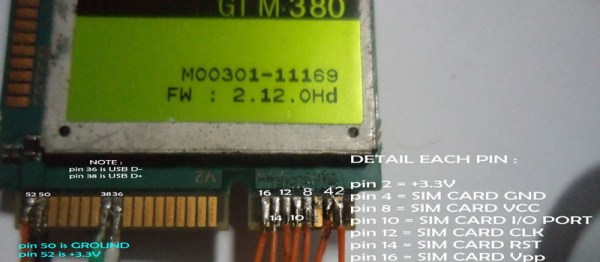
Back the late 2000s, when netbooks were the latest craze, some models would come with an inbuilt 3G modem for Internet access. At the time, proper mobile Internet was a hip cool thing too — miles ahead of the false prophet known as WAP. These modems would often slot into a Mini PCI-e slot in the netbook motherboard. [delokaver] figured out how to use these 3G cards over USB instead.

It’s actually a fairly straightforward hack. The Mini PCI-e standard has a couple of pins dedicated to USB data lines, which the modem in question uses for communicating with the host computer. Unfortunately it’s not quite as simple as just soldering on a four-wire USB cable. The modem relies on the 3.3V power from the Mini PCI-e slot instead of the 5V from USB. No problem, just get a low-dropout 3.3V regulator and run that off the USB port. Then, it’s a simple enough matter of figuring out which pins are used to talk to the SIM card, and soldering them up to a SIM adapter, or directly to the card itself if you’re so inclined. The guide covers a single model of 3G modem but it’s likely the vast majority of these use a very similar setup, so don’t be afraid to have a go yourself.

Overall Mini PCI-e is a fairly unloved interface, but we’ve seen the reverse of this hack before, a Mini PCI-e to USB adapter used to add a 12-axis sensor to a laptop.

[Thanks to Itay for the tip!]

2017: The Year Of The Dishwasher Security Patch

As if Windows Update wasn’t bad enough, one has to deal with a plethora of attention-hungry programs and utilities all begging for a continual stream of patches from the Internet. It’s exhausting, but unfortunately also par for the course. Many of these updates are to close security vulnerabilities that could otherwise expose your computer to undesirables. The Internet of Things will only expand the amount of hardware and software you need to keep updated and protected on a daily basis. Now, it’s your dishwasher that’s under attack.

The Register reports that Jens Regel discovered the bug in a Miele dishwasher with a webserver. It’s a basic directory traversal attack that can net the intruder the shadow password file. Armed with this, it’s simple to take over the embedded Linux system and wreak havoc on your local network.

It’s not particularly surprising – we’ve talked about IoT security and its pitfalls before. The problem is, a dishwasher is not a computer. Unlike Microsoft, or Google, or even the people behind VLC, Miele don’t have infrastructure in place to push out an update to dishwashers worldwide. This means that as it stands, your only real solutions are to either disconnect the dishwasher from your network, or lock it behind a highly restrictive firewall. Both are likely to impede functionality. Of course, as always, many will ask why a dishwasher needs to be connected to the Internet at all. Why indeed.