Fail Of The Week: Reverse Engineering A Wireless Energy Monitor

fotw-wireless-energy-monitor-reverse-engineering

[Afonso] picked up a cheap energy use monitor a few years back. He really like the data it displays about his home’s electricity, using a sensor to gather this info and a display that communicates with it wirelessly. But there is no option to log or dump the data. He set out to reverse engineer the wireless protocol in order to extend the use of the system. As the name of this column implies, he failed to get this working.

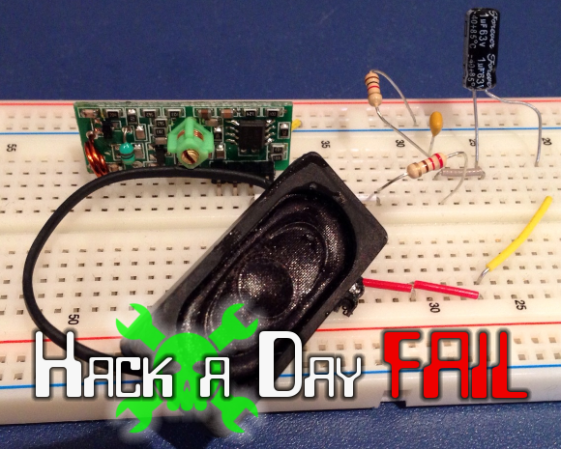
The hardware above is a 433Mhz transceiver that he rigged up as test hardware. It sounds like he’s assuming the monitor works on this band, which could have been his first misstep (we really don’t know). The speaker is there to give audible confirmation that he’s receiving something from the transmitter. This is where things start to get pretty weird. White noise was coming from the speaker, but when he stepped away from the bench it stopped. He was able to measure a regular pattern to the noise, and proceeded to place the speaker next to his computer MIC so that he could record a sample for further analysis.

Fail of the Week always aims to be a positive experience. In this case we’d like to have a conversation about the process itself. We agree that connecting a speaker (or headphones) should help get your foot in the door because your ear will recognize a rhythmic pattern when it is received. But with this noise, measuring the timing and recording a sample we’re not so sure about. Given the situation, how would you have soldiered on for the best chance at successfully sniffing out the communication scheme used by this hardware? Leave a comment below!


2013-09-05-Hackaday-Fail-tips-tileFail of the Week is a Hackaday column which runs every Wednesday. Help keep the fun rolling by writing about your past failures and sending us a link to the story — or sending in links to fail write ups you find in your Internet travels.

Retrotechtacular: Salvaging A Capsized Ocean Liner

salavaging-a-capsized-ocean-liner

The scale of this salvage operation is nothing short of daunting. The SS Normandie was an ocean liner put into service in 1935 and capable of carrying 1,972 people across the Atlantic Ocean. The ship is still the fastest turbo-electric-propelled passenger vessel ever built, so it’s no surprise that it was seized by the US Navy during World War II for conversion to a troop carrier called the USS Lafayette. But in 1942, during retrofit operations, the vessel caught fire and capsized. The topic of today’s Retrotectacular is the remarkable salvage operation that righted the ship. Unfortunately, it was subsequently scrapped as bringing it into service was going to be too costly. Lucky for us the US Navy documented the salvage operation which makes for a fascinating 35-minutes of footage.

Continue reading “Retrotechtacular: Salvaging A Capsized Ocean Liner”

Recap: Hackaday’s First Live Event

Packed house

Last Tuesday was the first time I know of that Hackaday hosted our own live event. There were some less official get-togethers associated with conferences and things like that. But we threw The Gathering to see if readers would rise from their lairs for a chance to interact with one another. We called, you answered, and I had an amazing time. Hackaday packed the place with over four hundred readers, and every conversation I had ended up being a fascinating interaction. Thank you!

[Brian], [Eliot], and [Mike] via [Mike's] phone an color corrected by [Hefto
[Brian], [Eliot], and [Mike] via [Mike’s] phone an color corrected by [Hefto
[Brian Benchoff] and I returned to our snowy homelands the next morning. Surprisingly this was the first time we had met each other despite working closely on Hackaday for the past several years. I also had the pleasure of meeting [Eliot Phillips] and [Jack Buffington] for the first time. I’m sorry I didn’t have more time to hang out with them, but when you’re trying to say hello to several hundred people you’ve just got to keep moving.

Before I get too wordy I better throw the more tag in here. Join me after the jump for a blow-by-blow of what we did, what sticks out in my mind, and where we’re going next.

Continue reading “Recap: Hackaday’s First Live Event”

Hackaday Links: January 26, 2014

hackaday-links-chain

The automotive industry is rolling more and more tech into their offerings. This is great for us because replacement or salvaged parts are great for projects. Here’s one component to look for. [MikesElectricStuff] tears apart the thermal imaging camera form an Audi. [via Hacked Gadgets]

Give your valentine an analog love note on the big day. [Tom’s] LED heart chaser design does it without any coding. It’s a 555 timer with CD4017 decade counter. The nice thing about the setup is a trimpot adjusts the chaser speed.

[Jan] is overclocking his Arduino to 32 MHz. For us that’s kind of an “eh” sort of thing. But his statement that you need to use a clock generator because the chip won’t work with an oscillator at that frequency raised an eyebrow. We saw an AVR chip running from a 32MHz crystal oscillator in the RetroWiz project from yesterday. So do we have it wrong or does [Jan]? Share your opinion in the comments.

Download a copy of the Apple II DOS source code… legally. Yay for releasing old code into the wild! The Computer History Museum has the DOS source code and a bunch of interesting history about it. [via Dangerous Prototypes]

While we were prowling around DP for the last link we came across [Ian’s] post on a new version of Bus Pirate cables. We’ve got the old rainbow cables which are pretty convenient. But if you’ve used them you’ll agree, hunting for the correct color for each connection isn’t anywhere near a fool-proof method. The new cable uses shrink tube printed with probe labels. They sound like a huge pain to manufacture. But this makes connections a lot easier. In our experience, when it doesn’t work its always a hardware problem! Hopefully this will mean fewer botched connections.

Make your tiny LiPo cells last longer. Not capacity wise, but physically. The delicate connections to the monitor PCB break easily, and the plug is really hard to connect and disconnect. [Sean] shows how he uses electrical tape for strain relief, and a bit of filing to loosen up the connector.

KerbalEdu: Kerbal Space Program for education. That’s right, you can play Kerbal as part of school now. Some may shake their heads at this, but school should be fun. And done right, we think gaming is a perfect way to educate. These initiatives must be the precursor to A Young Lady’s Illustrated Primer method of education. Right?

Update From Wayback: AVGA Reborn As RetroWiz

retrowiz-vga-avr-gaming-system

This one has been a long time coming. We’re finally seeing an update to [Jaromir’s] retro gaming platform based around and ATmega chip. The thing that was novel about it back in 2009, and continues to be to this day, is the use of VGA output (PAL) from an AVR chip rather than composite video like most offerings.

Good projects never die and recently he picked the hardware up again, spinning a mostly surface mount board and putting together a new website to feature his work. Above you can see a demo of Commander Keen 4 running on the hardware (video below). He’s also has a rather trippy Super Mario port and adapted [Albert Seward’s] PacMan source for the hardware.

The chip is being clocked at 32MHz with VGA clock running at 19.6608 MHz. This gives him sixteen colors with a resolution of 192×144. He concedes that you get better resolution out of composite video, but who needs resolution for retro gaming?

Continue reading “Update From Wayback: AVGA Reborn As RetroWiz”

ARM Debugger For Nearly One Dollar

Oh that title is so misleading. But if you squint your eyes and scratch your noggin it’s almost true. Thanks to the hard work of [Peter Lawrence] it is now possible to hack together an extremely inexpensive CMSIS-DAP ARM debugger.

Let’s talk about function and we’ll get back to cost later. CMSIS-DAP is a standard that gives you the kind of breakpoint control you expect from a proper debugger. In this case [Peter] implemented the standard using 4k words of space on a PIC 16F1454. This lets it talk to the debug port on ARM chips, and the bootloader (also written by him) doubles as a USB-to-UART bridge. Boom, done. OpenOCD (and a couple of other software packages) talks to the PIC and it talks to the ARM. Nice.

Back to the cost question. You can get a 16F1454 for nearly a dollar when you order in quantity. If you cut up an old USB cable, recycle some jumper wire, and already have power and decoupling on hand, you’re in business for nearly one dollar.

Stealth Camper Van

Sometimes you need to sleep where you’re not supposed to. In this case, [MisterE] wanted to cut the costs associated with his climbing trips. He took a 2001 GMC Savana cargo van and turned it into a stealthy mobile living space. The project is from back in 2008 and we almost waved off from featuring it. But when you start to look at all of the creative space-saving solutions in the hack we think you’ll agree it’s worth a look.

Since he’s a climber that means time in the mountains, which can be quite cold. The sides and floor of the van were insulated to about R19 before the build work itself started and there’s a small wall-mounted heater. For comfort, a fouton was a must for sleeping but also for its double use as a sofa. For style the only choice here was bead-board to cover all of the walls. There is a small kitchenette that is mainly just a sink (we’ve seen running water in vehicles before). A couple of extra batteries power all of the electronics: audio, laptop, etc. When asked, [MisterE] confirms that he added hidden storage areas for his more pricey gear. Total cost on the project came it at $11,500. About nine for the van and the rest for improvements.

He mentions he blew an inverter because of grounding issues while starting the van. As long as he turns it off before start-up he’s fine. Shouldn’t there be a better way to build protection into this? Please leave a comment after the break and let us know what you’d do differently.

[Thanks Mac]