Bolstering Raspberry Pi HDMI With A Current Regulator

rpi-hdmi-current-regulator

We’ve never tried using an HDMI to VGA converter with Raspberry Pi. We heard they were expensive and have always just used HDMI out (although DVI would be just as easy). Apparently if you have a VGA converter that isn’t powered the RPi board may output unstable video due to lack of current from the connector. [Orlando Cosimo] shows how to fix the problem with a few inexpensive components.

Just this morning we saw a portable PSU using an LM317. This project uses the same part, but in a different way. [Orlando] uses three resistors in parallel to make the LM317 behave like a current regulator (as opposed to a voltage regulator) which will output about 550 milliamps. Input voltage is pulled directly from the 5V line of the microUSB port. The output is injected into the HDMI connector. This will boost the amount of juice available to the unpowered VGA converter, stabilizing the system.

There are a lot of other power hacks out there for the RPi. One of our favorites is pulling the stock linear regulator in favor of a switch mode regulator.

[via Dangerous Prototypes]

Pull-out Pantry Fills Space Next To Refrigerator

pull-out-pantry


Your refrigerator needs a few inches of space on the hinge side in order for the door to open fully. If there’s a wall on that side it means you leave a gap. A bit of lumber and some inexpensive hardware can turn that gap into a pull-out pantry.

This picture is from [Ratmax00’s] pantry project. He had a 6.5″ gap to work with and started the build by making a wooden frame using pocket screws for the butt joints. Four casters were added to the bottom to make it roll in and out easily. He needed a handle and a way to make sure commodities didn’t fall off the shelves. He chose to use a 3D printer for brackets that hold the fence dowels and a custom handle. If you don’t have that just hit the cabinet hardware aisle at your local home store.

We wonder if it would have been possible to use full-extension draw rails mounted above and below the cabinet in addition to a couple of wheels? This would help keep the pantry from scraping against the fridge or the wall.

While you’re building bookshelf sized things why not get to work on a hidden door as well?

LED Strip Pong As An Arduino Shield

led-pong-strip

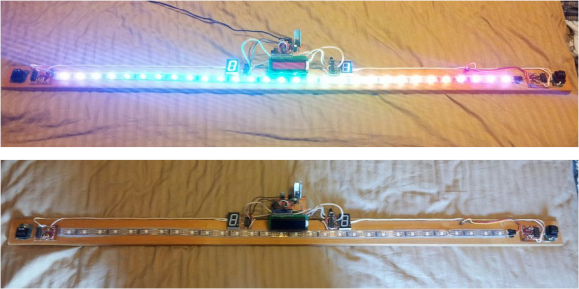
[Schuyler Sowa] has been hard at work on his own version of LED strip Pong. We’d say his work has really paid off. The game is robust and full of features.

Unlike the original Pong video game LED pong only has one axis on which the ball travels. The ball will bounce back if the button at the end of the strip is pressed when either of the last two LED pixels are illuminated. To add in a difficulty adjustment [Schuyler] included a poteniometer which alters the speed.

The game board is one meter of LED strip with individually addressable pixels. It cost a whopping $28 and was the second kind he tried after having trouble with the WS2801 based version (which often come as strings of lights). An Arduino board controls the game, with a shield made from protoboard to connect the components. In addition to the two user buttons — which were hacked out of a computer keyboard — you’ll notice a pair of seven segment displays acting as a scoreboard and an HD44780 character LCD rounding out the user interface.

Continue reading “LED Strip Pong As An Arduino Shield”

PlayStation 3 Controlled With Head Movement

Our excitement just keeps building about how hackers can ply their skills to develop new adaptive technologies. Here’s another great example of custom control technology that helped [Steven] get back into gaming. The effects of muscular dystrophy have left him unable to use the stock PS3 controller. But after being paired up with [John Schimmel] he’s able to game again thanks to a head motion control system.

[John] looked at the way [Steven] interacts with the assistive technology at hand. He can drive his wheelchair with one finger, and interacts with his computer by moving his head. The computer detects a marker on the brim of his hat. [John] grabs input from the computer using Java and sends it to an Arduino board connected via USB. The Arduino has a USB Bit Whacker board letting it also connect to the PS3 as a controller. In the image above you can see the computer screen has a GUI for each of the controller’s buttons. [John] moves his head to select a control and clicks a button with his finger to actuate it.

If you like this check out some of the other assistive gaming hacks we’ve seen lately.

[via The Controller Project]

Simon Says Learn How To Program ARM Chips

barebones-simon-says

This breadboard version of a Simon Says game is a great way to try your skills on a new microcontroller platform. The eight-pin chip seen in the center of the board is an LPC810 microcontroller which [Hartmut Wendt] is just getting started with. It’s a rare example of a low-pin count DIP package for an ARM device (Cortext M0). The breadboard friendly footprint makes it easy to work with, but you could pull off the same build with a dev board like one of the STM discovery offerings or the Stellaris Launchpad boards.

Why is this a good way to learn? It involves input, output, and generating waveforms which we’d assume means timers (we didn’t dig through the source code which is available form the page linked above). Each colored button has a matching LED which blinks out the pattern which you must replicate to keep the game going; you know how Simon Says works, right?. At the same time a different pitch is played by the speaker on the right.

Another good exercise would be to take [Hartmut’s] code and port it for a different chip, be it ARM or otherwise.

Continue reading “Simon Says Learn How To Program ARM Chips”

Packing A Jeep Wrangler Full Of Hacks

Picking just one image to show off all of the hacks done on this Jeep Wrangler is a tough order. We decided to go with this custom ceiling console as it features the most work done in a confined area.

Give the video walk-around a bit of time before you decide it’s not for you. [Eddie Zarick] spends the first moments touting his “Oakley” branding of the vehicle in decals, emblems, embroidered seats, zipper pulls, and more. But after that you’ll get a look at the pressurized water system we previously saw. Pull open the back gate and there’s a nice cargo cover he built that includes a cubby hole which stores the soft sides when he wants to take the top off. There are several other interesting touches, like the police radar spoofer that he uses to scare the crap out of speeders. Ha!

The ceiling console we mentioned earlier was completely custom-built. It includes a CB, scanner, HAM, and seven-inch Android tablet. There is also a set of push buttons which control the various bells and whistles; well, spotlights and inverter actually. Just add a commode and he’s ready to live out of his car.

Continue reading “Packing A Jeep Wrangler Full Of Hacks”

Is An LED Bow Tie Ironic Or Awesome?

led-bowtie

We’re not exactly trend setters when it comes to wardrobe. And so the recent revival of the bow tie as an accepted dress item confounds us. We’re even more confused by [Arichter’s] LED bow tie. Sure, the hobby electronics part of it is a win… but when it comes to fashion is he making fun of the bow tie wearers, or setting a new standard?

The tie is made of three PCBs, which lets the wings sit on a bit different plane than the center. He populated the boards with about 100 RGB LED modules which he desoldered from a couple of meters of LED strip. They draw a lot of juice and to supply that he uses a boost converter. A standard Arduino UNO board controls the lights.

If you’re still sold on the bow tie form factor we’d like to direct your attention to this long-tie version. It doesn’t just show patterns, but plays a wicked game of Tetris with you as the game board.

[via Reddit]