Solder Trick To Make Your Own Surface Mount Breakout Boards

surface-mount-breakout-trick

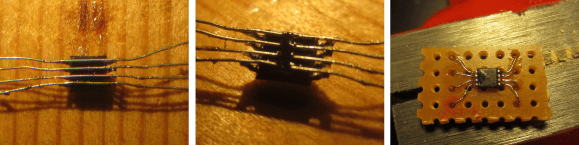
We think you’re really going to enjoy this trick for making surface mount breakout boards. It’s common to use magnet wire to connect individual pins of a surface mount part to breadboard friendly protoboard with pin headers. What’s new here (at least to us) is that [Raul] solders one wire to both pins directly across from one another.

The image at the left shows an eight pin part with four wires soldered in place. To get to this point he first taped the wires down to a work surface being careful to space them to match the pitch on the chip’s leads. He then tapes the chip in place and solders all of the legs to the wires. This seems to kill two birds with one stone as aligning one wire to one leg is tough. From there he flips the chip over and cuts the wire spanning under it. This leaves an easy job of soldering the trailing side of the wire to a hunk of protoboard.

It’s perfect for chips with a small number of pins. Of course you may still want an etched breakout board for something with a ton of leads.
Build A Waterproof Music Controller On The Cheap

shower-controller-for-music-playback

[Aaron] wrote in to show off the waterproof music controller (translated) he just finished building. He uses it in the shower — which makes us wonder how long he’s spending in there. We could also see it being useful by the pool, on the beach, or anywhere else that you need a cheap and easy control system.

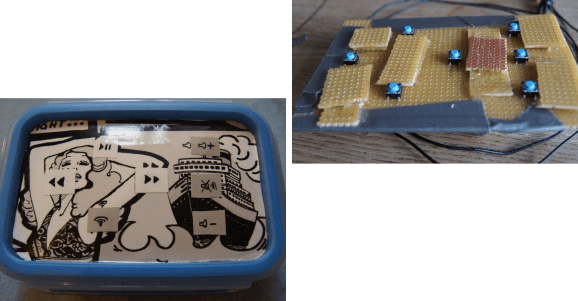
His computer plays tunes while he’s getting ready for the day. This means he was able to use an inexpensive wireless keyboard for control. The donor keyboard has dedicated music control keys which he carefully traced to the PCB before removing the flexible sheets that detect key presses. Next he found a water tight food container and sized his protoboard to fit. You can see his button layout above. Holes were cut in the lid of the container, with a plastic membrane glued on the underside. This will keep the water out while still allowing him to actuate the momentary push switches.

Most mobile devices will work with wireless keyboards. If your car is nearby just hook your phone to the stereo and control it with this rather than building a dedicated beach stereo system.

How To Build A Tron Bar That Daft Punk Would Hang Out At

tron-bar-daft-punk

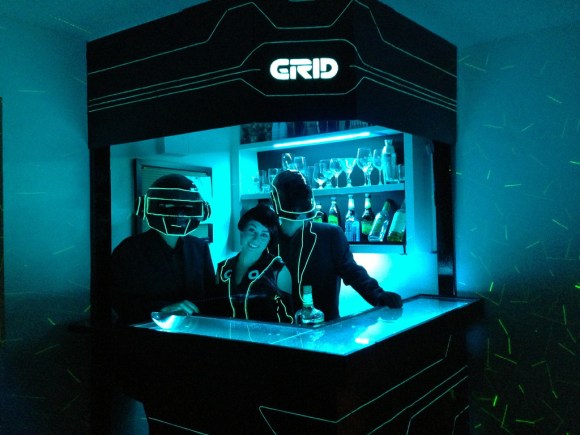
Sure, the bar in this image looks pretty neat. But the video showing off its synchronization with the music brings it to the next level. The flashing lights and EL wire put on a quite a show that may make the bartenders feel like they’ve already had a few too many.

The most amusing part of the project is that it all started from that half bookcase mounted on the wall. [Alexander Givens] and his roommate decided to augment its usefulness as a liquor cabinet by building a bar around it. But why stop there? LED Strips and 120 feet of elecroluminescent wire give the bar its inner glow. The illuminated lines are obvious, but the LED strip locations may not be. Several of them light the shelves hosting liquor and glass wear. The bartop itself is made of glass, filled with 75 pounds of marbles, and lit from underneath by the rest of the strips.

An Arduino Mega with an EL shield drives the system. The guys built a rudimentary control interface that looks partially spill tolerant. It’s located just under the inside lip of the bar.

Their costumes came out pretty well too. But with a built-in centerpiece like this they may want to upgrade to a more accurate replica.

Continue reading “How To Build A Tron Bar That Daft Punk Would Hang Out At”

Transformer Built From MIT Admissions Mailing Tube

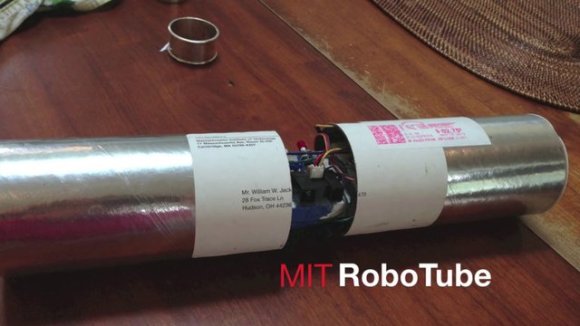
mit-admissions-tube-robotIt’s not quite on the scale of [Michael Bay], but that’s probably a good thing. We do think that this robot built from a mailing tube by [Will Jack] would be right at home in a Transformers movie.

The bot starts out looking like a normal cardboard mailing tube. But the seam at the middle splits to reveal the electronics inside. An Arduino Uno drives the device, monitoring that infrared rangefinder which is facing forward. Each half of the tube acts as a wheel, pushing against the at-rest mass of the internals to create motion. It can even pull off a tank-like pivot to turn in place by spinning he halves in opposite directions.

We were intrigued to hear that the admissions department at the Massachusetts Institute of Technology sent a single page acceptance letter in these silver tubes to those students accepted into the class of 2017. The letter invites the incoming class to hack the tube and send in their results. We’re going to have to dig through the submissions and see if there are any other noteworthy projects.

Continue reading “Transformer Built From MIT Admissions Mailing Tube”

Hackaday Links: Sunday, June 23rd, 2013

hackaday-links-chain

Need to connect a male pinheader to male jumper wires? [Scoops] came up with a brilliant method using jumpers meant for dual-pin headers like on motherboards.

Atanua, a real-time logic simulator, was just upgraded for the first time in a few years. We’ve liked this one since way back. The changes mostly involve performance improvements.

You can see what’s inside of Google Glass without shelling out $1500 for your own hardware. [Thanks Itay]

Coding a Minecraft clone in x86 assembly is pretty impressive. We had to install nasm and qemu to get it to compile but it does work. If you don’t want to build the project just check out the demo video. There’s no sign of creepers but dig too deep and you’ll fall out of the world. [Thanks Dmitry]

Here’s a way to use multiple Google Drive accounts as a RAID array.

[Sick Sad] produced some really trippy photographs using long exposures with a laser line on a servo. The result is a photorealistic image of the subject (faces in this example) that looks like it was melted à la [Salvador Dalí]. If you’re just interested in using the laser for light painting check out Hackaday alum [Jeremy Cook’s] work in that area.

And finally, two monitors are better than one. [Bryan] put his both together in portrait orientation using a laser-cut mounting bracket of his own design.

Adding RGB Backlight To Arcade Buttons

backlit-arcade-buttons

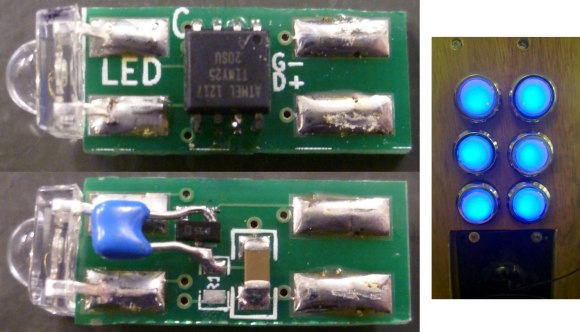
These arcade buttons started out as illuminated buttons. But they were bulb-based which only allowed for one color. [Jon] and his friends at the Leeds Hackspace wanted to find a way to retro fit them with RGB LEDs, without changing the buttons themselves. The hack lets them replace the bulb with an addressable circuit board. The really interesting thing about it is that there is no separate interface for addressing. The communications happen on the voltage bus itself.

After deciding to include a microcontroller inside the button they built a test version using some protoboard to see if it would fit. Indeed there was enough room and the proof-of-concept led to the factory spun board which you see above. It has pads for two of the four LED module feet on either side, with the opposite end of the board fitting into the bulb receptacle. The voltage line is pulsed to send commands to the microcontroller. We’re interested in finding out exactly how that works but we’ll have to dig through the code before unlocking the secret.

Continue reading “Adding RGB Backlight To Arcade Buttons”

Kinect Full Body Scanner

kinect-full-body-scanner

Why let the TSA have all the fun when it comes to full body scanning? Not only can you get a digital model of yourself, but you can print it out to scale.

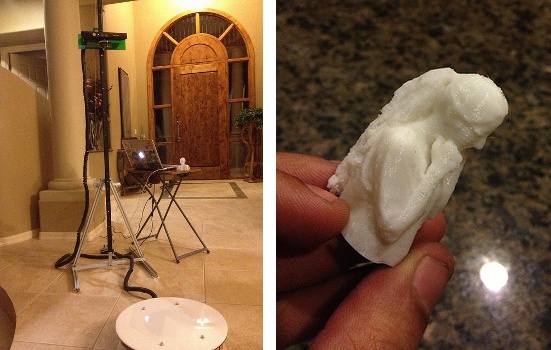
[Moheeb Zara] is still in development with a Kinect based full body scanner. But he took a bit of time to show off the first working prototype. The parts that went into the build were either cut on a bandsaw, laser cut, or 3D printed. The scanning part of the rig uses a free-standing vertical rail which allows the Kinect to move along the Z axis. The sled is held in place by gravity and moved up the rail using a winch with some steel cable looped over a pulley at the top.

The subject stands on a rotating platform which [Moheeb] designed and assembled. Beneath the platform you’ll find a laser cut hoop with teeth on the inside. A motor mounted in a 3D printed bracket uses these teeth to rotate the platform. He’s still got some work to do in order to automate the platform. For this demo he move each step in the scanning process using manual switches. Captured data is assembled into a virtual module using ReconstructMe.

The Kinect has been used as a 3D scanner like this before. But that time it was scanning salable goods rather than people.

Continue reading “Kinect Full Body Scanner”