Pager Message Sniffing With RPi And SDR

rpi-pager-message-sniffing

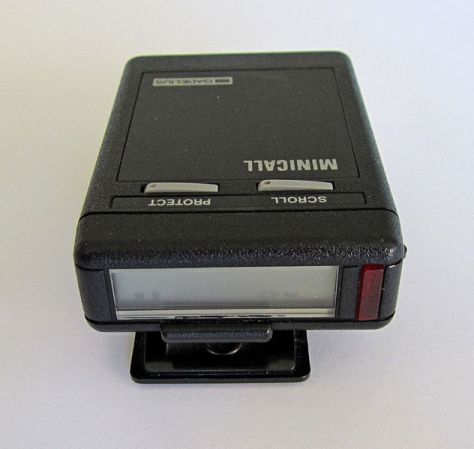
The 1990’s called, they want you to use modern technology to listen in on your friends’ pager messages. Seriously, how many people are still using pagers these days? We guess you can find out by building your own Software-Define Radio pager message decoder.

[Sonny_Jim] bought an RTL2832 based USB dongle to listen in on ADS-B airplane communications only to find out the hardware wasn’t capable of communicating in that bandwidth range. So he set out to find a project the hardware was suited for and ended up exploring the POCSAG protocol used by paging devices. It turns out it’s not just used for person-to-person communications. There are still many automated systems that use the technology.

Setting things up is not all that hard. Reading the comments on the project log show some folks are having dependency issues, but these sound rather banal and will be a good chance for you to brush up on your Linux-fu. Once all the packages are installed you’re simply working with text which can be displayed in a myriad of ways. [Sonny] set up a text files on the Pi’s webserver so that he can check out the latest captures from a smartphone.

[Image Source]

Modifying A CRT Television For Use As An Arcade Monitor

Finding himself in need of an arcade monitor [Eric Wright] turned to this ancient CRT television. The problem is that arcade monitors and televisions didn’t operate in the same way, differing in both resolution and refresh rate. [Eric] modified the television to work like an arcade monitor, but only with limited success. He’s hoping a few more alterations will lead him to a complete solution.

The image above shows him testing a Pac-Man machine on the altered Sharp television. Those familiar with the game will immediately notice that there is something wrong. We see most of the tracks upon which Pac-Man and the ghosts travel, but he maze itself is completely missing. To get to this point [Eric] consulted the television and arcade schematics to figure out how to connect the composite sync and three color channels directly to the arcade machine. This way the CRT timing is forced to conform to the game standard. The problem is that there is no way to adjust the drive and cutoff of the individual color channels. This is something [Eric] hopes to fix in the next iteration of his experiments.

If you already have a working arcade monitor but no gaming cabinet why not use a Raspberry Pi?

Continue reading “Modifying A CRT Television For Use As An Arcade Monitor”

Raspberry Pi Replaces A Volvo Nav System

rpi-replaces-volvo-nav

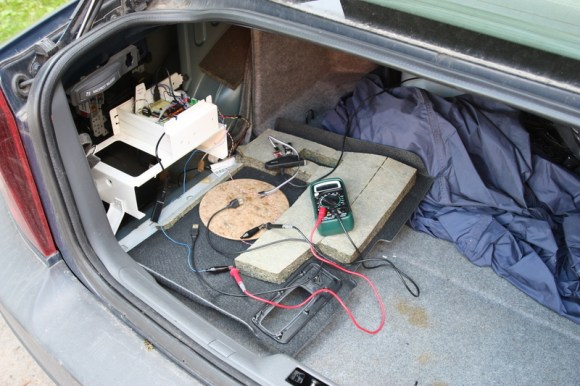
[Reinis] has a Volvo S80. One of the dashboard features it includes is a 6.5″ LCD screen which periscopes up to use as a navigation system. The problem is that Volvo stopped making maps for it around five years ago and there are no maps at all for Latvia where he lives. So it’s worthless… to you’re average driver. But [Reinis] is fixing it on his own by replacing the system with a Raspberry Pi.

That link leads to his project overview page. But he’s already posted follow-ups on hardware design and initial testing. He’s basing the design around a Raspberry Pi board, but that doesn’t have all the hardware it needs to communicate with the car’s systems. For this he designed his own shield that uses an ATmega328 along with a CAN controller and CAN transceiver. The latter two chips patch into the CAN bus on the car’s On Board Diagnostic system. We didn’t see much about the wiring, but the overview post mentions that the screen takes RGB or Composite inputs so he must be running a composite video cable from the trunk to the dashboard.


Letting Bluetooth Take The Wires Out Of Your Headphones

bt-wireless-headphones

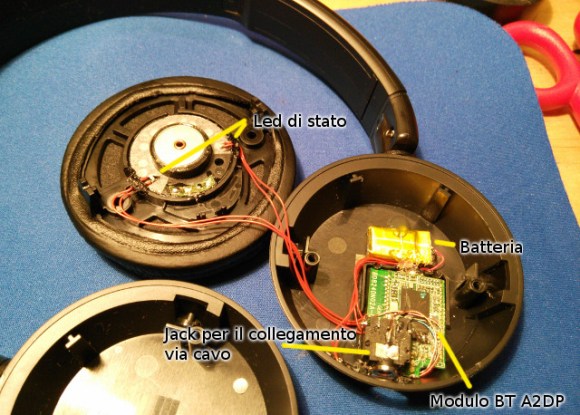
This picture shows the gist of [Alan’s] hack to transition his wired headphone to internalize a Bluetooth audio receiver (translated).

He starts with a pair of wired “ear muff” style headphones and an aftermarket Bluetooth audio adapter that he’s been using with them. But if you’re not going to plug them into the audio source why have six feet of extra wire hanging about? [Alan] ditched the plastic case surrounding the Bluetooth hardware and cracked open the earpieces to find room for it. It’s a tight fit but there was just enough room.

It is unfortunate that the headphone design doesn’t already have a wired crossover hidden in the arc connecting the earpieces. Alan strung some of that red wire himself to connect the two speakers. The board is mounted so that the USB port is located where the wires used to enter the plastic body. This makes it a snap to plug them in when they need a recharge.

You can play a little “Where’s Waldo” with this one by trying to spot the Raspberry Pi in his build log.


Hackaday Links: Sunday, June 16th, 2013

hackaday-links-chain

Summertime means mowing the grass and now [Everst X] can do so in 7.1 channel delight thanks to his wireless headphone antenna hack which extends the range.

[Kevin] is trying to build a better reverse geocache box. It’s not the GPS that he’s improving, it’s the latching mechanism. He’s got four linear latches actuated by a single servo.

What’s a links post without some blinky lights? This week we take a look at [Daniel’s] hack which connects the Ikea Dioder to a router.

It’s a pretty early prototype but we like where [Shae] is going with his spouse-friendly silent alarm. It’s a wristband you wear to bed that wakes with vibration rather than sound.

[Leland] wrote in to share his multi-console emulator. It’s built using a Raspberry Pi and he plans to fit everything inside an original Game Boy case.

Fans of the game Candy Crush may want to take a look at this hack for the iPhone version. It attacks the game by accessing the file system of a jailbroken device.

Water Tank Level Meter Prevents Overflow

roof-water-tank-level-meter

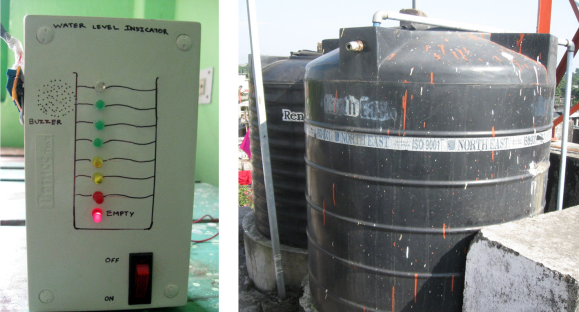
Most of the homes in the area where [Raikut] lives have tanks on the roof to hold water. Each is filled from a well using a pump, with gravity serving as a way to pressurize the home’s water supply. The system isn’t automatic and requires the home owner to manually switch the pump on and off. [Raikut] made this process a lot easier by designing an LED bar indicator to monitor the water level.

The sensor is very simple. Each LED is basically its own circuit controlled by a transistor and a few resistors. A 5V signal is fed from 7805 linear regulator into the tank. The base of each transitor is connected to an insulated wire, each extending different depths in the tank. As the water rises it completes the circuit, illuminating the LED.

[Raikut] is conservation minded and built a buzzer circuit which is activated by the LED indicating the highest water level. If someone walks away from the pump switch while it’s filling the alarm will sound as it gets to the top and they can turn it off before it wastes water.

[via Reddit]

Autonomous RC Car Navigates By Waypoints

autonomous-rc-car

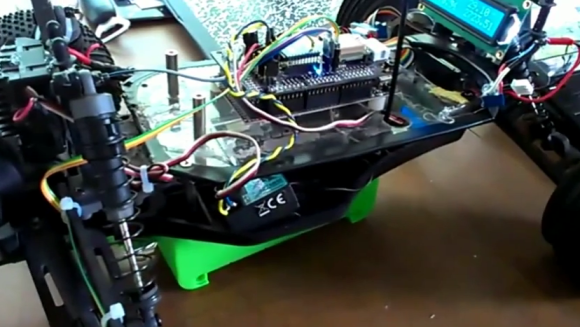
Check out this autonomous RC car which [Jason] built for the chipKIT design challenge. It’s been able to successfully navigate a planned route taking just a few waypoints as inputs.

Obviously this uses a chipKIT as the controller, the max32 to be specific. [Jason’s] write-up shows off all of the components of the design, but you’ll have to head over to his recently posted update to hear about the custom board he had spun to host them all. It starts with a GPS module, but that’s only accurate enough to give the rover the big picture. To handle getting from one waypoint to the next successfully he also included a gyroscope which provides very accurate orientation data, as well as optical encoders on the wheels for on-board distance traveled information.

We hope he’ll keep refining the design and make a trip to next year’s Autonomous Vehicle Competition.

Continue reading “Autonomous RC Car Navigates By Waypoints”