Digging Deeper Into The Apollo Saturn V LVDC

LVDC-NAND-proto

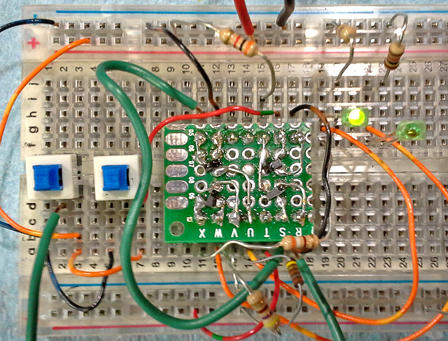
[Fran] went all-out with her reverse engineering of the Apollo Saturn V LVDC board. Regular readers will remember that she was showing of the relic early this year when she took the board to her Dentist’s office to X-ray the circuit design. Since then she’s been hard at work trying to figure out how the thing functions using that look inside the board and components. When we say ‘hard at work’ we really mean it. Not only did she explore many different theories that resulted in dead ends, she also built her own version of the circuits to make sure they performed as she theorized. Above you can see her version of the NAND/AND gates used on the hardware.

We find her explanation of how the logic devices were originally fabricated to be very interesting. They started with a ceramic substrate and used additive processes to form the traces and add the gates. We’ve embedded her video explanation after the jump.

Continue reading “Digging Deeper Into The Apollo Saturn V LVDC”
GLCD Clock Project Packed With Great UI And Features

glcd-clock-packed-with-features

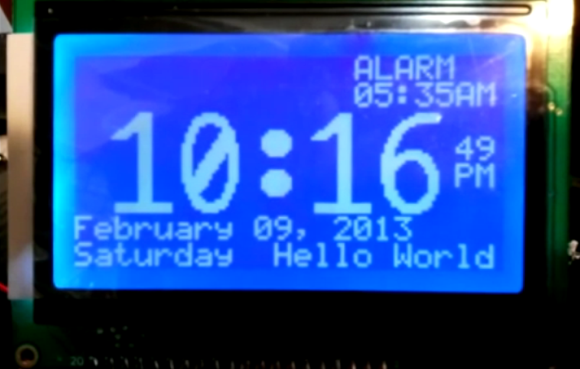
This Graphic LCD clock doesn’t have a fancy case, but [Gregory Wright] built in so many great features we think it will serve as inspiration for many projects to come. If he does decide to add a case it will be quite easy as there are no buttons to work around.

Without buttons how can the thing be adjusted? He decided to go with an IR remote control for all settings. This gives him a lot more options than a handful of buttons would have. Plus, heavy sleepers will need to find the remote control in order to shut off the alarm. We also think it’s interesting that the 595 shift registers he used have a low enough data high threshold (3.15V when VCC is 4.5V) that he didn’t need level converters to drive the 5V display with his 3.3V MSP430 Launchpad.

Check out his video after the break to learn about all the features he included in the UI. Our favorite is shown on the bottom right where it says “Hello World”. This is an area dedicated to a custom message for each day. He uses it to remind him about trash day (now there’s a feature!).

Continue reading “GLCD Clock Project Packed With Great UI And Features”

Harry Potter Location Clock Spies On Your Smart Phone

harry-potter-clock

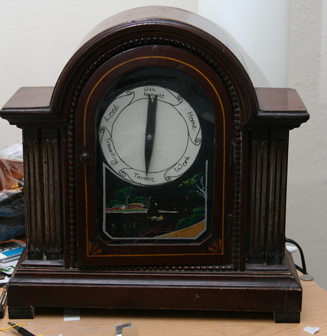
The location clock found in the Harry Potter books makes for a really fun hack. Of course there’s no magic involved, just a set of hardware to monitor your phone’s GPS and a clock face to display it.

[Alastair Barber] finished building the clock at the end of last year as a Christmas gift. The display seen above uses an old mantelpiece clock to give it a finished look. He replace the clock face with a print out of the various locations known to the system and added a servo motor to drive the single hand. His hardware choices were based on what he already had on hand and what could be acquired cheaply. The an all-in-one package combines a Raspberry Pi board with a USB broadband modem to ensure that it has a persistent network connection (we’ve seen this done using WiFi in the past). The RPi checks a cellphone’s GPS data, compares it to a list of common places, then pushes commands to the Arduino which controls the clock hand’s servo motor. It’s a roundabout way of doing things but we imagine everything will get reused when the novelty of the gift wears off.

Hackaday Links: February 9th, 2013

Hobby electronics from 1982

links-twinkling-star

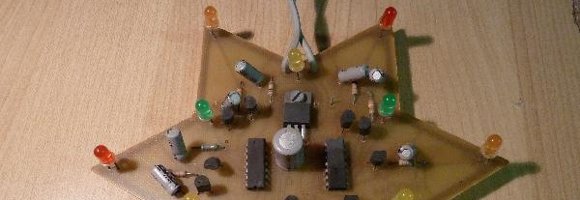
[Lennart] came across one of his projects from several decades ago. It’s a twinkling star which blinks LEDs at different rates using some 7400 logic chips and RC timers.

Solder fume extractor

links-fume-sucker

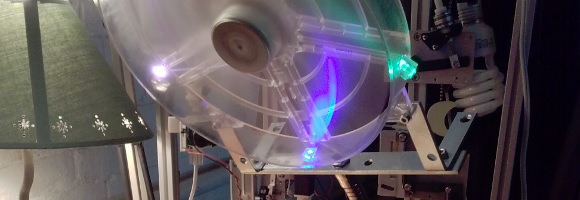
We’re still blowing the solder fumes away from us using our mouth, but this might inspire us to do otherwise. It’s a large PC fan mounted on a lamp goose neck. It clamps to the bench and is quite easy to position.

Ultrasonic liquid level measurement

links-dual-tank-level-sensors

Wanting a way to measure the liquid in these tanks without submerging a sensor, [JO3RI] turned to an Arduino and an ultrasonic rangefinder. His method even allows the level to be graphed as shown in his Instructible about the project.

Adding an ‘On’ light to save batteries

links-on-light-for-musical-toy

Dumpster diving yielded this electronic drum machine for [MS3FGX’s] daughter to play with. The problem is that pushing any of the buttons turns it on, it doesn’t have an auto-off, and there’s no way to know when it’s on. This is unacceptable since it runs on 5 AA batteries. His quick fix adds this green On LED. We wonder if he’ll improve upon this and add an auto-off feature?

CMOS Binary Clock

links-cmos-binary-clock

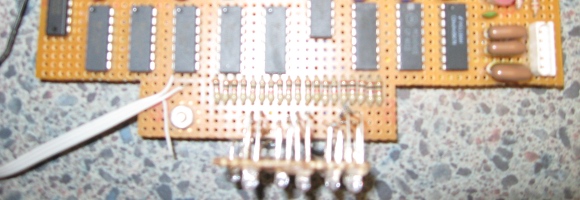
This is a portion of the guts of [Dennis’] CMOS Binary Clock project from the early 2000’s. He even built a nice case with a window for the LEDs which you can see are mounted perpendicular to the protoboard.

Arduino As An Inexpensive Ham Radio Frequency Counter

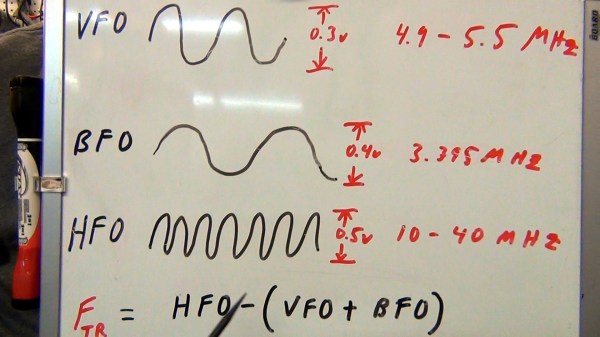
[Todd Harrison] really has our number. Like him, we don’t want to spend money when we don’t have to, and hacking our own solutions is a lot more fun anyway. This time around he’s helping out a friend who is a ham radio enthusiast. The friend’s radio didn’t come with a frequency display, and buying the add-on would cost more than the radio did. So [Todd] has set out to build an Arduino frequency counter for a Kenwood TS-520S HF ham radio.

This post (and the video found after the break) doesn’t cover the entire project. It’s rather involved just to make sure that [Todd’s] initial idea is viable so he spends about 35 minutes explaining the problem, then measuring the radio outputs and testing to see that the Arduino can read them accurately. Because the radio has a very large range of operation, [Todd] will need to add external component to facilitate this. That extra circuit design will be the topic of the next project segment.

Continue reading “Arduino As An Inexpensive Ham Radio Frequency Counter”

NASA Inspired Circadian Rhythm Lights

circadian-rhythm-light-rig

After reading about an initiative between NASA and Boeing to develop lights for the International Space Station [Rasathus] decided to give it a go at building his own. The project uses RGB pixels to build a circadian rhythm light installation. Without the normal rise and fall of the sun the sleep wake schedule for the astronauts can be pretty rough. This uses color and intensity of light in a well-defined schedule to help alleviate that. [Rasathus] is trying to bring his project in well under the $11.1 million mark which was established for the ISS.

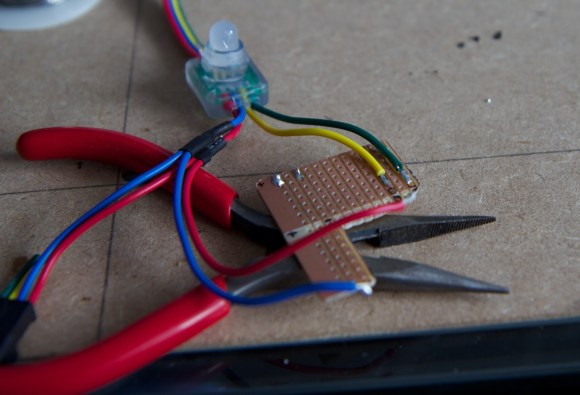
The light modules he’s using are from a strand of LEDs from Adafruit. Each is driven by a WS2801 controller, a common driver used for easy and complicated projects like this huge ball of light which our own [Jesse Congdon] tackled. The board above is the start of an adapter board for interfacing with the Raspberry Pi GPIO header. [Rasathus] wanted to make certain he didn’t fry the control electronics so he built some protection into this adapter. The control software is covered in the second portion of  the write up. We’ve embedded the video from that post after the break.

Continue reading “NASA Inspired Circadian Rhythm Lights”

Another Take On The 6502 Computer

another-take-on-the-6502-computer

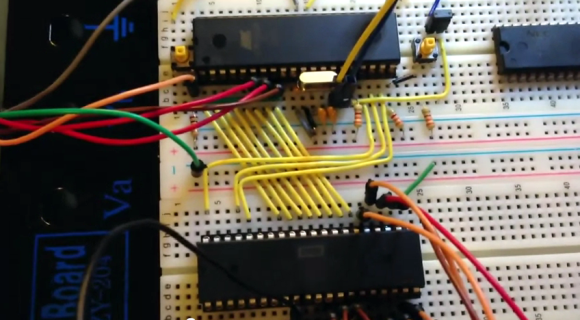
[Mark] is just starting off on his own 6502 computer odyssey. He was inspired by some of the other projects we’ve seen around here, like [Quinn Dunki’s] Veronica Project, but with a spin that leverages modern processors to alleviate some of the messy work. As you can see above, there’s an Atmel chip perched above the 65C02 processor. This chip not only feeds the processor data (through all those slightly diagonal yellow wires) but also provides the clock signal and operates the reset and bus enable lines.

This is more of a hello world post for [Mark]. The chip is simply running NOP commands right now. But it shows that the basic idea works, and the video after the break lets us see another time-saving aspect of the circuit. He’s using a character LCD to display memory location and data values. The plan is to get a blog going, which he’s hesitant to do as it takes valuable hacking time away from the project. We disagree. The write-up (although incredibly fun for us to read) ends up being a reference manual for him once the project starts to get really hairy.

Continue reading “Another Take On The 6502 Computer”