Billiards Concepts Plied To Position Acoustic Panels

If you know your way around a pool table you should be able to apply those skills to improving the sound of your home theater. [Eric Wolfram] put together a post that discusses the issues caused by unwanted sound reflections and shows how to position acoustic tiles to solve the problem.

This is a companion post to his guide on building your own acoustic tiles. Don’t worry if you haven’t gotten around to doing that yet. With just a wood frame, dense fiberglass, and some fabric they’re simple to build. They’re also easy to hang but until now you might have just guessed on where they should go.

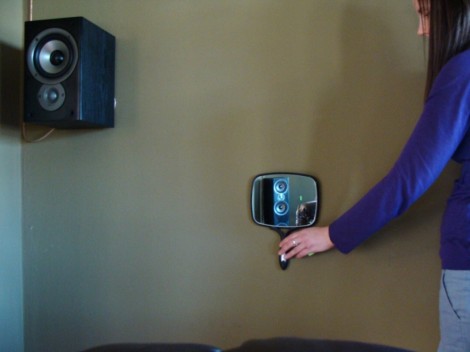
Once you have all of your speakers and seats in position grab a mirror and some post-it notes. Take a seat as the viewer and have a friend operate the mirror as seen above. With it flat against the wall, mark each spot with a sticky-note where you can see a reflection of one of the speakers. Finding the reflection points is just like lining up a bank shot in Billiards. With five speakers (5.1 Surround Sound) and six surfaces (walls, ceiling, and floor) you should be able to mark 30 reflections points. Now decide how wild you plan to go with the project. The best result will address all 30 reflection points, but you can get by with just the front marks if you’re a bit more conservative.
WAV Playback With An ATmega32

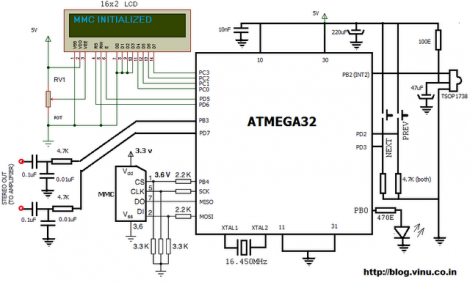
[Vinod Stanur] just finished another hobby project by building a WAV audio player using a microcontroller. He had started development a while back using a PIC microcontroller. But the chip he was using didn’t have enough SRAM to allocate as a playback buffer. When he got his hands on an ATmega32 his mind turned back to the project and he saw it through to the end.

He takes advantage of what he learned on several earlier builds. He’s using a TV remote as input, just like his Snake game did. Storage is provided by an MMC card, a trick he perfected with this voice recorder project. Instead of using a FAT library, he uses his own code to read the linked-list (File Allocation Table) for sector addresses, then he parses the WAV header and processes the file accordingly.

Playback uses two 512 byte buffers. One is feeding the output while the other is being populated from the memory card. When the output buffer is exhausted the two are swapped and the process continues. You’ll find [Vinod’s] demo of the project after the break.

Continue reading “WAV Playback With An ATmega32”

Wardriving For Zigbee

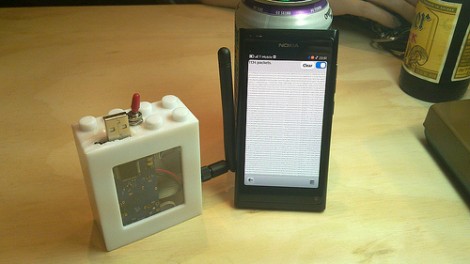
Wardriving started out as a search for unprotected WiFi access points before hot spots were prevalent. And so this ZigBee protocol wardriving hardware which [Travis Goodspeed] put together really gives us a sense of nostalgia for that time. Don’t get us wrong, we love our pervasive WiFi access and don’t wish to go back to simpler times. But if the radio signals your looking for are scarce, locating them provides a challenge.

Regular readers will recognize that [Travis] is interested in all things RF. One of his projects included sniffing wireless keyboard packets out of thin air and displaying them on the screen of his Nokia N900. This is right along those lines but he’s upgraded to an N9 phone for the display hardware. He switched up the RF hardware, using a TelosB (a board he’s already familiar with) to get on the 802.15.4 ZigBee spectrum. This dev board has an expansion port which let him use an RN42 module for wireless communications with the phone. This means the sniffing hardware can be hidden away in a backpack or jacket. After all, nobody will question someone walking around staring at a smart phone.

Another Take On Using ‘dead’ Batteries

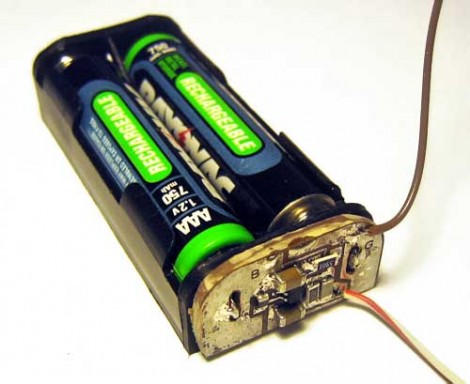
Here’s another circuit that can be used to squeeze the remaining potential from supposedly dead batteries. Just like the AASaver, we see this as a useful prototyping tool, providing juice for a breadboard even though it’s not reliable enough for long-term use (the batteries are just about through after all).

First off, the image above shows rechargeables instead of alkalines. We don’t recommend this as the circuit has no cutoff feature and the 0.7V input for the boost converter surely is below the recommended low-voltage limit for those cells. But that aside, we like the diminutive board which solders onto the end of a battery pack. It uses an SC120SKTRT which is a variable boost regulator capable of outputting 1.8-5V depending on resistor choices. You can leave the resistors off and it will default to 3.3V, set the output explicitly, or roll in some potentiometers and use your multimeter to tune the output.

This regulator costs more than the MCP1640 used in the AASaver, but it appears to use less passive components making for a smaller footprint. At a total of $3.50 plus the PCB (which will be a snap to etch at home) this is another great option to top off your next parts order.

[Thanks Uwe]

New Extruder 3D Prints Tasty Treats Using Chocolate

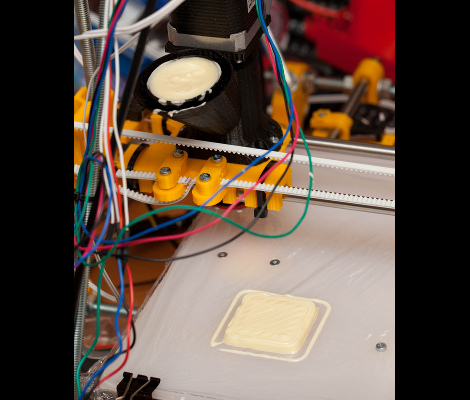
If you’ve never felt at home with a piping bag in your hands this chocolate extruder will come to your rescue. It can replace the plastic extruder head on your 3D printer (RepRap, Makerbot, most 3-axis CNC machines, etc.), letting you turn your digital creations into decadent reality.

The head uses a progressive cavity pump to feed the chocolate from a reservoir through the printing nozzle. It’s important to keep the chocolate warm or it will set up so when [Tomi Salo] designed the print head he included a heat shroud through which warm air can be circulated. He uses a shoe dryer to source the hot hair which is patched into the heat shroud with a length of tubing.

This extruder can be 3D printed but be careful what material you use. [Tomi] mentions that PLA is ‘sort of food-safe’ but ABS is not. We wonder if the design could be altered for milling out of aluminum or stainless? At any rate, if you’re going to give it a try you might find [Tomi’s] advice on working with chocolate useful.

[via @clothbot]

Human-shaped Planes Troll NYC


It looks like a genetic leap has unleashed the age of mutants, but this is really just a few guys trolling New York City with some custom RC aircrafts. The video after the break shows the fliers up close. They’re pretty much full size, we’d guess 5’10” from head to heel. The outstretched arms and body act as wings, while the legs act as ailerons and rudders. But from afar (or even a medium distance) it’s quite difficult to make out the flat surfaces… they look like office workers loosed from their cubicles. Unfortunately we don’t have more than a flight demo to share with you. If you know where to find build info (or any extra details at all actually) don’t forget to send in a tip We wonder if these are the same guy who made the flying hero we posted back in July?

There’s another nugget of delight right at the beginning of the video. A sweet octocopter which looks much like this one was used to capture the aerial footage.

Continue reading “Human-shaped Planes Troll NYC”

$15 Toy Becomes Fully Programmable Robot

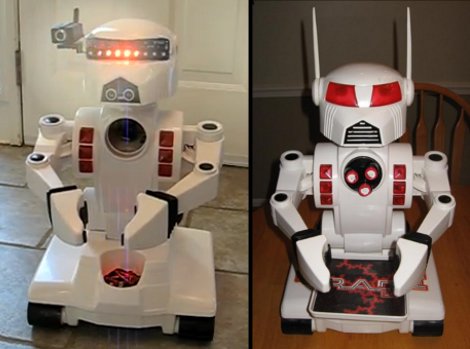
[Kevin] undertook a robot build partly for his own enjoyment, but also to include his kids in the action. He acquired a cheap toy and packed it full of programmable goodness. The starting point was a $15 toy called Rad 2.0. It’s a great starting point as it already included some motorized parts, and takes care of much of the mechanical issues like joints and structure.

The image on the left is the fourth update which [Kevin] has posted. The robot now responds to voice commands (with the same syntax as Chippu uses), moving its gaze to face forward or to either side. You’ll notice there’s a wireless webcam which lets him spy on what’s in front of the robot’s gaze. An ultrasonic range finder makes itself at home in the beak of the bot, and a Larson Scanner is nestled in the brow using the kit from Evil Mad Scientist Labs. Check out the video after the break for an overview of the hardware modifications.

The build log for this project is a forum post. That forum is run by [DJ Sures], a veteran at taking cheap toys and making them awesome. It seems like he’s taken a web forum and made it awesome too because the conversation about [Kevin’s] project is packed with constructive tips and encouragement.

Continue reading “$15 Toy Becomes Fully Programmable Robot”