Winning Video Games By Letting Arduino Push Your Buttons

[Lars] shows you how to get a perfect score on the first four levels of BIT.TRIP RUNNER by using an Arduino to time and send button presses. This is a pretty simple game that uses a couple of buttons to jump or slide past obstacles. The constant speed of the character makes it quite easy to time these movements without any input from the game. This means that the pixel sampling which some web-game bots use isn’t really necessary here. Just work out the timing and hard-code it into the sketch. As you’ll see after the break, it works perfectly

The real value of this hack is the guide he wrote to send key presses from the Arduino hardware. It’s not hard at all, but there are several steps and this will get you up and running in no time. Where might you go from here? It wouldn’t take much to turn this into a keyboard prank that misspells all your words.

Continue reading “Winning Video Games By Letting Arduino Push Your Buttons”
Microcontroller Gives You More Control Of Your Camera Lens

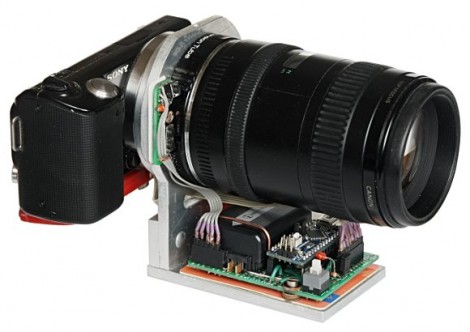
Here’s one way to get more control of your camera lenses. [Vladimir] built an Arduino-based pass-through ring (translated) which intercepts automatic lens controls. It’s meant for use with the Canon EOS lenses which have their own electronics allowing control of things like focus and zoom.

It seems like part of the motivation here was to uses the lenses with other brands of cameras. But [Vladimir] does also talk about the possibility of improving on some of the sensors that don’t perform well in certain climate conditions (think of how crystal oscillators will drift as temperature changes).

The machine translation is a bit rough to follow, but it seems the adapter ring still uses the settings sent in from the camera but has the Arduino clone to translate them into a format that the lens is expecting. In addition to this there is a set of buttons on that small PCB beside the lens which allow for fine tuning the aperture.

This is a lengthy writeup, but there’s two more on the way that will help fill in the gaps of how this hack works with different lens models, and some more tips on how to use it.

[Thanks Vasily]

Rotating Platform Makes Most Useless Machine Concept Useful

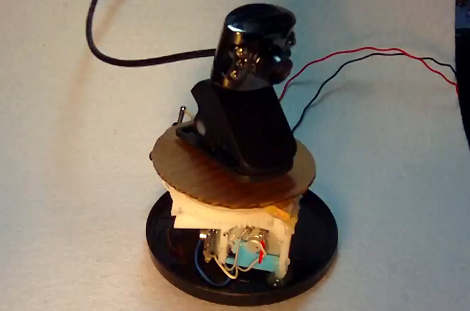
[Valentin] used a simple concept to build this auto-reversing rotating platform. The concept is extremely simple, the leads for the motor are attached to a double-pole double-throw switch which allow the polarity to be reversed. Flip the switch in one direction and it spins clockwise. Flip it in the other direction and it spins counter-clockwise.

In this case, he’s harnesses the power of the most useless machine. That often seen hack uses a similar switch, but accomplishes nothing by having the moving parts act as the actuator. This one is useful, taking advantage of a single or double arm to flip the switch and make the platform spin backwards. In the video after the break you can see it’s used to create a scanning security camera. But [Valentin] also shows it at work as a turntable for salable goods. We think’s the gearing is a little brisk for both purposes, but slowing it down is a hack for another day. Continue reading “Rotating Platform Makes Most Useless Machine Concept Useful”

Electronic Bag Pipes Need No Bag And Use Only 1 Pipe

A lot of people might turn their noses up at an electronic version of bagpipes. But we see a definite need for them. After all, it’s pretty hard to take your bagpipes on a road trip, but this eChanter will have no trouble entertaining your fellow travelers.

The musical instrument is Arduino-based and the builder can decide between a headphone jack (use it with that FM transmitter when in the car!) or a speaker. The version seen above uses headphones with a piece of PVC pipe as the body, screw heads as touch sensors, and a project box to hold the electronics. But there are a lot of alternatives suggested, such as using automatic sprinkler parts. It sounds like a riser, connector, and pop-up sprinkler head body will do just as well hosting all of the components.

Want to hear what it sounds like? There’s an mp3 clip under the final steps section.

[audio http://www.echanter.com/marine-corps-hymn.mp3]

Backyard Ski Lift

If you own a cabin in the mountains of British Columbia what do you do during the warmer summer months? Well, we’d probably mix of a cocktail and string up a hammock, but [Darrin] is quite a bit more motivated. He planned for the snowy season by building his own ski lift. He shared the details in a forum post, but you’re going to have to register and wait for approval before you can view that thread. Perhaps you’ll want to look at the video after the break before making that kind of commitment. Normally we would just pass over projects that require a login to view, but this one deserves the attention.

The setup is essentially a very steep tow rope. 1600 feet of 1/8″ aircraft cable covers an 800 foot span of his property. Apparently he’s got a total of 1000 feet of vertical drop but the lift doesn’t cover the whole area quite yet. That 6.5 horsepower Honda engine drives the cable loop, with the pulley system seen above used as an RPM reducer. Each skier can hook onto the cable used the nylon rope with a ski-pole spacer and a hook. The RC vehicle remote control works as a dead man’s switch, starting the lift slowly when the throttle is depressed and stopping it when released.

Normally we like to link to similar projects, but so far this is the only ski lift we’ve covered. You’ll have to settle for this ski-pole mounted POV display.

Continue reading “Backyard Ski Lift”

Automated Squinting Instead Of Glasses, Contacts, Or Lasik

[Lee] is nearsighted and has had it with contacts and glasses. When trying to figure out an alternative, he looked at the core of the problem. The eye is not shaped correctly and therefore cannot focus adequately. The solution is to change the shape of the lens. This is exactly what lasik (laser eye surgery) does, but instead of going under the incredibly bright knife [Lee] built some headgear that pulls on your face to reshape your eye.

The hardware is from an old portable CD player. The sled that moved the laser lens has been repurposed to pull a thread taped to the skin at the corner of his eye. He built a control system that lets him adjust the tension by moving his fingers. Basically when the skin is pulled tight it causes him to squint and possibly reshapes the cornea just a bit. We’re not sold on the idea, but we can’t poo-poo the experiment; who knows what discovery this could lead to? We’re just glad he didn’t use electrical impulses to hack his peepers.

You can find some test video embedded after the break.

Continue reading “Automated Squinting Instead Of Glasses, Contacts, Or Lasik”

Heatless Compressed Air Dryer

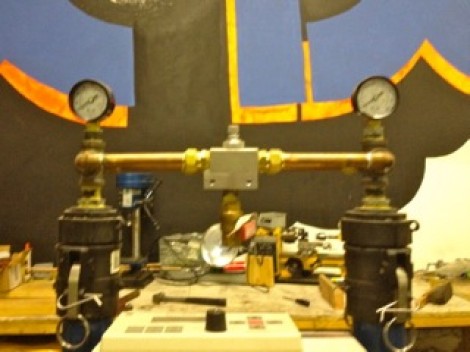
The pressurized air from a standard air compressor is fine for most uses. But some applications like plasma cutting call for low-humidity air and the hardware available to facilitate this can cost a bundle. [Roland] and his cohorts at TX/RX Labs (a Houston, Texas Hackerspace) just built this air drying system.

It works using a desiccant; a substance that sequesters moister. It’s the stuff in those little packets you find in shoe boxes and the like with a warning that you shouldn’t eat it. The image above shows two chambers which house the desiccant. Only one is used at a time, so that as it’s ability to remove moisture drops, the system can switch over to the other chamber. There’s even an automatic recharging system built in that uses a portion of the dried air to remove the humidity from the unused desiccant chamber.

There’s a functional diagram at the link above. It’s resolution is low enough that the text is almost unreadable but we’ve asked [Roland] if he can repost the image. This seems like a build in which other hackerspaces will be interested.