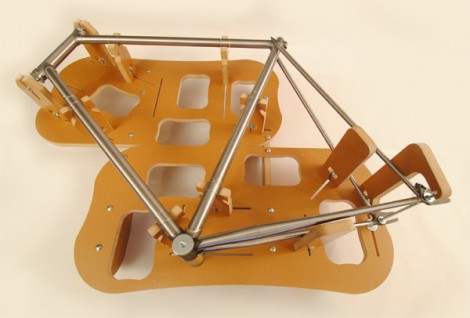
CNC Milled Bicycle Frame Jig

This bicycle frame jig is cut from MDF. It’s the latest in a growing trend that we love to see: the increasing availability of manufacturing techniques for the common hacker. This is a Kickstarter project, and alas it appears the designs are not available for you to cut your own. But we love the potential this shows, and maybe you can use the concept the next time you’re welding together a frame for something.

We really never look at building traditional frames at home. Mostly it’s the oddities that catch our eye. But if you’re into cycling and want to get your own custom-fit frame this has got to be the lowest-cost option available. In fact, you can get the jig and a tube set for under $600. The frame can be fit with just a few hand tools (a hack saw and a file). It uses lugs so the joints will be strong as long as you get the pipes fitting well enough for a quality welded joint.
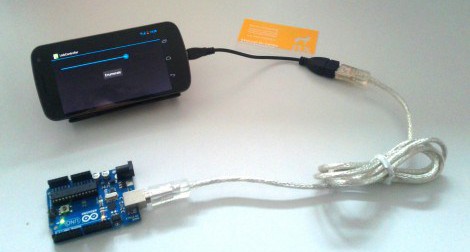
Android 3.1 Devices Have USB Host Mode. Here’s How To Use It.

With the coming of Android 3.1 you finally have the option of using the device as a USB host. This may be through a USB OTG (On-the-Go) adaptor, but nonetheless it’s a feature which was sorely missed until now. [Manuel] put together a guide on using Android as a USB host. As you can see, his example hardware is an Arduino board but this is applicable with just about any device.

The tutorial implements a test app for the Android device where a slider will set the brightness of the Arduino’s on-board LED. The Arduino sketch is nothing special, it just reads data received on the UART. This means that it doesn’t care if it’s connected to an Android, PC, OSX, or Linux system, it goes about its business until the RX interrupt updates the data variable.

This will greatly simplify a lot of projects we’ve seen, such as this message scrolling belt buckle. That used extra hardware to make the Arduino the host, a step that is now necessary.

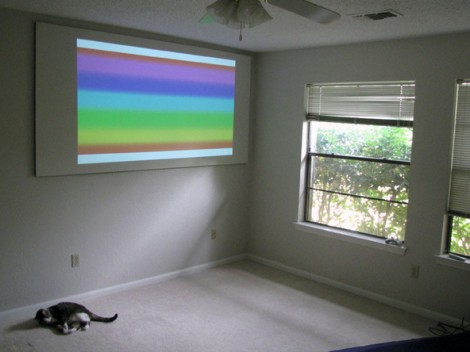
Projection Screen Using Latex Paint And Sand Blasting Beads

This method of building your own projection screen is new to us. [Sean Michael Ragan] ran across some sand blasting material made up of minuscule glass beads at Harbor Freight and inspiration struck. He purchased a fifty-pound bag and set out to see if it could be used with regular latex paint to create a projection screen. The answer is an absolute yes, but results are dependent on how you apply it.

Now there is paint you can buy which will turn your wall into a projector screen, but it’s expensive. [Sean’s] hack isn’t a direct replacement as he found the results of just mixing the beads with paint and applying them to a vertical surface weren’t up to the standards he’s looking for. But if you build a screen to hang on the wall you can let gravity work for you. He laid the screen flat and applied a heavy coat of paint to the surface. He then sprinkled a heavy coat of the glass bead over the wet paint and let it dry. Finally he cleaned off the material which didn’t stick and hung it on the wall.

Don’t have a projector to use with this hack? No problem, just build your own.

[Thanks Skuhl]

Up Your FPGA Game By Learning From This LCD Control Prototype

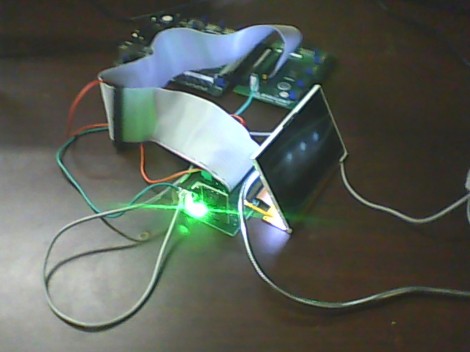
[Cesar] recently got a PSP display up and running with his FPGA development board. That’s a nice project, but what we really like is that he set aside a lot of time to show how it’s done every step of the way. This isn’t just a tutorial on that particular screen, but an overview of the skill set needed to get any piece of hardware working.

The screen itself is a Sharp LQ043T3DX02; a 480×272 TFT display with 16 million colors. Not bad for your project but when you start looking into the control scheme this isn’t going to be like using a Nokia screen with an Arduino. It takes twenty pins to control it; Red, green, and blue take sixteen pins, four pins are used for control, the rest are CK, DISP, Hsync, Vsync.

Wisely, [Cesar] designs his own interface board which includes the connector for the ribbon cable. It also has drivers for the screen’s backlight and supplies power to the device. With hardware setup complete he digs into the datasheets. We just love it that he details how to get the information you’re looking for out of this document, and shows his method of turning that first into a flow chart and then into code for the FPGA.

Retro Hardware Mash-up Spouts Archaic Geekery

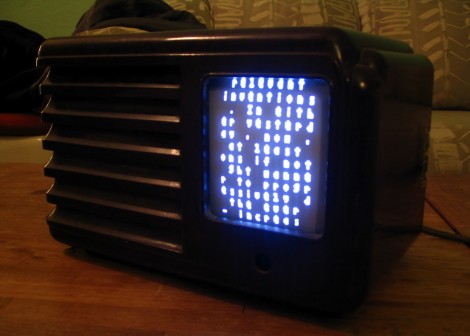
This delightful little box is something only a hacker could love. It uses some second-hand hardware to display random sayings attributed to [Buckminster Fuller]. The image above doesn’t do the display justice. There are other photos which show very crisp lettering which is easier to read.

[Autuin] always keeps his eyes open for cool gear at the end of its consumer life. The screen for this project is a CRT from a Coleman TV lantern (you know, for camping… bah!). It finds a home in the chassis of an old non-functional radio he had picked up a few years earlier. With those parts in hand the real adventure started: getting an Arduino to read in quotes and generate a TV out signal to display them.

We love the SD card holder which he fashioned from a card-edge connector he grabbed at the local electronics store. From there he scoured the Internet for help on where to patch into the TV signal. Once the right trace was discovered the Arduino TV out library does the heavy lifting.

Hacking Together A Color Changing Water Wall

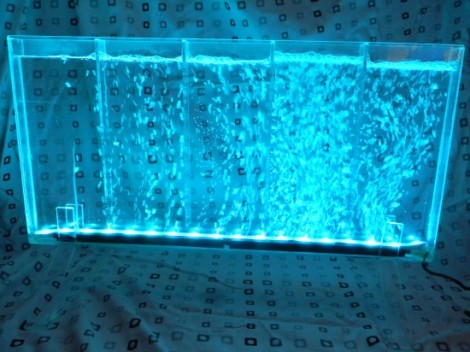
[BadWolf’s] girlfriend wanted him to build her a lamp for Christmas and he didn’t disappoint. What he came up with is a water-filled color changing lamp with bubbles for added interest. See for yourself in the clip after the jump.

The color changing properties are easily taken care of by some waterproof RGB LED strips. [BadWolf] went the Arduino route for this project but any microcontroller will be able to fill the role of color cycling. The enclosure is all hand-made from acrylic sheets. He grabbed some chemical welding liquid from the hardware store and applied it to the acrylic with a syringe. That’s easy enough when attaching the edges to one side of the enclosure. But it gets much tougher when it’s time to seal up the other side. He recorded a video of this which shows the syringe taped to a rod so he can get it down in there, pushing the plunger with a second extension device.

Bubbles are supplied by a small aquarium pump. We’re wondering if this will need frequent cleaning or if you can get some pool chemicals to keeps it nice and clear (or just a teaspoon of bleach)? Continue reading “Hacking Together A Color Changing Water Wall”

Data Broacasting “Transparency Grenade” Ads Whimsy To Your Meetings

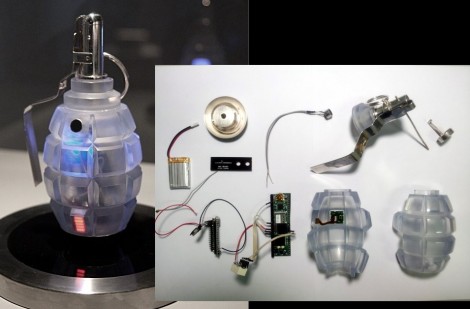
If you’re tired of underhanded deals going down behind closed doors maybe you need to start carrying around this transparency grenade. The enclosure is modeled after a Soviet-era F1 Hand Grenade. But it’s not filled with explosives and won’t send deadly shrapnel around the room. Instead, when the pin is pulled it starts recording audio and sniffing network packets, then broadcasts both to a remote server. Perhaps you could consider this to be data shrapnel sent around the world.

The exploded parts image above shows what hardware is at use. There’s a Gumstix board at the heart of the device which uses a WiFi module for sniffing and broadcasting data. The LED bar graph which you see in the fully assembled unit shows the wireless signal strength.

It sounds like the enclosure itself was 3D printed from Tusk2700T translucent resin but we’re a little confused by this part of the hardware description. We don’t have much of a need to transmit recordings of our meetings, but we’d love to use this case design for that MP3 enclosure.

[via Reddit]