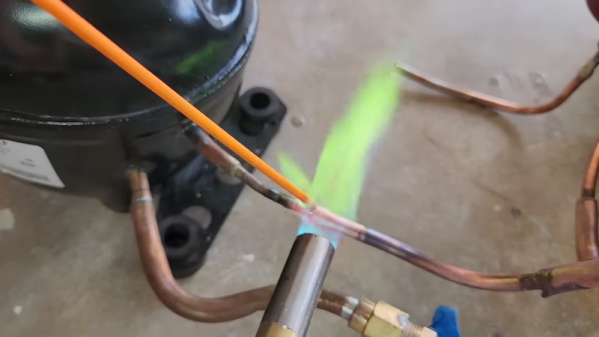
Two Stage Refrigerator Is Chill

Every time we check in with [Hyperspace Pirate] he’s trying to make things cold. Really cold. His recent two-part video shows a propane vapor compression system that can go down to -37° C as well as a two-stage system using homemade ethylene that can get to -83° C. He’s trying to get to -100°, so he’s close, and we have no doubt he’ll get there.

The video explains that using two different refrigerants makes the design more practical. At the low temperatures involved, you have to deal with compressor oil freezing. There is a lot of theory required to design an efficient cooler and a lot of know-how required to make gas-tight connections with all the different materials involved.

Using propane in both stages did provide a little additional cooling. But using ethylene in the second stage didn’t work as expected. There were two issues to work through. Part of it was the average temperature of the system, and also, the homemade ethylene needed purification. The ethylene purification setup was almost as complex as the main system and also reminded us, for some reason, of the movie Darkstar. It didn’t work as well as he wanted, which means we have to wait for part two to see it all actually working.

We’ve seen this same guy make dry ice. He’s also tried to make liquid nitrogen, too.

Continue reading “Two Stage Refrigerator Is Chill”

Modern CO2 Laser Reviewed

If you’ve got a laser cutter, it is highly probable that it uses a laser diode. But more expensive machines use a carbon dioxide laser tube along with mirrors. There was a time when these lasers came in two flavors: very expensive and amazing or moderately expensive and cheaply made. However, we are seeing that even the moderately expensive machines are now becoming quite advanced. [Chad] reviews a 55-watt xTool P2. At around $5,000, it is still a little spendy for a home shop, but it does have pretty amazing features. We can only hope some less expensive diode lasers will adopt some of these features.

[Chad’s] video that you can see below attempts to recreate some of the amazing things xTool did on their product introduction live stream. He was able to recreate most, but not all of the results. In some cases, he was also able to do better.

Continue reading “Modern CO2 Laser Reviewed”

Zippy Plastic Welding

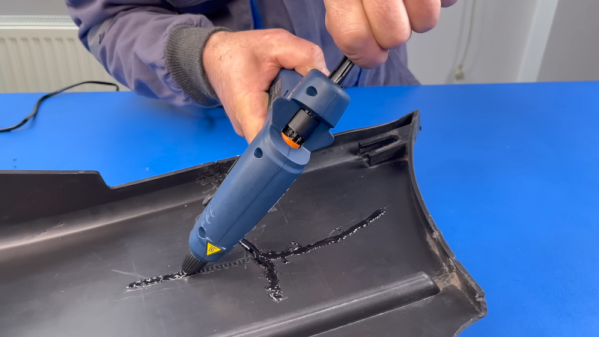
Plastic welding isn’t a new idea. But a recent video from [The Maker] shows an interesting twist. Given a broken piece of plastic, he secures it together with tape, machines out a channel around the cracks, and then melts zip ties into the channels. Honestly, although he mentions plastic welding and soldering, we aren’t sure this isn’t just simple gluing, but it did give us some ideas. Watch the video below and you’ll probably get the same ideas.

The ingenuity here isn’t necessarily using hot plastic to glue together two pieces — that’s just a hot glue gun, after all. Rather, it occurred to us that the key here was machining out the places where significant amounts of the hot plastic could bond the two pieces together. He cut the channels with a rotary tool, buffed them, and used a hot knife to give them some internal texture. But with a 3D printer, you could build these channels into parts that were made to interlock.

Continue reading “Zippy Plastic Welding”

Anodizing Titanium In Multiple Colors

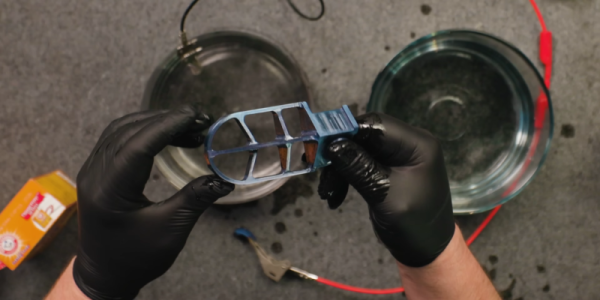
[Titans of CNC Machining] wanted to anodize some titanium parts. They weren’t looking for a way to make the part harder or less prone to corrosion. They just wanted some color. As you can see in the video below, the resulting setup is much simpler than you might think.

The first attempt, however, didn’t work out very well. The distilled water and baking soda was fine, as was the power supply made of many 9V batteries. But a copper wire contaminated the results. The lesson was that you need electrodes of the same material as your workpiece.

Continue reading “Anodizing Titanium In Multiple Colors”

Never Stare Down A Robot

There are a few things historically difficult to make a robot do. Stairs, of course, are the obvious problem. But realistic blinking behavior is harder than you might think. At first, it might seem frivolous and simple to have a robot blink, but according to Italian scientists, it is both more important and more difficult than you probably think.

Blinking is a nonverbal cue when humans communicate. The post quotes a Finnish researcher:

While it is often assumed that blinking is just a reflexive physiological function associated with protective functions and ocular lubrication, it also serves an important role in reciprocal interaction.

Continue reading “Never Stare Down A Robot”

Your Childhood Inventions Brought To Life

If you are the kind of person who reads Hackaday, you probably spent time in school doodling little design day dreams. [Allen Pan] gets it, and he’s taken it upon himself to make some of those daydreams into reality. You can see how it worked out — or didn’t — in the video below.

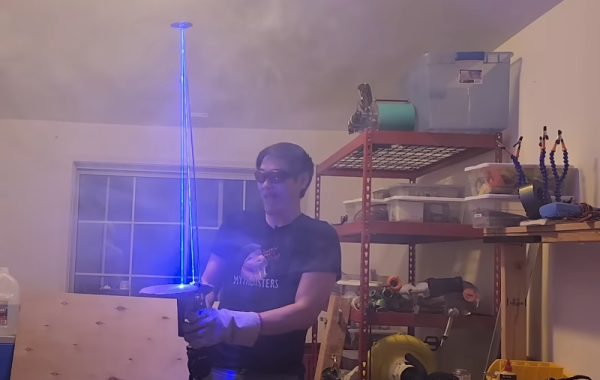
The video starts out with suction cup boots for walking on the ceiling, a laser sword made with a mirror, a plunger gun, and lawnmower boots. Some of these were more successful than others.

Continue reading “Your Childhood Inventions Brought To Life”

FNIRSI Vs Rigol: An Alternate View

We’ve heard of the FNIRSI 1014D scope, but we’ve had the impression that it might not be a great scope, although it is economical. [Learn Electronics Repair] had heard from another YouTuber that it was “a piece of junk.” However, he wanted to look at it compared to another inexpensive scope, the Rigol DS1052E. His results were different from what we usually hear. To be clear, he didn’t think it was a perfect scope, but he did find it very usable for his purpose.

The 46-minute-long video does more than just a casual look. He uses both scopes in some real-world measurements. If you are in the market for a scope in this price range, it is worth the time to watch.

Continue reading “FNIRSI Vs Rigol: An Alternate View”