Quantum Interconnects Get Faster

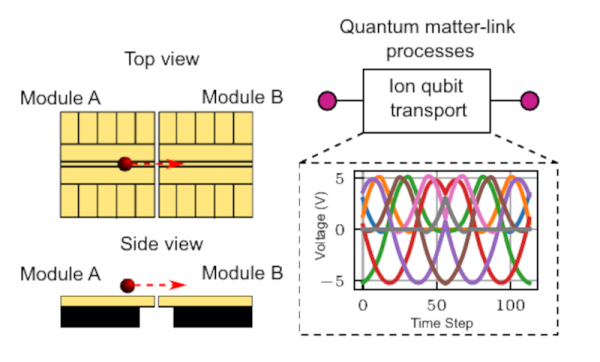
If you are a retrocomputer fan, you might remember when serial ports were a few hundred baud and busses ran at a few megahertz at the most. Today, of course, we have buses and fabric that can run at tremendous speeds. Quantum computing, though, has to start from scratch. One major problem is that jockeying quantum states around for any distance is difficult and slow. Part of it is that qubits decay rapidly, so you don’t have much time. They are also generally susceptible to noise and perturbation by outside forces. So many quantum machines today are limited by how much they can cram on one chip since there isn’t a good way to connect to another chip. The University of Sussex thinks it has improved the outlook for quantum interconnects with a technique they claim can move qubits around at nearly 2,500 links per second.

The technique, called UQ Connect, uses electric field links to connect multiple chips using trapped ions for qubits. If you want to read the actual paper, you can find it in Nature Communications.

Continue reading “Quantum Interconnects Get Faster”

3D Printing With Rice Might Be Nice

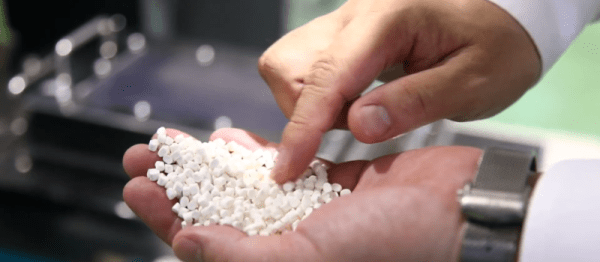
The United Nations Industrial Development Organization recently pointed out a possible replacement for petrochemical-based polymers: rice resin. A Japanese company makes the material from inedible rice and also makes a biodegradable polymer known as Neoryza, which seems to contain some amount of rice as well. The rice resin contains 10 to 70% rice waste. You can see a video with English subtitles about the material below.

According to the video, there is plenty of waste rice. The resulting resin isn’t as toxic as petrochemical-based plastics and doesn’t consume food crops like other plant-based polymers. The video shows the rice resin being extruded like a normal polymer, so it should work like any other thermoplastic.

The video says the properties are similar to petrochemical-based plastics and no special equipment is required to handle it. They also claim that production is easier because, unlike other bioplastics, they don’t generate ethanol as the first part of the process. Waste rice should be cheap to obtain since it is essentially trash today. We aren’t sure what polymers are used in the 90 to 30% of the plastic that isn’t rice, but presumably, that is being brought in as a raw material.

We’ll be interested to see if anyone tries to make 3D printing filament from the stuff. We know that it is being used to replace polyethylene in furniture. We couldn’t help but think about using waste coffee grounds in 3D printing. If you want to compare this to PLA, we’ve talked quite a bit about the corny polymer.

Continue reading “3D Printing With Rice Might Be Nice”

MIT Spins Qubits Round And Round

Quantum computers are coming, but there are still many problems with realizing practical machines. One is finding a reliable and affordable way to encode qubits — the basic unit for quantum computers. MIT researchers have a proposal. By using two slightly different colored lasers, they can manipulate nuclear spin. This isn’t the first time someone’s tried to use light to impact spin, but according to MIT, the other methods use an indirect coupling which is more prone to noise, something that limits the viability of quantum computers. They published a recent paper on the process if you want to read more.

Nuclear spin has weak interactions, but the new method doesn’t require intermediate steps, so it may be much more practical than previous methods. MIT mentions that typical quantum elements have coherence time limits, which means data stored in them becomes useless in less than a second. The new method promises to have coherence times measured in hours.

The method is known as the optonuclear quadrupolar effect or ONQ. From the paper:

[The ONQ effect] is second order in the electric field and nuclear spin I, as mediated by the quadrupole electric coupling, and is thus one of the nonlinear optical (NLO) responses of materials present in perfect crystals. Via the ONQ effect, nuclear spins can be coherently controlled by two-color photons, without electron spins as the media.

If you understood that, you should probably head over and read the rest of the paper. Meanwhile, the rest of us are waiting for our quantum Arduino.

Retro Gadgets: Nintendo R.O.B Wanted To Be Your Friend

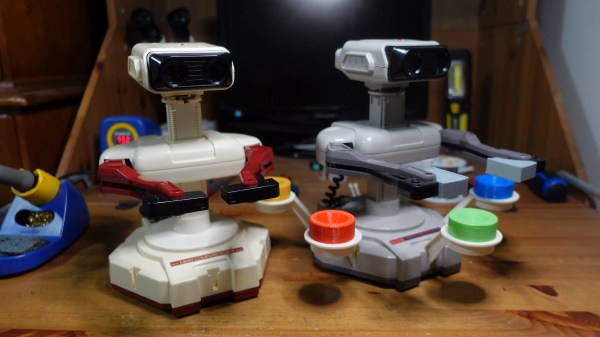
Too busy playing video games to have a social life? No worries. In 1985, Nintendo introduced R.O.B. — otherwise known as the Robotic Operating Buddy. It was made to play Nintendo with you. In Japan, apparently, it was the Family Computer Robot. We suppose ROB isn’t a very Japanese name. The robot was in response to the video game market crash of 1983 and was meant to keep the new Nintendo Entertainment System (NES) from being classified as a video game, which would have been a death sentence at the time of its release.

Since you might not have heard of R.O.B., you can probably guess it didn’t work out very well. In fact, the whole thing tanked in two years and resulted in only two games.

Continue reading “Retro Gadgets: Nintendo R.O.B Wanted To Be Your Friend”

Hobnobbing With The Knob

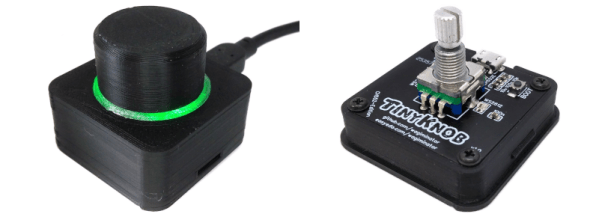
The scroll wheel might be the best thing that happened to the computer mouse since, well, the computer mouse. But sometimes you want something a little more tangible. For example, with a software-defined radio setup, it doesn’t feel right to scroll your mouse to change frequencies. That’s where [Wagiminator]’ USB knob would come in handy. Marrying a 3D printed case, some addressable LEDs, a rotary encoder, and a CH552E microcontroller, the knob appears to the host operating system as a normal USB keyboard. That means most programs can use it without any special drivers or software.

There’s honestly not much to the hardware. A custom PCB holds two WS2812’s, the tiny CPU, the encoder, and the USB plug. There are a few random discrete components, too, but not many. Everything you need is on the project page. The PCB layout, the software, the schematics, and the 3D print files. The code that does the main work is extremely simple. The USB code is a bit more complex (look in the include directory) but honestly, it isn’t as bad as most USB examples we’ve seen.

This project is ripe for hacking. The software is simple enough to modify easily. The 3D printed case wouldn’t be hard to spruce up or print in different colors. Following the example, this would make a reasonable core for a custom keyboard peripheral that used exotic keys instead of a rotary encoder.

Knobs can be simple or complex. If you want our take on the odd volume control, we used sonar.

Sol-20 Integrated Computer Teardown

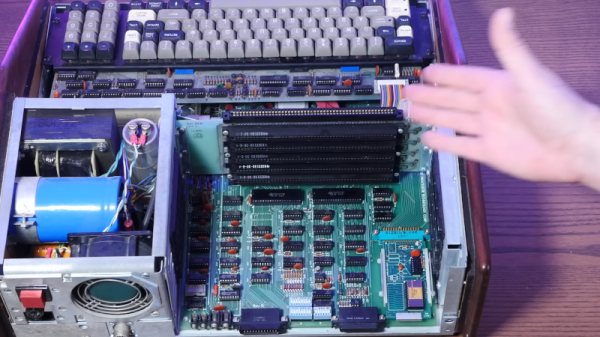
[Action Retro] came into an antique Sol-20 computer and argues that it was the first totally integrated computer aimed at consumers that didn’t require you to buy or build some kind of terminal. These are fairly rare, so we appreciated the peek inside that you can see in the video below.

Sure, the Sol-20 wasn’t the very first computer out there in the market. It was, however, one of the first ones that didn’t need anything more exotic than a monitor to have a functional system (and the monitor was included). There were alternatives such as a Xerox Alto or a Wang 2200, but those had price tags that didn’t land them in your home. Even Apple, which would become famous for a turnkey system, was only producing the Apple I at that time. As the video points out, it was complete as long as you could build your own power supply and knew how to interface a keyboard — keeping in mind that keyboards were all wildly different in those days.

Continue reading “Sol-20 Integrated Computer Teardown”

Too Cool For 8-bit Retro? Try 1-bit Gaming

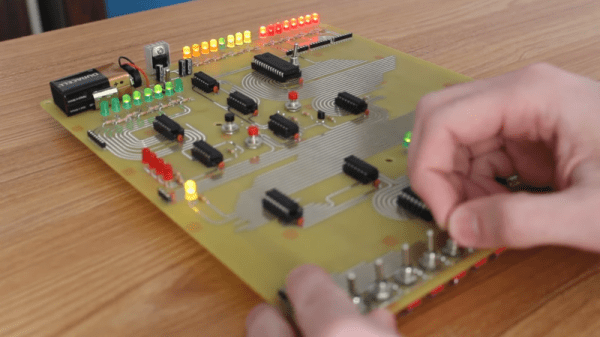
While the world has been racing for higher and higher bit counts for CPUs, there are always those that buck the trend. Consider the venerable Motorola MC14500B, a 1-bit CPU, no kidding. [Usagi Electric] built up a computer based on one of these chips using a breadboard but has since pulled it apart to use the breadboard for other things. So this time, he’s made a permanent version on a PCB and created a simple game to show it off. You can see the result in the video below.

Well, the chip had one bit in the datapath. It did not have any memory, but it did have a way to feed it 4-bit instructions, and, as you might guess, there were 16 possibilities for instructions. The chip was meant to replace industrial controllers where even a PLC might be overkill, and apparently, it did see some use in the real world.

Continue reading “Too Cool For 8-bit Retro? Try 1-bit Gaming”